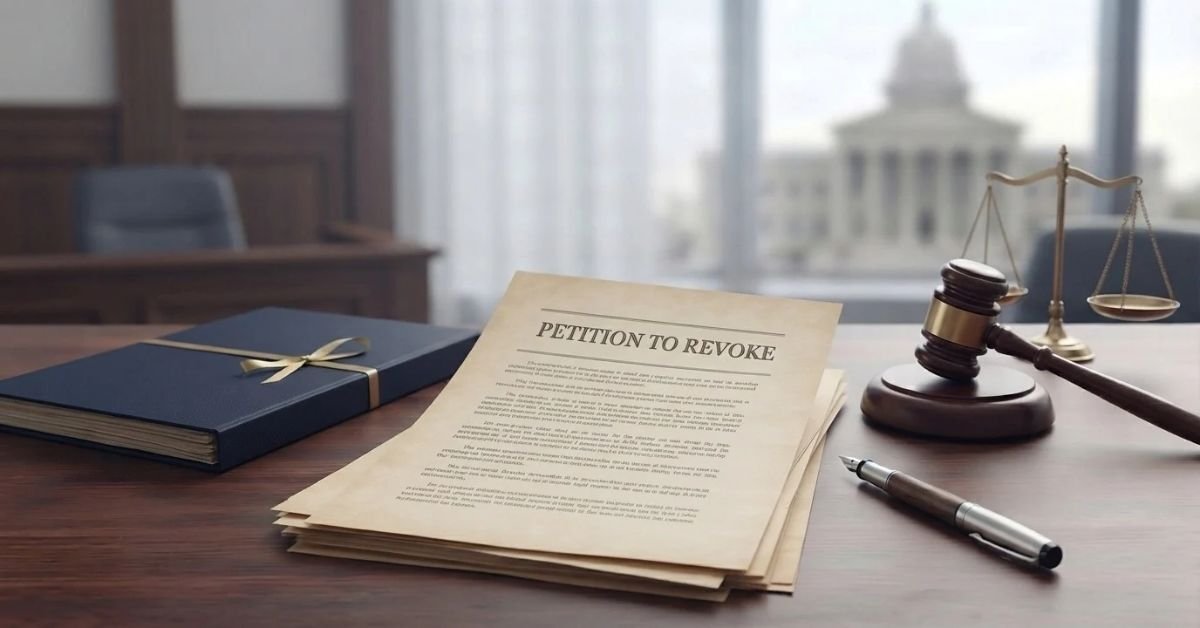
A court notice with the words “petition to revoke” can be stressful, especially if you are unsure what it means or why it was filed.
You may wonder whether it means you are going to jail, whether your probation is over, or whether you need to appear in court.
The meaning depends on the order or legal status involved. In criminal cases, the phrase often refers to a request asking a judge to end probation or another form of court ordered supervision because of an alleged violation.
It can also apply to other legal arrangements, depending on the case and jurisdiction.
Understanding the difference between an allegation and a court decision can help you make sense of the notice.
This guide explains the term in plain American English, gives a practical example, and covers what may happen after a petition is filed. It also explains why the state, the type of case, and the wording of your paperwork matter.
⚡ Quick Answer
A petition to revoke is a formal request asking a court to cancel or end a legal status, permission, or order. In criminal cases, it often asks a judge to revoke probation because of an alleged violation. Filing the petition does not automatically mean probation has ended or that jail time will follow.
What Does a Petition to Revoke Mean in Plain English?
A petition to revoke is a written request asking a judge to withdraw something that was previously granted or ordered. The exact meaning depends on what the petition seeks to revoke.
In criminal court, it often concerns probation revocation. Probation allows a person to remain in the community under certain rules instead of serving some or all of a sentence in custody. If an officer or prosecutor believes the person has broken one or more of those rules, they may ask the court to take action.
For example, the petition may claim that someone:
- Missed required meetings with a probation officer.
- Failed to complete a court-ordered program.
- Tested positive for a prohibited substance.
- Left an approved area without permission when permission was required.
- Was arrested or charged with another offense.
These are examples of possible allegations, not proof that a violation occurred. The rules depend on the person’s court order and the law that applies to the case.
The word petition means a formal request to a court. The word revoke means to withdraw, cancel, or take back something that was previously granted.
Put together, the phrase describes a request for a judge to withdraw a legal status or arrangement.
Does it always mean probation?
No. Probation is a common context, but the phrase is not limited to it. A court or legal authority may use similar wording in other proceedings involving a prior order, privilege, or legal status.
The surrounding words matter. A document that says “petition to revoke probation” is different from one that concerns a license, a permit, or another legal matter.
If you see this phrase on a court document, look for the complete title and the section identifying the order or status involved. That information can help you understand what the filing is asking the judge to do.
A Simple Example of a Petition to Revoke
Imagine that Jordan is placed on probation after a criminal case. The court orders Jordan to attend scheduled meetings with a probation officer and complete a required program.
Jordan misses several meetings. The probation officer reports the missed appointments, and a petition to revoke probation is filed with the court.
Here is how the situation may develop:
- The allegation: The petition states that Jordan failed to follow specific probation conditions.
- The court process: Jordan receives notice of a hearing or is otherwise brought before the court under the applicable procedure.
- The response: Jordan may have an opportunity to respond to the allegations and present relevant information.
- The judge’s decision: The court considers the evidence and applicable law before deciding whether a violation occurred and what action is appropriate.
Possible outcomes vary. Depending on the jurisdiction, the court may continue probation, change its conditions, impose an authorized sanction, or revoke probation. If probation is revoked, incarceration may be a possible consequence, depending on the original sentence and applicable law.
The important distinction is that the petition starts or requests court action; it does not, by itself, establish that the allegations are true.
This is a general example, not a prediction of how any particular case will end.
Where You’ll Encounter This Legal Term
You may see “petition to revoke” in a court notice, probation paperwork, a docket entry, or a filing prepared by a probation officer or prosecutor.
The phrase is most often searched in connection with criminal proceedings, but the exact context can change its meaning.
Criminal court and probation
In a criminal case, the petition may ask a judge to revoke probation after an alleged breach of supervision conditions. Some jurisdictions also use revocation procedures for other forms of supervised release or court-ordered supervision.
California, for example, provides a court form for a supervising agency to request revocation of parole, probation, mandatory supervision, or post-release community supervision.
Self Help Guide
Court records and online case searches
A case docket may show that a petition has been filed, that a hearing has been scheduled, or that a judge has entered an order. These entries describe different stages of a legal proceeding.
Seeing the filing on a docket does not necessarily tell you whether the judge has ruled on it. Check for later entries and the actual court orders before drawing conclusions.
Official notices and legal paperwork
A notice may identify the alleged violation, the hearing date, the court, or the order at issue. Some documents may use abbreviations or refer to related filings.
Read the entire notice rather than relying on the phrase alone. If the wording is unclear, a lawyer familiar with the case can explain what the filing requests and what deadlines apply.
Why a Petition to Revoke Matters Legally
A petition to revoke matters because it may put an existing legal arrangement at risk. In a probation case, the outcome can affect a person’s freedom, supervision conditions, and potential sentence.
However, the consequences depend on the facts and the law in the relevant jurisdiction.
It can lead to a court hearing
The filing may trigger a hearing where the court considers the alleged violation. Procedures differ among states and between state and federal courts.
The person involved may have rights to notice, legal representation, and an opportunity to respond. The specific rights and procedures depend on the type of proceeding and applicable law.
It may affect probation status
A judge may have several options rather than simply choosing between ending probation and doing nothing. Depending on local law, the court may continue supervision, adjust conditions, impose an authorized sanction, or revoke probation.
The available choices can also depend on the original offense, the terms of the sentence, and the nature of the alleged violation.
Jail or prison may be a possible outcome
If probation is revoked, a person may face incarceration under the applicable sentencing rules. But a petition does not guarantee that a person will go to jail or prison.
The court’s decision may depend on the alleged conduct, the evidence, the person’s case history, the original sentence, and any limits imposed by law.
A warrant or custody decision may also be addressed separately from the final decision about revocation. Some people may be required to appear in court without being held in custody; others may face different conditions.
The timing can matter
A court notice may include a deadline, a hearing date, or instructions about appearing. Ignoring those instructions can create additional problems.
If you have received a petition or hearing notice, confirm the date, identify the court, and promptly seek legal guidance. Do not assume that a filing has been dismissed simply because you have not heard anything recently.
Legal information disclaimer: This article provides general educational information, not legal advice. Laws and court procedures vary by state and case type. Consult a licensed attorney for advice about your specific situation.
How the Petition Process Typically Works
There is no single nationwide procedure for every petition to revoke. The following steps describe a general pattern that may apply to a criminal probation case.
1. An alleged violation is reported
A probation officer or another authorized person may report conduct that appears to violate a condition of supervision.
The relevant condition might involve reporting to an officer, attending a required program, following travel restrictions, or complying with another court-ordered requirement.
A report is not the same as a final finding by the judge.
2. A petition is filed
An authorized party files a document asking the court to take action. The petition may describe the alleged violations and explain why revocation is being requested.
The filing rules, required details, and party authorized to file vary by jurisdiction.
3. The court may issue a notice or warrant
Depending on the applicable procedure, the court may schedule a hearing, issue a summons, or issue an arrest warrant.
For example, Arizona’s criminal procedure rules allow a court to issue a summons or a warrant after a petition to revoke probation is filed. The applicable rule also addresses decisions about release or custody.
Arizona Court Rules
This example illustrates why you should not assume that every petition follows the same process.
4. The allegations are addressed in court
The court may hold one or more hearings. The person involved may be able to challenge the allegations, present evidence, and have a lawyer represent them, subject to the applicable rules.
The standard of proof and hearing procedures can differ from those used at a criminal trial. Do not assume that the process will be identical to the original criminal case.
5. The judge decides what happens next
The judge considers the relevant facts, evidence, and legal requirements. Possible results may include continuing supervision, changing its conditions, imposing an available sanction, or revoking probation.
If the court finds that revocation is warranted, the next step may involve sentencing or another decision about the consequences. The precise options depend on the case and jurisdiction.
What should you do if you receive a petition?
If the document concerns you or someone you are helping, consider these practical steps:
- Read the entire document. Identify the court, case number, alleged violation, and any hearing date.
- Do not ignore a court appearance. Ask a lawyer or the court clerk about procedural questions if the instructions are unclear.
- Contact a criminal defense attorney promptly. If you cannot afford one, ask about eligibility for appointed counsel or local legal aid.
- Keep relevant records. Save notices, appointment records, program attendance information, messages, and other documents that may help your lawyer understand the situation.
- Follow current court orders. Do not assume that the filing automatically changes your existing obligations.
Avoid making decisions based only on general online information. The actual petition and court orders are more important than a broad description of the term.
Common Misunderstandings About Petitions to Revoke
The phrase can sound like a final judgment, but several important distinctions can help you understand what the document actually means.
A petition is not the same as a court order
A petition asks the court to take action. A court order records a decision or directs someone to do something.
A petition to revoke probation therefore does not automatically mean the judge has revoked probation. Look for the court’s ruling and any later orders.
An alleged violation is not automatically a proven violation
The petition may describe conduct that the filing party believes broke a probation condition. The court must follow the applicable process to decide what has been established.
The person’s response, supporting records, and other evidence may matter to that decision.
Not every petition results in jail
Incarceration can be a possible outcome, but it is not automatic. Depending on the jurisdiction and circumstances, a court may choose another outcome permitted by law.
No one can reliably predict the result from the phrase “petition to revoke” alone.
A new criminal charge and a probation violation are not identical
A new arrest or criminal charge may be relevant to a probation proceeding, but it is not the same thing as a final conviction. A petition may also involve alleged violations unrelated to a new criminal charge.
The court will consider the issue under the rules that apply to the revocation proceeding.
The rules are not identical in every state
Different jurisdictions have different procedures, deadlines, and limits on the court’s authority. Even the consequences of a particular violation may depend on the original sentence and local law.
Advice based on another state’s rules may not fit your case. Always identify the state and court involved before relying on jurisdiction-specific information.
Related Legal Terms & How They Differ
These terms may appear in the same court records, but they do not all mean the same thing.
- Petition: A formal request asking a court or other authorized body to take action.
- Revocation: The act of withdrawing or ending a previously granted status, privilege, or order.
- Probation violation: An alleged or established failure to follow a condition of probation, depending on the context in which the term is used.
- Probation revocation hearing: A court proceeding to consider whether probation should be revoked.
- Motion to revoke: A request for court action that may serve a similar purpose to a petition, depending on local terminology and procedure.
- Summons: An official notice directing a person to appear as instructed.
- Arrest warrant: A court-authorized document permitting an arrest under the applicable law.
- Probation modification: A change to one or more conditions of probation without necessarily ending probation.
- Probation termination: The ending of probation, which may occur through different legal procedures and is not necessarily the same as revocation.
- Supervised release: A form of supervision that may follow imprisonment in certain federal criminal cases and has its own rules.
The distinction between revocation and modification is especially important. A court may be able to change supervision conditions without ending probation, but that option is not available in every situation.
Likewise, a petition, a hearing, and a final order are separate stages. Knowing which stage appears in the paperwork helps you avoid treating a request as though it were already a decision.
When to Talk to an Attorney
Consider contacting a licensed attorney promptly if you or someone close to you has received a petition to revoke probation, a notice of a revocation hearing, or paperwork referring to an alleged supervision violation.
This is particularly important if:
- A court hearing is scheduled soon.
- The document mentions an arrest warrant or possible detention.
- You believe the alleged violation is incorrect.
- You have records that may help explain what happened.
- You are unsure whether an existing court order still applies.
- You have questions about possible jail time, sentencing, or your rights at the hearing.
An attorney can review the actual filing, explain the applicable state or federal procedure, and help you understand the available options.
If you cannot afford private counsel, ask the court or a local legal aid organization about available assistance. Eligibility for appointed counsel or legal aid depends on the applicable rules and circumstances.
If a hearing date is approaching, do not wait for an online answer to resolve the matter. Get advice based on the actual documents and deadlines.
🎯 Practical Takeaway
A petition to revoke is a request for a court to withdraw an existing legal status or arrangement. In a probation case, it may put your supervision status at risk, but it does not automatically mean probation has ended or that incarceration will follow. Read the paperwork carefully, pay attention to hearing dates, and consult a licensed attorney to understand the rules and options that apply to your case.
FAQs:
1. Does a petition to revoke mean you are going to jail?
No. A petition to revoke does not automatically mean you will go to jail. It asks the court to consider taking action, often because of an alleged probation violation. Depending on the evidence, applicable law, and circumstances, the judge may revoke probation or choose another outcome permitted by law.
2. What happens after a petition to revoke probation is filed?
The court may schedule a hearing, issue a summons, or take other steps allowed by local procedure. The allegations may then be addressed in court, where the judge considers the evidence and applicable law. The possible outcomes vary by jurisdiction and may include continued probation, changed conditions, sanctions, or revocation.
3. Can a petition to revoke be dismissed?
It may be possible for a petition to be withdrawn, dismissed, or resolved without revocation, depending on the facts, procedure, and applicable law. A filing does not guarantee a particular result. An attorney can review the allegations, available evidence, and local rules to explain which options may apply.
4. Can you stay out of jail after a petition to revoke?
Possibly, but no general answer can guarantee that outcome. The court may consider different options depending on the case, the alleged conduct, and the law. Whether a person can remain out of custody while the case is pending is a separate question that may depend on a release decision or other court order.
5. What is the difference between a petition to revoke and a probation violation?
A probation violation is conduct alleged to break a condition of probation. A petition to revoke is a formal request asking the court to take action because of an alleged violation. The petition may lead to a hearing, but the court must follow the applicable process before deciding whether revocation is warranted.
6. Can probation be extended instead of revoked?
In some jurisdictions and circumstances, a judge may be authorized to extend probation, change its conditions, or impose another permitted sanction instead of revoking it. These options are not universal, and some laws restrict when revocation or modification is allowed. A lawyer can explain what the relevant court is permitted to do.
7. Do you need a lawyer for a petition to revoke?
Getting legal advice is strongly recommended because a revocation proceeding can affect your freedom and probation status. The right to appointed counsel depends on the applicable law and circumstances. If you cannot afford an attorney, ask promptly about appointed counsel or legal aid rather than assuming you must handle the case alone.
Conclusion:
Understanding what a petition to revoke means can help you make sense of a court notice without assuming the worst. In a criminal case, the phrase often refers to a formal request asking a judge to revoke probation because of an alleged violation of its conditions.
The filing is an important legal step, but it is not the same as a final court decision. Depending on the evidence, the original sentence, and the rules in the relevant jurisdiction, the court may continue probation, change its conditions, impose another permitted sanction, or revoke probation.
If you receive this type of paperwork, focus on the details that matter: what the petition alleges, which court is handling the case, and when you must appear. Keep relevant records and seek advice from a licensed attorney who understands the applicable law.
The key point to remember: a petition asks the court to act; the judge’s decision determines what happens next. Understanding that difference is a useful first step toward responding carefully and protecting your legal interests.
I am Alex Carter, an author at Meaningary.com and an expert in meanings, slang, and everyday expressions. I specialize in explaining name meanings and language in a simple, clear, and reader friendly way.