If you have seen the phrase supervised custody in a court document, parenting plan, or family law discussion, you may be wondering what it means for a parent and child.
Does a parent still get to spend time with their child? Who must be present during visits? And does supervision mean a parent has lost custody?
These are important questions, especially when a court order affects your family. The wording can feel confusing, and the details matter because different custody arrangements can give parents different rights and responsibilities.
In the United States, supervised custody often refers to a parenting arrangement in which a parent spends time with a child while another person monitors the contact.
Courts and legal documents may use the more specific term supervised visitation or supervised parenting time. The exact meaning depends on the order and the state’s laws.
Self Help Guide
+1
This guide explains how supervised visits work, why a court might order them, who can supervise, and what parents should check before a visit.
It also clears up common misunderstandings so you can better understand the term and know where to look for reliable answers about your situation.
⚡ Quick Answer:
Supervised custody generally means a parent can spend time with their child only while an approved adult or professional supervisor is present. The goal is to support the child’s safety and well-being during contact. The court order determines the schedule, supervisor, location, and any special rules. The exact arrangement varies by state and case.
Self Help Guide
+1
What Supervised Custody Means in Plain English
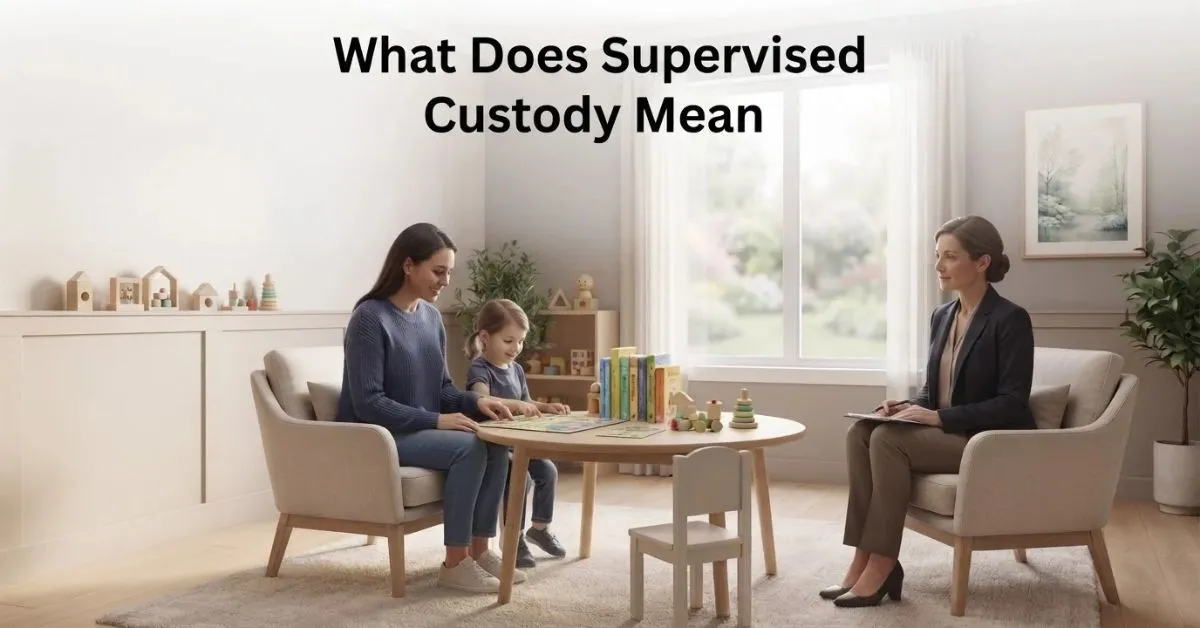
Supervised custody is a term people often use when a parent must have another person present during visits with their child. The supervisor watches the interaction and follows the conditions set by the court or agreed to in an approved arrangement.
For example, a parent may be allowed to see their child every Saturday for two hours, but only at a designated visitation center with a trained supervisor present.
The parent still has contact with the child. However, that contact takes place under specific conditions rather than through ordinary, unsupervised visits.
Does supervised custody mean a parent has lost custody?
Not necessarily. Supervised visitation and custody are related, but they are not the same thing.
Courts commonly distinguish between two main forms of custody:
- Legal custody: The authority to make important decisions about a child’s upbringing, such as education and health care.
- Physical custody: The arrangement governing where a child lives and who provides day-to-day care.
Visitation, also called parenting time, concerns when and how a parent spends time with a child. A court can order supervised visits without automatically removing all of that parent’s legal custody rights. The effect depends on the complete court order.
Self Help Guide
+1
For this reason, do not assume that supervised visits mean a parent has no decision-making rights, has permanently lost custody, or will never have ordinary visits again.
Is supervised custody the same in every state?
No. Family court procedures, terminology, and requirements vary across the United States.
One state may use the term supervised visitation, while another may describe the arrangement as supervised parenting time. The court may also specify whether a professional provider, family member, or another approved adult must supervise the visits.
The written order is the best starting point for understanding the rules that apply to a particular family. General online explanations cannot replace the wording of that order.
Self Help Guide
+1
A Simple Example of Supervised Custody
Imagine that two parents are separated, and their child has been living primarily with one parent.
The other parent wants regular time with the child. However, the court has concerns that unsupervised contact may not be appropriate at that point. The judge orders supervised visitation at a family visitation center.
The order might require the following:
- Visits take place on specified days and at set times.
- A designated supervisor remains present throughout each visit.
- The parent follows the center’s safety rules.
- The supervisor may intervene if the visit becomes unsafe or violates the order.
- Changes to the arrangement must follow the court’s requirements.
During a visit, the parent might read a book with the child, play a game, talk about school, or share a meal if the setting and rules allow it.
The supervisor’s presence does not automatically mean the parent cannot have a meaningful relationship with the child. It means the contact must take place under the conditions established for that case.
The important point: This is an illustrative example, not a standard order used in every state. The actual schedule, activities, and supervision rules depend on the court’s directions and the provider’s policies.
Self Help Guide
+1
Why a Court May Order Supervised Visits
A court may consider supervised visits when it believes that contact between a parent and child needs additional safeguards or structure.
The reason is specific to the family and the evidence before the court. Supervision does not, by itself, establish that a parent committed wrongdoing.
Possible reasons include the following.
Safety concerns
A judge may order supervision when there are concerns about a child’s physical or emotional safety. These concerns may involve allegations or evidence of domestic violence, abuse, neglect, substance misuse, or threats to take a child without permission.
The court considers the information available in the case and decides what arrangement is appropriate. An allegation alone should not be treated as proof that misconduct occurred.
Self Help Guide
+1
Reintroducing a parent after a long absence
A child may have had little or no contact with a parent for an extended period.
In some situations, supervised visits can provide a structured way to rebuild contact gradually. This may help the child become more familiar with the parent while another adult is present.
A long absence does not automatically mean supervision is required. The court considers the family’s circumstances and the child’s needs.
Supporting a child-parent relationship
Sometimes a court may decide that a parent and child need help establishing a relationship or adjusting to renewed contact.
A structured visit may provide an opportunity for interaction while a supervisor monitors how things are going. In some arrangements, a qualified professional may offer additional support.
Addressing other case-specific concerns
A judge may also consider concerns about possible abduction, parenting practices, or other circumstances that could affect a child’s safety.
The reasons and requirements differ from case to case. The purpose of supervision is not necessarily to punish a parent; it is to manage contact in a way the court considers appropriate for the child’s welfare.
District Court
+1
Who Can Supervise Parent Child Visits?
The person who supervises visits depends on the court order, local requirements, and the needs of the family.
Two broad types of supervisors are commonly used.
Professional supervised visitation providers
A professional supervisor may work for a visitation center or an organization that provides supervised contact services.
Depending on state rules and the provider’s qualifications, the supervisor may have specialized training, follow written procedures, document visits, and respond to safety concerns.
A professional setting may be appropriate when the case involves complex safety issues or requires more formal oversight. Fees, availability, qualifications, and procedures vary.
Family members or other trusted adults
In some cases, a court may allow a suitable relative, family friend, or another nonprofessional adult to supervise.
This option may offer a more familiar setting for the child. However, the person must be acceptable under the court order and able to follow the required conditions.
A parent should not assume that any relative or friend can serve as the supervisor. If the order names a specific person or requires a professional provider, those instructions matter.
Self Help Guide
+1
What does a supervisor actually do?
A supervisor’s role is generally to monitor the visit, follow the applicable rules, and respond to concerns.
Depending on the order and provider policies, this can include:
- Staying within sight and hearing of the parent and child.
- Watching for behavior that could threaten the child’s safety or well-being.
- Following restrictions on conversations, contact, or activities.
- Intervening when necessary.
- Preparing records or reports when required by the applicable rules.
The supervisor is not automatically the person who decides custody or changes the court order. Those responsibilities remain with the appropriate legal authority. A supervisor’s reporting duties and powers depend on the governing rules and the arrangement in place.
Self Help Guide
+1
How Supervised Custody Usually Works
Although the details differ, supervised visitation often follows a clear process.
1. The court establishes the arrangement
A judge may issue an order that explains when visits can occur and what conditions apply. Depending on the case, it may identify the supervisor, location, length of visits, and other restrictions.
Some arrangements arise through an agreement reviewed or approved by the court. Others follow a contested hearing.
2. The parent checks the order and contacts the provider
If a professional center or named supervisor is required, the parent should follow the order’s instructions about arranging visits.
The provider may ask for a copy of the order and information needed to understand the restrictions. If no provider is named, the parent can ask the court’s family services office or self-help center how to find an appropriate service.
Self Help Guide
+1
3. The visit takes place under supervision
The parent and child meet at the approved location or through another permitted arrangement.
The supervisor remains present as required. Activities may be limited by the child’s needs, the court order, and the provider’s rules.
A supervisor may interrupt or end a visit if a safety concern arises or the rules require it. The exact response depends on the situation and applicable procedures.
4. The arrangement continues under the existing rules
Visits may continue according to the schedule while the court’s order remains in effect.
A parent should not assume that good visits automatically end supervision. Likewise, a difficult visit does not automatically establish that the arrangement will become more restrictive.
If the court needs updated information, it may consider evidence, reports, or other relevant material under the applicable process.
5. Changes must follow the proper process
If a supervisor becomes unavailable, the location no longer works, or a parent believes the restrictions should change, the next step depends on the order.
Some details may be handled through an approved provider or written agreement. Other changes may require court approval.
For example, California’s court guidance explains that a parent who needs to change a court-ordered provider may have to ask the judge to modify the order. This illustrates why parents should check their own state’s rules instead of assuming the process is identical everywhere.
Self Help Guide
+1
Why Supervised Custody Matters Legally
Supervised custody matters because it affects how a parent may spend time with a child and what conditions must be followed.
A court order can establish limits on visits, approved supervisors, locations, communication, and other details. Ignoring those conditions may create legal problems or lead to a request for the court to review the arrangement.
It can set clear boundaries
A detailed order helps parents and supervisors understand what is permitted.
For example, an order might require visits at a designated center and prohibit unsupervised contact. A parent should not interpret the permission to visit as permission to take the child elsewhere alone.
When the wording is unclear, asking a family law attorney or the court’s appropriate support office for clarification is safer than guessing.
It can affect parenting time without deciding every custody issue
A supervised visitation order may restrict the way contact occurs while leaving other custody questions unresolved.
For instance, the order might address visits but say little about who makes medical or educational decisions. Those issues may be governed by separate parts of the custody order.
Read the full document rather than relying on a short description of the arrangement.
It may be temporary or continue for a longer period
There is no single nationwide timeline for supervised custody.
In some cases, supervision may be reviewed after circumstances change. In others, the restrictions may continue unless the court modifies them.
A parent should not assume that supervision expires after a set number of visits or after a specific period. The order and the relevant state procedures determine what happens next.
A concrete example
Suppose a court order permits a parent to visit a child every Sunday at a supervised visitation center. The parent later wants to take the child to a nearby park without the supervisor.
Even if the parent believes the outing would be harmless, the order may not permit it. The parent should seek clarification or an authorized change before acting outside the stated conditions.
This example is general information, not legal advice. Family law rules and court orders differ, so a licensed family law attorney can help explain the legal effect of a specific order.
Common Misunderstandings About Supervised Custody
The term can sound more final or restrictive than it always is. These are some important distinctions to understand.
“Supervised custody means a parent has no rights.”
Not necessarily. A supervised visitation arrangement restricts how visits take place. It does not automatically eliminate every parental right or decision-making responsibility.
The full order determines which rights and duties remain in place.
Self Help Guide
+1
“The supervisor can change the court order.”
Generally, a supervisor follows the existing order and applicable provider rules. A supervisor does not automatically have authority to grant unsupervised visits, change the schedule, or remove restrictions.
If a change is needed, the parent should follow the appropriate legal process.
“Every supervised visit must happen at a professional center.”
Not always. Depending on the court’s directions and local rules, supervision may be provided by a professional or an approved nonprofessional adult.
The written order is what matters for a particular family.
Self Help Guide
+1
“Supervision always lasts forever.”
There is no universal rule that supervision must be permanent. Some orders may be reviewed or modified, but a change is not automatic.
A parent who wants the arrangement changed should ask a qualified attorney about the relevant process and what information the court may consider.
“A supervised visit means the court has proved abuse.”
No. Courts may consider allegations, evidence, safety concerns, and other family circumstances when deciding whether supervision is appropriate.
The existence of a supervised visitation order does not, by itself, prove that a particular allegation is true.
Related Custody & Family Court Terms
Understanding related terms can make a court order easier to read. These concepts are connected, but they do not all mean the same thing.
Legal custody
Meaning: The authority to make important decisions about a child’s upbringing, including education and health care.
Self Help Guide
+1
Physical custody
Meaning: The arrangement for a child’s residence and day-to-day care.
Supervised visitation
Meaning: Parent-child contact that takes place while another person monitors the visit.
Parenting time
Meaning: The time a parent spends caring for or visiting a child under an agreed or court-ordered schedule.
Unsupervised visitation
Meaning: Parent-child visits that do not require a supervisor to remain present, subject to any other restrictions in the order.
Sole custody
Meaning: An arrangement in which one parent has sole legal custody, sole physical custody, or both, depending on the order and state terminology.
Joint custody
Meaning: An arrangement in which parents share legal decision-making, physical care, or both. The exact structure depends on the order.
Custody modification
Meaning: A legal change to an existing custody or parenting-time order through the applicable process.
These definitions are general guides. State laws may use different terms, and the same phrase may have a more specific meaning in a particular court document.
When To Talk To A Family Law Attorney
Consider speaking with a licensed family law attorney if you need to understand a supervised custody order or decide what steps to take next.
Legal help may be especially useful when:
- You do not understand the order. You need clarification about visit times, approved supervisors, locations, or restrictions.
- You want supervision to end. You want to learn what legal process applies and what evidence may support a request for change.
- The required supervisor is unavailable. You need to know whether you can use someone else or must seek court approval.
- You believe the order is being violated. You want to understand your options and how to document the issue appropriately.
- You have an upcoming hearing. You need help preparing documents, understanding deadlines, or presenting your concerns.
If you cannot afford private counsel, check whether your local legal aid organization, family court self-help center, or bar association offers assistance. Availability and eligibility vary by location.
Important legal disclaimer: This article provides general information about supervised custody in the United States. It is not legal advice and does not replace guidance from a licensed attorney familiar with your state and circumstances. If you have a court order, read it carefully and seek legal advice before acting in a way that could conflict with it.
🎯 Practical Takeaway
Supervised custody generally means a parent spends time with a child while an approved person monitors the visit. It does not automatically mean the parent has lost all custody rights or that supervision will last forever. If this term appears in your court papers, check the exact conditions, follow the existing order, and ask a family law attorney about anything you do not understand.
FAQs:
1. Why would a judge order supervised custody?
A judge may order supervised visits when there are concerns about a child’s safety, a long absence between parent and child, or other circumstances that call for structured contact. The decision depends on the case and the child’s needs. Supervision does not, by itself, prove that a parent committed wrongdoing.
Self Help Guide
+1
2. Does supervised custody mean you cannot be alone with your child?
If an order requires supervision throughout each visit, you generally cannot have unsupervised contact during those visits unless the order is changed or otherwise permits it. Read the exact wording carefully. If you are unsure whether an activity or location is allowed, seek clarification before making plans.
3. Who can supervise supervised custody visits?
Depending on the court order and local rules, a supervisor may be a trained professional, a visitation center employee, or an approved adult such as a relative. Not every person is automatically eligible. Check whether the order names a specific supervisor or requires a professional provider before arranging visits.
Self Help Guide
+1
4. How long does supervised custody last?
There is no standard duration across the United States. Some orders may be reviewed as circumstances change, while others remain in place until a court approves a modification. Do not assume supervision ends after a particular number of visits. Check the order and ask an attorney about the applicable review or modification process.
5. Can supervised custody become unsupervised visitation?
It may be possible, depending on the case, the court order, and the state’s law. A parent may need to request a change and provide information supporting that request. The court decides whether a modification is appropriate under the applicable legal standard. A positive visit history alone does not guarantee a change.
6. Does supervised custody mean a parent has lost legal custody?
No, not automatically. Supervised visitation concerns the conditions under which a parent spends time with a child. Legal custody concerns who has authority to make major decisions about the child’s upbringing. A court order may address these issues separately, so the complete document matters.
Self Help Guide
+1
7. What happens if a parent violates a supervised custody order?
The consequences depend on the order, the nature of the violation, and state law. A violation may lead to court review or other legal consequences. If you believe a violation occurred, document the relevant facts and consult a family law attorney about appropriate next steps. Avoid assuming that every violation has the same outcome.
Conclusion:
Understanding what supervised custody means can help you make sense of a family court order and the rules around parent child visits.
In general, it means that a parent spends time with a child while an approved adult or professional monitors the contact.
The arrangement may be used to address safety concerns, support renewed contact, or provide a more structured setting for visits.
Supervised custody does not automatically mean a parent has lost every parental right, nor does it mean supervision must continue forever.
The details depend on the court’s decision, the family’s circumstances, and the laws that apply in that state.
If this term appears in your court papers, start by reading the entire order. Check who can supervise, when visits may occur, where they must take place, and what restrictions apply.
If anything is unclear, a licensed family law attorney can help you understand your options.
Family court language can feel overwhelming, but knowing what the terms mean is a useful first step toward making informed decisions for yourself and your child.

I am Logan Reed, an author at Meaningary.com and an expert in meanings, slang, and everyday expressions. I specialize in explaining name meanings and language in a simple, clear, and reader friendly way.