Seeing the words motion to adjudicate on a court document can feel confusing, especially if you are not familiar with legal terms.
You may wonder whether the motion means a judge has already made a decision, whether you need to attend a hearing, or whether it could change the outcome of your case.
So, what does motion to adjudicate mean? In general, it refers to a formal request asking a court to decide a particular legal issue or resolve a dispute.
The exact meaning depends on the type of case, the court’s rules, and the issue the person is asking the judge to decide. In some criminal cases, related wording may also appear in requests involving probation violations or other specific legal matters.
Understanding the phrase can help you read your paperwork more clearly and recognize what questions you may need to ask.
This guide explains the meaning in plain American English, provides practical examples, and describes what to check if this term appears in your own court documents.
⚡ Quick Answer
A motion to adjudicate is a formal request asking a judge to make a decision on a legal issue. The request may concern a dispute, a claim, or a specific question in a court case. Filing the motion does not automatically mean the judge has approved it or made a final ruling.
1. What Does Motion to Adjudicate Mean In Plain English?
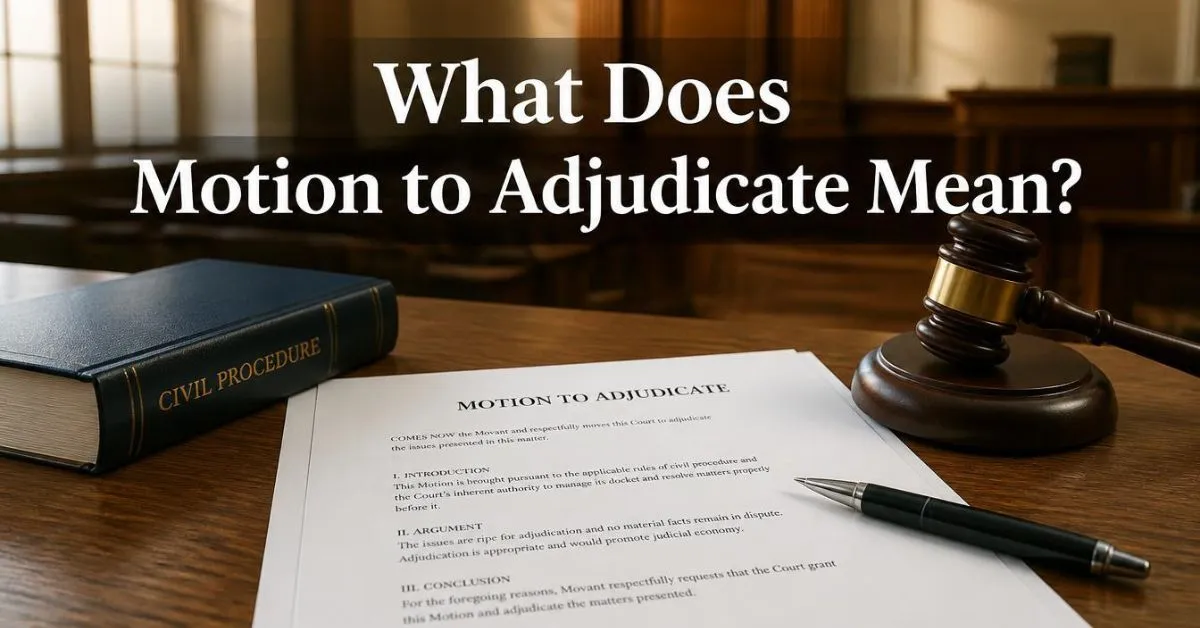
A motion to adjudicate is a written request asking a judge to make a legal decision. The word adjudicate means to decide a legal dispute or determine an issue through a court process. A motion is the formal request that asks the court to take a particular action.
United States Courts
+1
However, the phrase can have a more specific meaning in criminal court.
In Texas, for example, you may see the term motion to adjudicate guilt when a person has been placed on deferred adjudication community supervision. If the prosecutor believes the person broke a condition of that supervision, the prosecutor may ask the judge to proceed toward a formal finding of guilt.
LegalClarity
+1
This distinction matters because the words on your paperwork may refer to a general court request or a specific criminal procedure.
Here is the difference:
- General motion: A request for a judge to decide a particular legal question.
- Motion to adjudicate guilt: In the relevant deferred-adjudication context, a request for the court to consider formally finding the defendant guilty.
- Court ruling: The judge’s decision after considering the motion and the applicable law.
A motion is not the same as a ruling. Someone can file a motion without the judge granting it.
If you see this phrase in a court record, read the complete title and check the state, case type, and surrounding documents before deciding what it means for you.
2. A Simple Example of a Motion to Adjudicate
Imagine a person in Texas enters a deferred-adjudication agreement in a criminal case. The judge places the person on community supervision and sets certain conditions. Those conditions might include reporting to a supervision officer, attending required classes, or following other court-ordered rules.
Later, the prosecutor claims that the person failed to follow one of those conditions.
The prosecutor may file a motion to adjudicate guilt, asking the judge to consider the alleged violation and decide what should happen next.
The process could look like this:
Step 1: A motion is filed
The prosecutor submits a formal request explaining the alleged violation and asking the court to take action.
Step 2: The court considers the matter
The court follows the applicable procedure, which may include a hearing where the parties present arguments and evidence.
Step 3: The judge makes a decision
Depending on the law, evidence, and case circumstances, the judge may grant or deny the request or take another legally permitted action.
This example explains the general idea, not a guaranteed outcome. The exact process and available options depend on the jurisdiction and the case.
A filed motion does not automatically prove that a violation occurred. Nor does it mean the judge has already decided the defendant’s guilt.
3. Where You’ll Encounter This Legal Term
You may see the phrase in court paperwork, online case records, notices, or documents prepared by a prosecutor or defense attorney.
Its meaning often becomes clearer when you identify the type of case.
Criminal court and deferred adjudication
This is a particularly important context in Texas. A motion to adjudicate guilt may ask the court to move forward with a formal determination of guilt after an alleged violation of deferred-adjudication conditions.
LegalClarity
+1
Civil court
In a civil case, a motion may ask the judge to decide a specific issue involving the parties’ rights, responsibilities, or claims. The exact title and purpose of the motion depend on the court’s rules and the issue being raised.
Family court
Family-law cases also involve motions asking judges to make decisions about disputes or requests for court orders. Do not assume that every motion in family court is a motion to adjudicate guilt; the surrounding legal context matters.
Online court records
If you find the phrase in an online docket, it may be listed as a filing or pending court action. A docket entry usually tells you that a document was filed or an event was recorded, not necessarily the final result.
To understand the entry, check the document title, filing date, case type, court, and any later order or hearing notice.
4. Why A Motion To Adjudicate Matters Legally
A motion to adjudicate can matter because it asks a court to take action that may affect the parties’ legal rights or the next stage of a case.
The possible consequences depend on the kind of motion.
In an ordinary legal dispute, a motion might concern a particular claim, evidence, procedure, or requested court order. A judge’s decision could determine how that part of the case proceeds.
In a Texas criminal case involving deferred adjudication, a motion to adjudicate guilt may carry more serious consequences. If the judge grants the motion and formally adjudicates guilt, the case may move to sentencing, subject to the applicable law and circumstances. The specific consequences cannot be determined from the motion’s title alone.
Three points are especially important:
- It signals a request, not a final decision. The judge still has to consider the matter under the relevant rules.
- The response may have deadlines. Court papers may require action by a particular date.
- The result depends on the case. The same phrase can have different implications in different legal settings.
If the motion concerns you or someone close to you, the most useful next step is to find out exactly what relief the filing requests and whether a response or hearing is scheduled.
5. How Courts Typically Handle This Motion
There is no single procedure that applies to every motion to adjudicate. Courts follow the laws, rules, and procedures that govern the specific case.
For a general motion, the process may involve the following stages:
- Filing: A party submits a motion explaining the requested action and the grounds for it.
- Notice: The other parties receive notice or a copy as required by the applicable rules.
- Response: The other side may have an opportunity to object or file a response.
- Review or hearing: The judge reviews the papers and may hold a hearing if required or appropriate.
- Decision: The court issues a ruling or order explaining what happens next.
Federal court guidance describes motions as formal requests for judicial action and explains that judges may grant, deny, or partly grant or deny them. Whether a hearing is held depends on the applicable procedure.
United States Courts
+1
A motion to adjudicate guilt in a deferred-adjudication case follows the rules for that criminal procedure instead of necessarily following the same process as an ordinary civil motion.
For that reason, do not rely on a general online explanation to predict your hearing date, burden of proof, available defenses, or likely outcome.
What should you check?
- The complete name of the motion.
- The court and state where the case was filed.
- Whether a hearing date or response deadline appears on the paperwork.
- The allegations or legal grounds stated in the motion.
- Any later court order or notice.
These details can help you understand the procedural stage without assuming that a filing has already been decided.
6. Common Misunderstandings About Motions to Adjudicate
Legal language can sound more final than it really is. These are some important distinctions to understand.
Misunderstanding 1: Filing the motion means the judge has found someone guilty.
Not necessarily. A motion is a request. In a deferred-adjudication case, the court must follow the applicable process before making a formal determination.
Misunderstanding 2: Every motion to adjudicate involves criminal charges.
No. The word adjudicate has a broader legal meaning. The specific phrase motion to adjudicate guilt is associated with criminal proceedings, including deferred adjudication in Texas, but general motions can address other legal issues.
Misunderstanding 3: A motion to adjudicate is the same as a motion to revoke probation.
Not always. In Texas, these terms can refer to different procedures. A motion to adjudicate guilt is associated with deferred adjudication, while a motion to revoke commonly concerns a person who has already been convicted and placed on regular probation. The details depend on the jurisdiction and the type of supervision.
LegalClarity
+1
Misunderstanding 4: The motion guarantees a particular punishment.
A filing does not guarantee the result. The outcome depends on the governing law, the evidence, the judge’s decision, and the circumstances of the case.
Misunderstanding 5: You can ignore the motion until the judge makes a decision.
That can be risky. A notice may contain a hearing date, a response deadline, or other instructions. Ignoring court documents could affect your ability to respond appropriately.
The safest approach is to read the entire filing and seek legal guidance if you are unsure what action is required.
7. Related Legal Terms You Should Know
These related terms can help you understand court records and legal discussions.
- Motion: A formal request asking a court to take a particular action.
United States Courts
+1 - Adjudication: The process of resolving a legal dispute or deciding a case.
LII / Legal Information Institute - Deferred adjudication: A legal arrangement in which a formal finding of guilt is deferred under the applicable rules, often with conditions imposed by the court.
- Adjudication of guilt: A formal court determination of guilt in a criminal case.
- Probation: Court ordered supervision subject to specific conditions, depending on the jurisdiction and type of case.
- Motion to revoke probation: A request asking a court to revoke probation based on alleged violations of its conditions.
- Court order: An official direction or decision issued by a judge or court.
- Hearing: A court proceeding where a judge considers an issue, arguments, evidence, or other relevant matters.
These terms are related, but they are not interchangeable. For example, a motion is a request, a hearing is a proceeding, and a court order records a judicial direction or decision.
If your paperwork uses more than one of these terms, consider how they relate to one another in the specific case rather than relying on a single word.
8. When To Talk To An Attorney
Consider speaking with a licensed attorney if you receive a motion to adjudicate, especially if the document refers to criminal charges, deferred adjudication, probation, or an upcoming hearing.
An attorney familiar with the relevant jurisdiction can explain what the filing requests, what the applicable rules require, and what options may be available.
You may want to ask:
- What exactly is the court being asked to decide?
- Does the motion require me to respond?
- Is there a hearing date or deadline I must follow?
- What allegations or evidence are involved?
- What outcomes are legally possible in my situation?
- Are there documents I should gather before the hearing?
If the matter involves a criminal case, seek legal advice promptly rather than assuming the motion is routine. If you cannot afford an attorney, you may be able to contact a legal aid organization or ask the court about available assistance, depending on your circumstances and the type of case.
Important legal disclaimer: This article provides general legal information, not legal advice. It does not determine your rights, obligations, or likely court outcome. Laws and court procedures vary by jurisdiction. Consult a licensed attorney for guidance about your specific situation.
🎯 Practical Takeaway
A motion to adjudicate is a request for a court to make a legal decision, but its exact meaning depends on the case and jurisdiction. If you see this term in your paperwork, identify the type of case, read the full motion, and check any deadlines or hearing notices. For a motion to adjudicate guilt involving deferred adjudication, consult a qualified criminal defense attorney promptly.
FAQs:
1. Does a motion to adjudicate mean you are going to jail?
No. Filing a motion does not automatically mean someone will go to jail. The possible outcome depends on the case, the allegations, the governing law, and the judge’s decision. In a criminal case involving deferred adjudication, the consequences can be serious, so legal advice is important.
2. What happens after a motion to adjudicate is filed?
The court follows the applicable procedure, which may include notifying the parties, allowing a response, scheduling a hearing, and reviewing the relevant information. The judge then decides the request under the governing law. The exact steps and timing depend on the jurisdiction and type of case.
3. What does a motion to adjudicate guilt mean in Texas?
In Texas, a motion to adjudicate guilt generally asks the court to proceed with a formal finding of guilt after a person on deferred-adjudication community supervision is accused of violating its conditions. The judge considers the matter under Texas law. Filing the motion alone does not establish that the allegations are true.
LegalClarity
+1
4. Is a motion to adjudicate the same as a probation violation?
Not exactly. A probation violation describes an alleged failure to follow supervision conditions. A motion to adjudicate guilt is a legal request associated with deferred adjudication in certain criminal cases, including Texas cases. The terms and procedures can differ by state and type of supervision.
5. Can a judge deny a motion to adjudicate?
A judge may deny a motion if the applicable law and circumstances support that decision. However, the grounds for denial and the process involved depend on the particular case. The fact that a motion was filed does not guarantee that it will be granted.
6. Do you need a lawyer for a motion to adjudicate?
Legal representation can be especially important when the motion involves criminal charges, deferred adjudication, or probation. An attorney can explain the allegations, deadlines, hearing procedure, and possible outcomes. Whether representation is required or available at public expense depends on the circumstances and applicable law.
Conclusion:
Understanding what a motion to adjudicate means can help you make sense of court documents without assuming the worst. In general, it is a formal request asking a judge to decide a legal issue.
The exact meaning depends on the type of case, the jurisdiction, and what the person filing the motion wants the court to do.
In Texas criminal cases, a motion to adjudicate guilt has a more specific meaning related to deferred adjudication and alleged violations of supervision conditions.
It can lead to serious legal consequences, but filing the motion does not mean the judge has already made a final decision.
If you encounter this phrase in your own paperwork, focus on the complete document rather than the title alone. Check the court, the allegations, any hearing date, and any deadlines. If the motion could affect your rights or criminal case, speak with a licensed attorney who understands the relevant law.
Legal terms may seem intimidating at first, but understanding what they mean is a useful first step toward making informed decisions.

I am Cameron James, an author at Meaningary.com and an expert in meanings, slang, and everyday expressions. I specialize in explaining name meanings and language in a simple, clear, and reader friendly way.