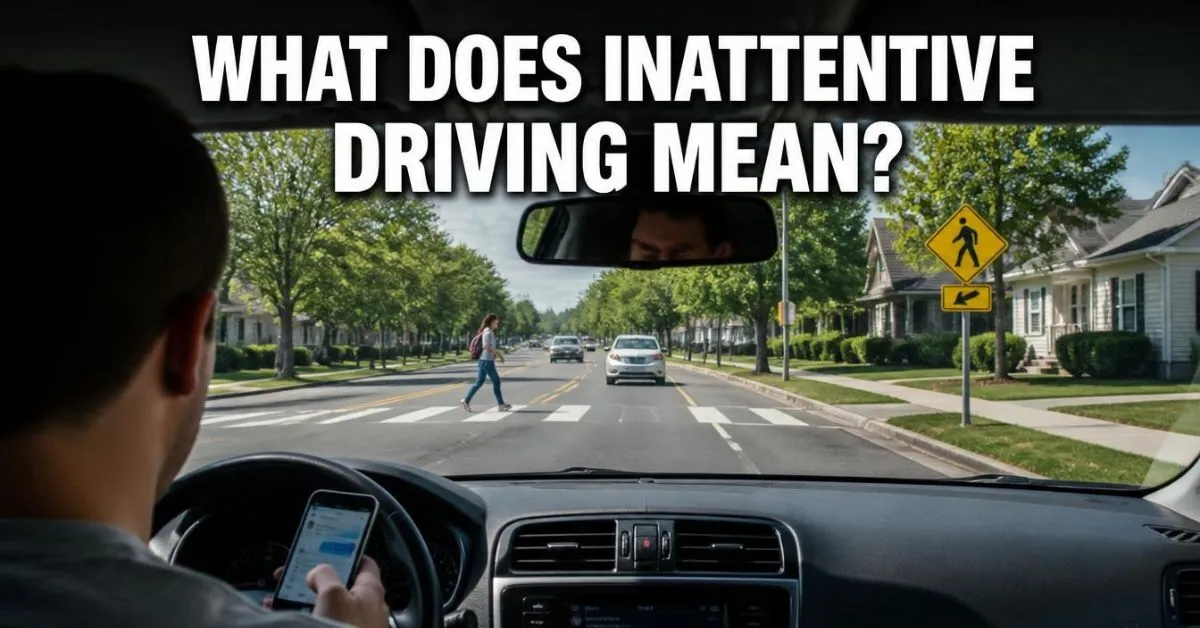
Have you ever seen the phrase inattentive driving on a traffic ticket, police report, insurance document, or driving related website and wondered what it actually means? The wording can sound confusing, especially if you were not speeding or breaking another traffic rule when the incident happened.
Understanding what does inattentive driving mean can help you see why a driver may be considered careless or distracted, even when there was no intention to cause harm.
It can also help you understand what to look for if the phrase appears in a legal document.
In simple terms, the phrase relates to a driver’s failure to give enough attention to the road, nearby vehicles, pedestrians, or other important driving conditions.
However, its exact meaning and legal effect can depend on the state, the circumstances, and the wording of the citation.
In this guide, I will explain the meaning in plain English, share realistic examples, clarify how it differs from distracted or reckless driving, and explain what you can do if you encounter this term.
⚡ Quick Answer
Inattentive driving means operating a vehicle without paying enough attention to the road and surrounding conditions. Examples include looking away from traffic, failing to notice a pedestrian, or not watching nearby vehicles closely. Depending on the state and circumstances, inattentive driving may be treated as a traffic violation or described in a police report.
What Does Inattentive Driving Mean?
Inattentive driving describes a situation in which a driver does not give enough attention to the task of driving. This may involve failing to watch traffic, missing important road signs, or not noticing a hazard in time to respond safely.
Driving requires more than keeping your hands on the steering wheel. You must watch the road, check your surroundings, notice changes in traffic, and make safe decisions. When your attention drifts, you may not react as quickly as the situation requires.
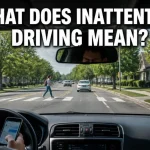
For example, imagine you are driving through a neighborhood and fail to notice a child approaching a crosswalk. Even if you are driving below the speed limit, your lack of attention could create a dangerous situation.
The legal meaning can be more specific. Delaware, for example, defines inattentive driving in terms of failing to give full time and attention to operating a vehicle or failing to maintain a proper lookout. Other states may use different laws or related terms.
Delaware Code
+1
The key point: Inattentive driving concerns the attention you give to driving, not simply how fast you travel.
Common Examples Of Inattentive Driving
Inattentive driving can happen in several ways. Some involve outside distractions, while others occur when a driver’s mind wanders or the driver fails to notice changing road conditions.
Here are realistic examples to help you understand the term.
1. Looking away from the road
A driver looks at a passenger, checks something on the dashboard, or turns to look at an event outside the vehicle. During that moment, traffic ahead may slow down or a pedestrian may enter the road.
2. Failing to check mirrors and blind spots
A driver changes lanes without checking nearby vehicles. The driver may not intend to put anyone at risk, but missing important information can lead to a collision.
3. Missing traffic signs or signals
A driver approaches a stop sign or red light but fails to notice it because their attention is elsewhere. This can create a risk for pedestrians and other road users.
4. Letting your mind wander
You may be looking straight ahead while thinking about work, an argument, or an upcoming appointment. Your eyes may appear to be on the road, but you might not be processing what is happening around you.
5. Failing to notice changing traffic
A driver does not notice that the vehicle ahead has slowed down or that traffic is merging. The driver may brake late or make a sudden move to avoid another vehicle.
6. Using a phone while driving
Reading a message, scrolling through an app, or typing a destination while moving can take attention away from driving. Phone use can involve visual, manual, and mental distraction.
NHTSA
+1
7. Driving while tired
Fatigue can make it harder to remain alert and respond to hazards. A tired driver may miss a turn, drift out of a lane, or react too slowly to traffic changes.
Not every mistake automatically proves a legal violation. The circumstances, available evidence, and applicable state law matter.
Where You’ll See Or Hear This Term
The phrase inattentive driving can appear in several situations. Knowing where you encountered it can help you understand what it means in that context.
On a traffic ticket
A police officer may use this phrase to describe an alleged failure to pay proper attention while driving. The citation should identify the relevant law or violation code, which can help you determine the specific allegation.
In a police report
After a traffic incident, a report may describe a driver as inattentive. This wording can refer to an observation or an assessment of what happened. It does not necessarily mean a court has found the driver legally responsible.
In court documents
The term may appear in a charge, case record, or discussion of a traffic incident. Its legal effect depends on the specific statute and the stage of the case.
In insurance discussions
An insurer may examine whether a driver’s actions contributed to a collision. However, an insurer’s description of a driver as inattentive is not automatically the same as a formal traffic conviction.
In driving education
Driving manuals may discuss inattention as a safety risk. These materials often explain how drivers can miss hazards when their attention moves away from the road.
RI Division of Motor Vehicles
+1
Practical tip: If you saw the phrase on a ticket, check the exact wording and code rather than relying on the phrase alone.
Why Inattentive Driving Matters
Inattentive driving matters because safe driving depends on noticing hazards and responding at the right time. A driver may follow the speed limit and still put others at risk by failing to watch traffic.
Attention helps drivers recognize when to slow down, stop, yield, or change lanes. If a driver misses a warning sign or fails to notice a vehicle braking ahead, there may be less time to respond.
The risk can affect more than the driver. Passengers, cyclists, pedestrians, and people in nearby vehicles may also be exposed to danger.
Inattention can result from different situations, including mental wandering, fatigue, or an activity that draws the driver’s focus away from the road. The cause may help explain what happened, but it does not automatically determine whether a legal violation occurred.
For example, a driver who briefly looks away and safely corrects their attention is not necessarily in the same legal position as a driver whose failure to watch the road contributes to a crash. The facts matter.
The safest approach is to reduce distractions before driving, stay alert, and pull over somewhere safe if you cannot give driving your full attention.
Is Inattentive Driving the Same as Distracted Or Reckless Driving?
These terms are related, but they are not always interchangeable. Their legal definitions and consequences can vary by state.
Inattentive driving
A driver fails to pay enough attention to driving or maintain a proper lookout. The cause may be a wandering mind, fatigue, or another factor, depending on the circumstances.
Distracted driving
Something diverts the driver’s attention, such as texting, eating, adjusting controls, or interacting with passengers. Distraction is one possible cause of inattention.
RI Division of Motor Vehicles
+1
Reckless driving
This generally refers to driving that creates a serious risk through conduct covered by the relevant law. It is a distinct legal concept, and inattention alone does not automatically establish reckless driving.
Careless driving
This often concerns driving without the level of care required under the applicable law. Some jurisdictions distinguish careless driving from inattentive driving, while others use related language.
The main difference is that distraction describes something drawing attention away, while inattention describes a failure to give driving enough attention. Reckless and careless driving have their own legal standards.
Do not assume that one term always carries a greater penalty than another. The state law, alleged conduct, and facts of the incident determine how a case is handled.
What Are The Possible Legal Consequences?
If inattentive driving appears on a traffic ticket, the consequences depend on where the incident occurred and what the citation alleges.
Possible outcomes may include:
- A fine: Some jurisdictions impose a monetary penalty for a qualifying violation.
- Driving-record consequences: A violation may affect a driving record under the rules of the relevant jurisdiction.
- Insurance effects: A traffic violation or collision may affect insurance decisions, depending on the insurer, state rules, and the driver’s record.
- Additional legal issues: If an incident involves a crash, injury, or other alleged violation, separate legal questions may arise.
These are possibilities, not guaranteed outcomes. A citation does not automatically establish guilt, and the consequences of one offense cannot be assumed to apply in every state.
For example, Delaware’s law specifically addresses inattentive driving and sets out fines for violations. That state’s rules should not be treated as the rules for drivers in California, Texas, Florida, or another jurisdiction.
Delaware Code
+1
Does inattentive driving always mean you caused an accident?
No. A driver may be cited for alleged inattention even if no collision occurred, depending on the applicable law and the circumstances. Likewise, the fact that a collision happened does not, by itself, prove that a driver committed inattentive driving.
The legal question depends on the specific allegation and supporting evidence.
Important legal note: This article provides general information, not legal advice. If you receive a citation or face a specific driving-related allegation, consult a licensed attorney familiar with the law in your state.
What to Do If You Receive an Inattentive Driving Ticket
Receiving a ticket can be stressful, especially if you do not understand what the officer believes you did wrong. The best first step is to read the citation carefully and identify the specific violation.
Step 1: Read the ticket closely
Check the alleged offense, the date and location, the cited statute or code, and any instructions about responding. Do not assume that the wording alone tells you the full legal meaning.
Step 2: Check the law in your state
Look for the relevant state government’s official court, motor vehicle agency, or legislative website. Laws can differ, so information from another state may not apply to your case.
Step 3: Keep relevant records
Save the ticket, photographs, dashcam footage, witness details, and other information that may help explain what happened. Preserve original records and avoid changing or deleting potentially relevant evidence.
Step 4: Check the response deadline
The citation may include a deadline for paying, contesting the charge, or appearing in court. Read the instructions carefully and confirm the available options with the court if anything is unclear.
Step 5: Consider legal advice
If you believe the ticket is incorrect, the incident involved an injury, or the possible consequences concern you, consider speaking with a licensed attorney. An attorney can review the facts and explain the options available under your state’s law.
Remember: Do not ignore a ticket simply because you disagree with it. Follow the applicable response process and keep copies of your records.
Common Misunderstandings About Inattentive Driving
Several misconceptions can make this term more confusing than it needs to be.
Misunderstanding 1: Inattentive driving only means texting.
Texting can cause inattention, but it is not the only possible cause. A driver may fail to notice traffic because of mental wandering, fatigue, or another distraction.
Misunderstanding 2: You must cause an accident to be accused of inattentive driving.
Not necessarily. Depending on the law, an alleged failure to maintain attention may be a violation even when no crash occurs.
Misunderstanding 3: Driving slowly means driving attentively.
Speed is only one part of safe driving. A slow driver who misses a stop sign or fails to notice a pedestrian can still create a dangerous situation.
Misunderstanding 4: Inattentive and reckless driving always mean the same thing.
They are different concepts, although the facts in a particular incident may raise questions about more than one offense. The applicable legal definitions matter.
Misunderstanding 5: Every inattentive driving ticket carries the same fine.
There is no single nationwide penalty that applies to every situation described by this phrase. The state, the specific offense, and the circumstances can affect the result.
Misunderstanding 6: A police report automatically proves guilt.
A report records information about an incident, but an allegation and a legal finding are not necessarily the same thing. The process for resolving a citation depends on the jurisdiction.
🎯 Practical Takeaway
Inattentive driving means failing to give driving enough attention, whether because of distraction, fatigue, or a lapse in focus. If the term appears on a ticket, check the cited law and response deadline before deciding what to do. On the road, keep your eyes on traffic, avoid distractions, and stop somewhere safe if you cannot remain alert.
FAQs:
1. Is inattentive driving a moving violation?
It can be. Whether inattentive driving is classified as a moving violation depends on the state and the specific offense. If you receive a ticket, check the statute or violation code printed on it and consult the relevant state motor vehicle agency or court for an accurate explanation.
2. Is inattentive driving a misdemeanor?
Not always. The legal classification depends on the applicable law and the circumstances of the incident. Some inattentive driving offenses may be handled as traffic infractions, while other facts could lead to separate or more serious allegations. Check the exact charge rather than assuming it is a misdemeanor.
3. Can you get a ticket for inattentive driving without causing an accident?
Yes, that may be possible. Some laws address a driver’s failure to pay proper attention or maintain a proper lookout without requiring a collision to occur. However, the legal requirements for issuing a citation vary by jurisdiction, so the specific state law is important.
4. What is an example of inattentive driving?
A driver approaches a crosswalk but fails to notice a pedestrian because they are looking away from the road. Another example is failing to notice that traffic ahead has stopped. These situations illustrate inattention, although whether either one violates a particular law depends on the facts and applicable rules.
5. Does inattentive driving affect your insurance?
It may. An insurer’s decision can depend on the nature of the violation, the driver’s record, the policy, and applicable state rules. A ticket does not guarantee an insurance increase, and insurance treatment can differ between providers. Ask your insurer how a specific violation may affect your policy.
6. What is the difference between inattentive and distracted driving?
Inattentive driving describes a failure to give enough attention to driving. Distracted driving generally involves something drawing attention away from the task, such as a phone or passenger. The two can overlap, but they are not always identical in meaning or legal treatment.
7. How can I avoid inattentive driving?
Put your phone away before moving, set navigation directions in advance, keep a safe following distance, and check your surroundings regularly. Avoid driving when you are too tired to focus. If you become distracted or feel unable to stay alert, pull over at a safe location before continuing.
Conclusion:
Understanding what does inattentive driving mean can help you make sense of a traffic ticket, a police report, or a road safety discussion.
The term generally describes a failure to give enough attention to driving, including overlooking hazards, missing traffic signals, or failing to maintain a proper lookout.
It is closely related to distracted driving, but the two terms are not always interchangeable. Reckless driving and careless driving also have separate legal meanings that depend on the applicable law.
If you are dealing with a citation, focus on the exact wording, the statute listed, and the deadline for responding. Check official state resources and seek legal advice if you need help understanding your specific situation.
For everyday driving, the lesson is simple: safe driving requires more than controlling the vehicle.
It requires noticing what is happening around you and responding in time. Small habits, such as putting your phone away and staying alert, can help protect you and everyone sharing the road.

I am Alex Carter, an author at Meaningary.com and an expert in meanings, slang, and everyday expressions. I specialize in explaining name meanings and language in a simple, clear, and reader friendly way.