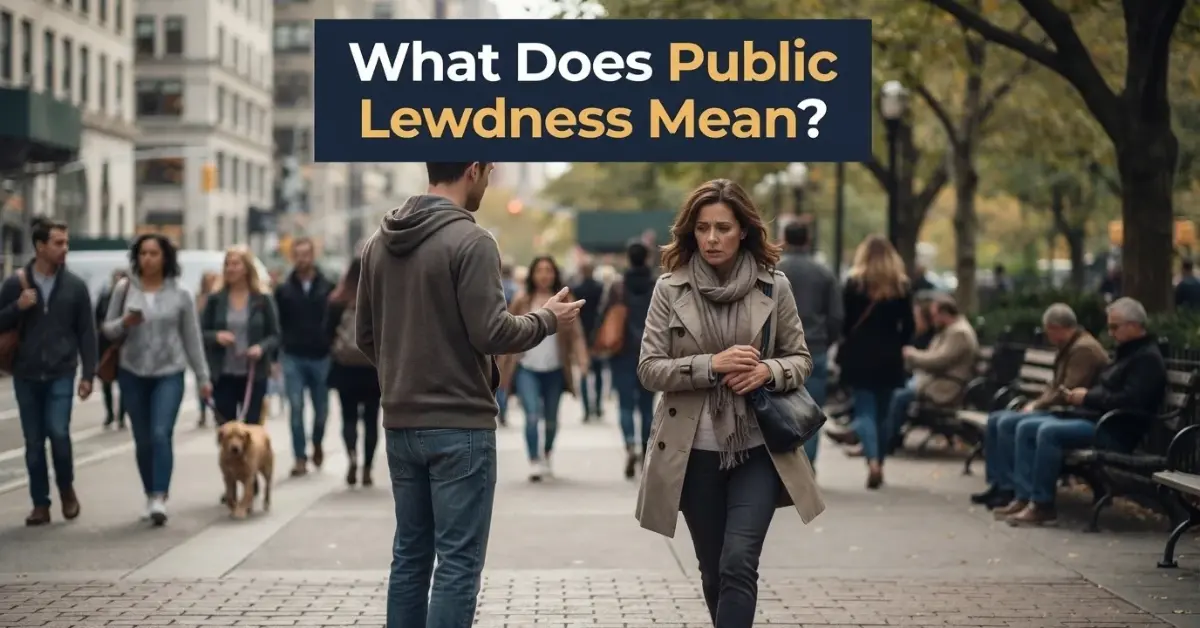
Seeing the words “public lewdness” on a police report, court document, or legal website can raise a lot of questions. You might wonder what the term means, what actions it covers, or whether someone can face criminal charges for behavior in a public place.
The answer depends on more than whether an act seems inappropriate. Public lewdness generally refers to sexual or indecent conduct that violates a law protecting people from certain behavior in public or in circumstances where others may see it. However, the exact definition depends on the state and the facts of the situation. Some laws focus on intentional exposure, while others cover different types of sexual conduct or acts likely to offend or alarm others.
LII / Legal Information Institute
+2
Understanding this term can help you make sense of a charge, read a court document, or know what questions to ask a lawyer. Below, you’ll find a plain-English explanation, practical examples, common misunderstandings, and guidance on what to do if the term applies to your situation.
Quick Answer
Public lewdness generally means engaging in sexual or indecent behavior that a state’s law prohibits in public or under certain circumstances where others may observe it. Depending on the law, this may include intentional sexual exposure or other sexual acts. The definition, required intent, and possible penalties vary by state.
What Does Public Lewdness Mean In Plain English?
Public lewdness is a legal term for certain sexual or indecent acts that occur in public or under other circumstances covered by a law. The word lewd generally describes conduct considered sexually indecent, obscene, or lascivious.
LII / Legal Information Institute
+1
In simple terms, the law may treat certain sexual behavior as a crime when it happens where other people can see it or under conditions specifically covered by a statute.
However, public lewdness does not have one identical definition across the United States. Each state sets its own legal rules. The name of the offense, the conduct it covers, and the requirements for proving it can differ.
For example, some laws focus on intentional exposure of intimate body parts or other lewd acts. Other laws use terms such as open lewdness or public indecency and define the prohibited behavior differently.
Justia Law
+3
The surrounding circumstances can matter, too. A court may need to consider what happened, where it happened, whether another person could observe it, what the person intended, and what the relevant statute requires.
What does the word “lewd” mean legally?
Lewd generally refers to conduct considered sexually indecent or obscene. Its precise legal meaning depends on the law and the context in which the word appears.
It is not simply another word for embarrassing, rude, or socially unacceptable behavior. A criminal charge must be evaluated under the applicable law, rather than personal opinions about what is appropriate.
Is public lewdness always a crime?
No. The term can describe conduct addressed by criminal laws, but whether a particular act qualifies as an offense depends on the jurisdiction and the facts.
An act that seems inappropriate to one person does not automatically meet the legal requirements for public lewdness. The state must establish the elements of the charged offense under the applicable legal standard.
A Simple Example Of Public Lewdness
Consider a hypothetical situation in which a person intentionally exposes intimate body parts in a crowded public area for a sexual purpose.
Depending on the state’s law and the surrounding facts, that conduct might fall under a public lewdness, indecent exposure, or public indecency statute. The correct legal classification cannot be determined from the example alone.
For instance, New York’s public lewdness law addresses intentional lewd exposure and other lewd acts in specified public or private circumstances. Delaware’s law uses a different definition of lewdness, including acts in public or acts the person knows are likely to be observed by people who would be offended or alarmed.
Justia Law
+1
These examples show why the location, conduct, intent, and wording of the statute matter.
What if the behavior happens in a private place?
Private property does not automatically rule out a public lewdness offense. Some laws cover certain conduct on private premises when the person intends to be observed, or when other specific statutory conditions apply.
New York law, for example, includes certain circumstances involving private premises and intentional observation, as well as a separate situation involving trespassing in a dwelling. These are specific legal conditions, not a rule that all conduct visible from a window is criminal.
Justia Law
+1
The key question is what the relevant law actually prohibits.
Where You’ll Encounter This Legal Term
People commonly encounter the term public lewdness in legal or official settings. Understanding the source can help you work out what the term means in that particular situation.
- Police reports: The term may appear when an officer documents suspected conduct. A report describes an allegation; it does not establish guilt.
- Court documents: A complaint, charging document, or court record may identify public lewdness as an alleged offense.
- State criminal statutes: Laws explain which acts are prohibited and what the prosecution must prove.
- Criminal defense websites: Legal resources often explain the meaning of the charge, possible defenses, and the importance of the facts.
- News reports: An article may use the term when describing an arrest, prosecution, or court decision.
What if you see it on a court record?
Start by identifying the state, the exact charge, and the statute number, if one is listed. These details matter because similar-sounding offenses may have different legal elements and consequences.
Also, check whether the record describes an allegation, a pending case, a dismissal, a plea, or a conviction. Those are different legal situations.
If the record concerns you or someone close to you, a criminal defense attorney can explain the document and what it means for that case.
Why Public Lewdness Matters Legally
Public lewdness matters because certain conduct can lead to criminal charges, court proceedings, and other consequences. The seriousness of the situation depends on the law in the relevant jurisdiction and the circumstances of the alleged act.
Possible criminal penalties
Some states classify public lewdness or a similar offense as a misdemeanor. Other laws create different levels of offenses based on factors such as the conduct involved, the circumstances, or a person’s prior record.
For example, New York classifies the offense defined in Penal Law § 245.00 as a class B misdemeanor. Delaware classifies its statutory lewdness offense as a class B misdemeanor, while Pennsylvania separately defines an offense called open lewdness. These classifications apply to their respective statutes, not to every public lewdness case nationwide.
Justia Law
+2
Depending on the jurisdiction and the case, a conviction may result in a fine, probation, jail time, or other legal consequences. No particular penalty should be assumed without checking the relevant law.
Other consequences to understand
A criminal case can involve more than the immediate penalty. Depending on the circumstances, a person may also face:
- The cost of legal representation and court proceedings.
- A criminal record if convicted.
- Difficulties explaining the case to an employer or licensing body.
- Other consequences tied to the specific offense or sentence.
These outcomes are not automatic. They depend on the offense, the final case result, and any rules that apply to the person’s circumstances.
Important: An arrest or charge is not the same as a conviction. The accusation, available evidence, legal defenses, and outcome must be considered separately.
Is public lewdness a serious offense?
It can be. Even when an offense is classified as a misdemeanor, a criminal case can have meaningful consequences. At the same time, the term alone does not tell you how serious a particular case is.
To understand the risk, identify the exact statute and determine what penalties it allows. An attorney can explain how those rules may apply to the facts.
How Public Lewdness Laws Are Typically Applied
Although the details vary, evaluating a possible public lewdness offense generally involves examining the law’s required elements and comparing them with the available evidence.
The following points explain the general process. They are not a checklist that determines whether a person has committed a crime.
1. Identify the conduct involved
The first question is what allegedly happened. Was there intentional exposure, a sexual act, or another type of behavior covered by the law?
The answer matters because a statute may prohibit specific conduct rather than every act that someone considers indecent.
2. Determine where it happened
Location may be important. A law might apply to conduct in a public place, a location where other people are present, or certain private premises.
The legal definition of a public place can also vary. A park, sidewalk, vehicle, private home, and business are not necessarily treated the same way in every legal situation.
3. Consider intent and awareness
Some statutes require proof of intentional conduct. Others may use different requirements relating to awareness, recklessness, or the likelihood that others would observe the act.
For example, Delaware’s lewdness statute refers to conduct the person knows is likely to be observed by people who would be offended or alarmed. New York’s public lewdness statute expressly addresses intentional exposure or other lewd acts in specified circumstances.
These differences make it important not to assume that one state’s rules apply everywhere.
4. Review the available evidence
Evidence may include witness statements, video recordings, photographs, physical evidence, or other information relevant to the alleged conduct. Which evidence matters depends on the particular case.
The existence of a complaint or recording does not, by itself, settle every legal question. The evidence must be evaluated under the applicable law and court procedures.
5. Apply the correct legal standard
In a criminal prosecution, the prosecution generally must prove the required elements beyond a reasonable doubt. The exact elements come from the statute and relevant case law.
A judge or jury may need to consider disputed facts, the credibility of witnesses, and the legal meaning of the conduct. The result cannot be predicted from the charge’s name alone.
Does intent always matter?
Intent can be important, but the requirement is not identical in every jurisdiction or offense. One statute may expressly require intentional exposure, while another may focus on different conduct or a different mental state.
Do not assume that a person’s explanation automatically resolves the issue. Likewise, do not assume that a particular intent requirement exists without checking the applicable statute.
Can someone be charged if nobody complained?
A complaint is not necessarily the only way suspected conduct can come to the attention of law enforcement. An officer, witness, recording, or other information may lead to an investigation, depending on local law and circumstances.
Whether a charge can be brought, and whether the evidence is sufficient to support it, are separate questions. The answer depends on the jurisdiction and the facts.
Legal information notice: This article provides general educational information, not legal advice. It does not establish whether any specific act is criminal. If you face a public lewdness investigation or charge, consult a licensed attorney in the relevant jurisdiction.
Common Misunderstandings About Public Lewdness
Several assumptions can make this legal term confusing. Here are the most important distinctions.
Misunderstanding 1: Anything inappropriate in public is public lewdness
Not necessarily. A behavior may be rude, offensive, or embarrassing without meeting the elements of a criminal offense.
The relevant law determines what conduct is prohibited. Personal opinions about good manners are not a substitute for that legal definition.
Misunderstanding 2: Public lewdness and indecent exposure are identical
These terms can overlap, but they are not interchangeable in every jurisdiction.
Indecent exposure commonly concerns the unlawful exposure of intimate body parts. Public lewdness may include exposure and, depending on the statute, other sexual or indecent acts. Some jurisdictions use different names for offenses that address related conduct.
LII / Legal Information Institute
+2
The statute’s wording matters more than the label alone.
Misunderstanding 3: An accusation proves guilt
An accusation starts or forms part of a legal process. It does not establish that the alleged conduct occurred or that all legal elements have been met.
The final outcome depends on the evidence, the applicable law, and the legal process.
Misunderstanding 4: It can only happen outdoors
Not always. Certain laws cover conduct in private premises under specific circumstances, including circumstances involving intentional observation. Other statutes may define the relevant location differently.
Justia Law
+1
The word public in the offense name does not settle every question about location.
Misunderstanding 5: Every state imposes the same penalty
States define and classify offenses differently. A penalty listed for New York or Delaware should not be treated as the penalty for a similar offense elsewhere.
Always check the current statute for the location where the alleged conduct occurred.
Misunderstanding 6: An arrest means a person will have a permanent conviction
An arrest, charge, dismissal, acquittal, plea, and conviction are different outcomes. The consequences depend on how the case is resolved and on the laws that apply.
If you are concerned about a record, ask an attorney about the actual case status and any applicable record-sealing or expungement rules.
Related Legal Terms & How They Differ
Several legal terms may appear alongside public lewdness. Their meanings overlap in some situations, but each has its own legal context.
| Legal term | Meaning and distinction |
| Indecent exposure | Generally concerns unlawful exposure of intimate body parts; the exact elements vary by law.LII / Legal Information Institute |
| Public indecency | A label used by some jurisdictions for prohibited conduct in public, with definitions set by statute.ilga.gov |
| Open lewdness | A distinct offense name used in some states; Pennsylvania, for example, has its own statutory definition.CRIMES AND OFFENSES |
| Lewd conduct | A broad description of sexually indecent behavior; its legal significance depends on the statute or legal context.LII / Legal Information Institute |
| Disorderly conduct | A separate offense that may address disruptive behavior, depending on local law; it is not automatically a sexual offense. |
| Obscenity | A legal concept often associated with certain sexually explicit material; its standards and context differ from public lewdness.LII / Legal Information Institute+1 |
These are general distinctions, not universal definitions. A single incident may raise questions about more than one law, but that does not mean every related offense applies.
If you are reading a court record, use the exact charge and statute number to find the correct definition rather than relying on a similar term.
When Should You Talk To an Attorney?
Consider speaking with a criminal defense attorney if you have been arrested, charged, contacted by investigators, or told that you are under investigation for public lewdness.
Early legal guidance can help you understand the charge, protect your rights, and avoid making decisions without knowing the possible consequences.
An attorney can help you:
- Understand the exact charge: Identify the statute and the elements the prosecution must prove.
- Review the evidence: Examine witness accounts, recordings, and other information relevant to the allegations.
- Understand possible penalties: Learn what consequences the law allows and what factors may affect the case.
- Explore available defenses: Determine whether factual disputes, legal requirements, or other issues may matter.
- Understand court procedures: Learn about deadlines, hearings, and your legal obligations.
If law enforcement contacts you, avoid guessing about the law or discussing the details publicly. Consider obtaining legal advice before answering questions about a suspected offense.
If someone has already filed a charge, do not ignore court papers or hearing dates. Ask a qualified attorney about the deadlines and steps that apply to your situation.
What if you are unsure whether an act was illegal?
Do not rely only on a general online definition. Write down the relevant facts while they are fresh, identify the jurisdiction, and find the actual statute. A local attorney can help you understand how the law applies.
Remember: This article offers general information, not legal advice. Only a review of the relevant law and facts can help clarify the legal position in a particular case.
🎯 Practical Takeaway
Public lewdness generally refers to certain prohibited sexual or indecent conduct, but the exact definition depends on state law and the circumstances. If you encounter this term in a police or court document, check the statute and the current case status rather than assuming what it means. If the matter involves a possible criminal charge, speak with a licensed attorney in that jurisdiction.
FAQs:
1. What is an example of public lewdness?
An example might involve someone intentionally performing a prohibited sexual act in a public park where other people can observe it. Whether the conduct qualifies as public lewdness depends on the state’s law, the person’s actions and intent, the location, and other relevant facts. An example alone cannot determine criminal liability.
2. Is public lewdness a misdemeanor or a felony?
The classification depends on the jurisdiction and the specific offense. Some public lewdness laws define a misdemeanor, while other related offenses may carry different classifications or enhanced penalties under certain circumstances. Check the current statute for the state involved rather than assuming that one classification applies nationwide.
3. Can you be charged with public lewdness on private property?
Possibly. Some laws cover specific conduct on private premises when certain conditions are met, such as an intent to be observed. Other laws use different requirements. Being on private property does not automatically settle the question, so the exact statute and circumstances matter.
4. What is the difference between public lewdness and indecent exposure?
Indecent exposure generally concerns unlawful exposure of intimate body parts, while public lewdness may cover exposure and other conduct under certain state laws. The terms can overlap, but they do not always describe the same offense. Their precise legal meanings depend on the applicable statute.
5. Can public lewdness charges be dismissed?
A charge may be dismissed in some circumstances, but dismissal is not guaranteed. The outcome may depend on the evidence, whether the alleged conduct meets the statute’s requirements, procedural issues, and other case-specific factors. A criminal defense attorney can review the facts and explain which options may be available.
6. Does public lewdness give you a criminal record?
An arrest or charge does not automatically mean a person has a criminal conviction. Whether a record results, what it contains, and whether it can later be sealed or expunged depend on the case outcome and applicable law. Anyone concerned about a record should seek advice specific to their jurisdiction.
7. Are public lewdness laws the same in every state?
No. States use different statutory language, define prohibited conduct differently, and set their own penalties. Some use terms such as public lewdness, public indecency, or open lewdness. Even when the names sound similar, the legal requirements may differ, so the state and exact statute matter.
Conclusion:
Public Lewdness Mean is a legal term for certain sexual or indecent conduct prohibited under applicable law. It can involve intentional exposure or other acts, depending on the state and the circumstances.
The term does not mean that every inappropriate action in public is automatically a crime.
The most important details are the exact behavior, where it occurred, any required intent, and the wording of the law.
Related terms, such as indecent exposure and public indecency, may describe similar conduct but are not always legally identical.
If you encounter public lewdness in a court document or police report, start by identifying the jurisdiction and the specific statute.
Remember that an accusation is not proof of guilt, and the outcome of a case depends on the evidence and applicable legal rules.
Understanding the term is a useful first step, but it cannot replace advice about an individual case.
When a real legal issue is involved, a qualified local attorney can help you understand your rights, responsibilities, and next steps.

I am Alex Carter, an author at Meaningary.com and an expert in meanings, slang, and everyday expressions. I specialize in explaining name meanings and language in a simple, clear, and reader friendly way.