If you have seen what does deferred probation mean on a court document, plea agreement, or legal website, you may be wondering what happens to the case next.
The phrase can sound like a normal probation sentence, but in some jurisdictions it refers to a different legal arrangement where the court delays a final adjudication while you complete court-ordered conditions.
That distinction can matter. Depending on the state and the exact type of deferred program, completing supervision may allow the case to be dismissed without a formal adjudication of guilt.
A violation, however, can expose you to further court proceedings. Texas law, for example, allows a judge to defer further proceedings after a guilty or no contest plea without entering an adjudication of guilt and place the defendant on deferred adjudication community supervision.
This guide breaks down what deferred probation means, how it differs from regular probation and diversion, what can happen after successful completion, and why the exact wording of your court order matters.
⚡ Quick Answer
Deferred probation generally refers to a court arrangement where final adjudication is delayed while a person completes court-ordered supervision. The person must follow specific conditions for a set period. If those conditions are successfully completed, the case may be dismissed or otherwise resolved without a formal conviction, depending on state law and the specific program.
What Deferred Probation Means Plainly
The term deferred probation is often used casually to describe a situation where a court delays a final decision while the defendant completes probation like conditions.
However, the exact legal term may be deferred adjudication, deferred disposition, deferred prosecution, or something else. Those terms are not automatically interchangeable because each state can create its own rules.
In a deferred-adjudication system, the court may accept a guilty or no-contest plea but postpone entering an adjudication of guilt.
The defendant is then placed under court supervision and must satisfy certain conditions.
Texas law provides one example: after receiving a guilty or nolo contendere plea and finding that the evidence supports guilt, a judge may defer further proceedings without entering an adjudication of guilt and place the defendant on deferred adjudication community supervision.
This creates an important distinction:
The case is not simply over. The court is postponing a final adjudication while the person completes the required conditions.
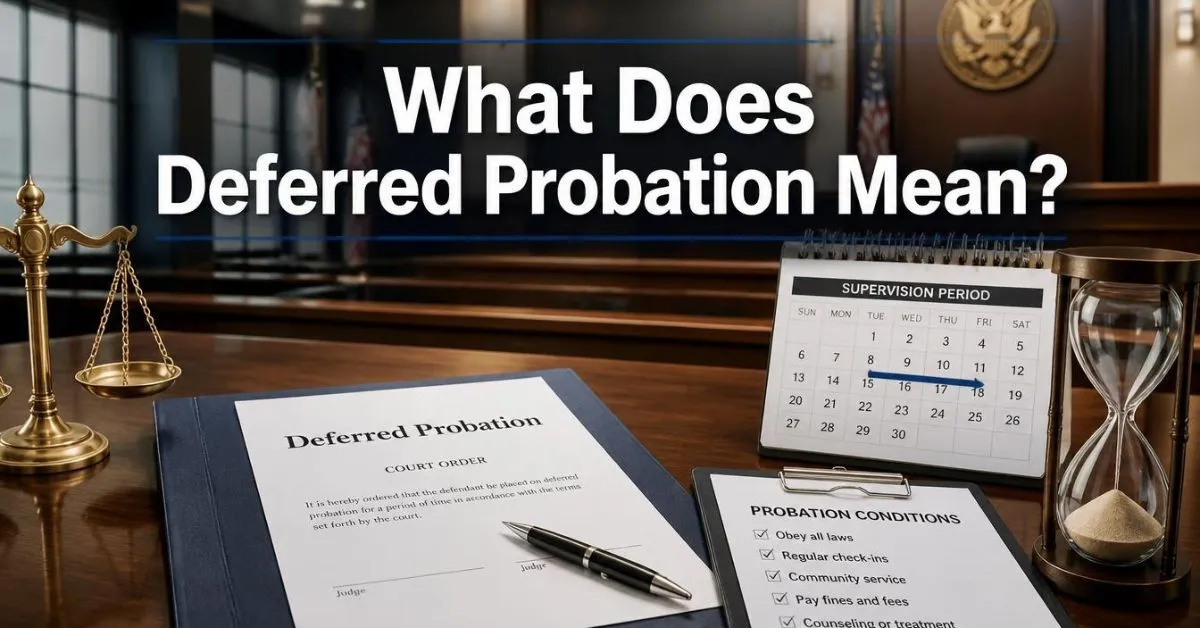
Those conditions may include reporting to a probation officer, completing community service, paying restitution or other court-ordered amounts, attending counseling or educational programs, avoiding new offenses, or following travel and contact restrictions.
The actual conditions depend on the court order.
A Simple Example Of Deferred Probation
Imagine someone is charged with a criminal offense.
Instead of moving directly to a final conviction and sentence, the person enters an agreement or plea arrangement that allows the court to defer adjudication. The judge places the person under supervision for a specific period.
The court might require the person to:
- Report to a supervision officer
- Complete community service
- Pay restitution
- Follow testing requirements
- Attend an approved program
- Avoid new criminal offenses
- Follow every other condition in the court order
If the person completes the requirements, the applicable law may allow the case to be dismissed or otherwise resolved without an adjudication of guilt.
If the person violates a condition, the result can be very different. Depending on the jurisdiction, the court may hold a violation hearing and consider whether to proceed with the original case.
Texas provides a clear example of this structure. Its deferred-adjudication statute allows further proceedings to be deferred without entering an adjudication of guilt and separately addresses the consequences of violating supervision conditions.
So, think of deferred probation as a conditional period between the initial court proceeding and the final resolution of the case.
Where You’ll Encounter Deferred Probation
You may encounter the term in several places.
Court orders
A judge’s order can explain whether you are receiving deferred adjudication, community supervision, probation, or another disposition.
Plea agreements
A plea agreement may offer deferred adjudication or another deferred arrangement as part of resolving a criminal charge.
Probation paperwork
Your supervision documents may list the exact conditions you must follow and the length of the supervision period.
Background checks
A deferred case can still create records related to the arrest, charge, court proceeding, plea, or supervision. Whether those records appear on a particular background check depends on the type of record and applicable law.
Immigration matters
A deferred criminal case can also raise separate immigration questions. Criminal and immigration law do not always use the same definitions or consequences.
This is one reason you should not assume that “deferred” means “nothing happened” or that the case will be treated the same way for every legal purpose.
Why Deferred Probation Matters Legally
The most important issue is often the difference between delaying adjudication and entering a final conviction.
A deferred arrangement may give a person a chance to complete supervision without receiving a formal adjudication of guilt under the applicable state law.
But that does not automatically mean:
- The arrest disappears
- The court file disappears
- The plea disappears
- Every background check will show nothing
- Every government agency will treat the case as nonexistent
- Immigration law will treat it exactly like state criminal law
For example, a Texas appellate decision explains that a defendant placed on deferred adjudication community supervision has not been adjudicated guilty and that the deferred-adjudication order is not a conviction under the relevant Texas law.
That does not mean every state or every area of law follows the same rule.
This distinction becomes especially important if you are dealing with immigration, professional licensing, employment disclosures, firearm restrictions, housing applications, or another situation where the precise legal definition of a conviction matters.
How Deferred Probation Is Typically Applied
Although procedures vary, deferred adjudication commonly follows a basic pattern.
1. A criminal case exists
The person has been charged with an offense and is facing court proceedings.
2. A deferred arrangement is offered or authorized
Depending on the jurisdiction, the prosecutor, judge, or applicable statute may provide a path to deferred adjudication or another deferred disposition.
3. A plea may be entered
In many deferred-adjudication systems, the defendant enters a guilty or no-contest plea before the court defers adjudication.
FindLaw’s legal overview distinguishes deferred adjudication from pretrial diversion partly because deferred adjudication generally involves a plea, while pretrial diversion generally occurs without that prior plea.
4. Supervision begins
The person must follow the conditions ordered by the court.
5. The person completes or violates the conditions
Successful completion may lead to the resolution provided by the applicable statute or agreement.
A violation may result in additional court proceedings.
6. The case receives its final disposition
The final result depends on the jurisdiction, the type of deferred program, the person’s compliance, and the court’s authority.
The key point is that the court order controls. A general online definition cannot tell you exactly what will happen in a specific case.
Deferred Probation vs. Regular Probation
Deferred probation and regular probation can look similar because both may involve supervision and court-ordered conditions.
The major difference is often what has happened with the adjudication of guilt.
| Feature | Deferred Adjudication | Regular Probation |
| Final adjudication | Generally delayed | Generally already entered |
| Supervision | Usually required | Usually required |
| Conditions | Court-ordered | Court-ordered |
| Successful completion | May lead to dismissal or another favorable disposition, depending on law | Usually completes the probationary sentence |
| Violation | May lead to proceedings on the underlying charge | May lead to revocation or other sentencing consequences |
| Terminology | Varies by state | Varies by state |
This table is a general comparison, not a statement of universal state law.
The exact legal effect depends on the jurisdiction and the paperwork you received.
Deferred Probation vs. Pretrial Diversion
These terms are easy to mix up.
Pretrial diversion generally takes place before a guilty or no-contest plea. The prosecution may allow a person to complete certain requirements instead of continuing through the normal prosecution process.
Deferred adjudication, by contrast, generally involves a plea followed by delayed adjudication.
FindLaw identifies the plea as one of the main distinctions between the two types of programs.
That difference can become important if the person fails to complete the program.
With deferred adjudication, the prior plea can affect what happens next under the applicable law. With pretrial diversion, there may be no prior guilty plea for the court to act upon.
Again, the rules vary by jurisdiction.
What Happens If You Violate Deferred Probation?
A violation can be serious, but the exact consequence depends on the court order and local law.
A violation might involve:
- Missing a required appointment
- Failing to complete community service
- Missing a payment
- Violating a testing requirement
- Failing to attend a required program
- Traveling in violation of an order
- Being accused of committing another offense
The court may respond differently depending on the nature of the alleged violation.
Possible outcomes can include additional conditions, continued supervision, a warning, modification of supervision, or proceedings that could lead to adjudication.
For example, Texas law provides a statutory process for addressing an alleged violation of deferred adjudication community supervision, including a hearing concerning whether the court will proceed with adjudication.
That does not mean every violation automatically results in a conviction or incarceration.
The important point is that you should not ignore an alleged violation.
If you receive a violation notice, missed-reporting notice, or court date, review it promptly and consider speaking with a licensed criminal-defense attorney.
What Happens After You Complete Deferred Probation?
Successful completion generally means you have satisfied the conditions required by your court order for the required period.
What happens next varies by jurisdiction.
Some deferred-adjudication systems allow the proceedings to be dismissed after successful completion. Texas law, for example, provides for dismissal and discharge when the deferred period expires without adjudication of guilt, subject to the statute’s requirements.
But there is an important distinction between dismissal and record clearance.
A dismissed case may still have historical court records.
Depending on state law, additional steps may be available to seal or expunge certain records. Eligibility varies.
This means you should keep your final disposition paperwork instead of assuming the case has simply vanished.
If a future application asks about arrests, charges, pleas, convictions, or deferred adjudication, read the question carefully. Different questions can have different disclosure requirements.
Common Misunderstandings About Deferred Probation
“Deferred probation means I was never charged.”
Not necessarily. A deferred arrangement generally occurs after a criminal case has begun. The case can still create court and law-enforcement records.
“Deferred probation means I have no conviction anywhere.”
That is too broad. The legal effect depends on the jurisdiction and the specific purpose for which the question is being asked.
“Finishing probation automatically erases my record.”
Not necessarily. Successful completion may result in dismissal or discharge, but record sealing or expungement can involve separate rules and procedures.
“A violation automatically means I will go to jail.”
Not automatically. Consequences depend on the alleged violation, court order, jurisdiction, and applicable law.
“Deferred probation and diversion are identical.”
No. Deferred adjudication and pretrial diversion can differ in timing, plea requirements, and consequences.
“The word deferred always means the same thing.”
No. Courts and states use different terms and legal structures. Always look at the exact wording of your order.
Related Legal Terms You Should Know
Deferred adjudication
Meaning: A court delays entering an adjudication of guilt while the defendant completes specified conditions.
Community supervision
Meaning: Court-ordered supervision that requires compliance with stated conditions.
Probation
Meaning: A court-supervision arrangement that allows a person to remain in the community under specified conditions.
Pretrial diversion
Meaning: A program that can redirect a case away from ordinary prosecution before a final adjudication.
Adjudication of guilt
Meaning: The court’s formal determination of guilt.
Dismissal
Meaning: The court ends the criminal proceeding without continuing the case toward the same final judgment.
These terms may sound similar, but their legal effects can differ substantially.
When To Talk to an Attorney
You may want to speak with a licensed attorney if deferred probation appears in your own case, especially if you need to understand the consequences before accepting an agreement.
An attorney can be particularly useful if:
- You are deciding whether to accept a deferred arrangement.
- You are unsure whether a guilty or no contest plea is required.
- You believe you have violated a condition.
- You received a notice to appear in court.
- You need to understand your final disposition.
- You are concerned about a background check.
- You are applying for a professional license.
- You have an immigration issue.
- You want to know whether your record can be sealed or expunged.
The actual court order, plea agreement, statute, and jurisdiction are more important than a general definition found online.
This article provides general legal information, not legal advice. For advice about a specific case, speak with a licensed attorney in the relevant jurisdiction.
🎯 Practical Takeaway
Deferred probation generally means the court is delaying a final adjudication while you complete court-ordered supervision. Follow every condition exactly, keep copies of your court paperwork, and do not assume that completing supervision automatically erases your records. If you are facing a violation or deciding whether to accept deferred probation, get advice based on the specific law and documents in your case.
FAQs:
Is deferred probation the same as a conviction?
Not necessarily. In a deferred-adjudication arrangement, the court may delay entering an adjudication of guilt while the defendant completes supervision. Some jurisdictions may allow dismissal after successful completion. However, other laws may define or treat the case differently, so the answer depends on the jurisdiction and legal purpose.
Does deferred probation go on your record?
A deferred case can create records even when a final conviction is not entered. Court documents, arrest information, charges, pleas, and supervision records may exist. Whether those records appear on a particular background check, and whether they can later be sealed or expunged, depends on applicable law.
What happens when deferred probation ends?
If all required conditions are completed, the case may receive the favorable disposition provided by the applicable law. In some jurisdictions, this can include dismissal and discharge. The end of supervision does not automatically mean every record disappears, so obtaining the final court disposition is important.
Can you violate deferred probation?
Yes. A person can violate deferred probation by failing to follow a court-ordered condition. The consequences vary by state and case. Depending on the circumstances, the court may modify supervision, impose additional conditions, or begin proceedings that could result in adjudication of the underlying charge.
Is deferred probation better than regular probation?
They are different legal arrangements rather than simply two levels of the same thing. Deferred adjudication generally delays a final adjudication, while regular probation often follows an adjudication or conviction. The legal consequences depend on the specific state, offense, court order, and agreement.
Does deferred probation affect immigration?
It can. Immigration law may use its own definitions when evaluating criminal dispositions. A deferred state-court case should therefore not automatically be assumed to have the same effect under federal immigration law. Anyone with an immigration concern should obtain advice from an immigration attorney familiar with the specific disposition.
Can deferred probation be removed from your record?
Possibly, but it depends on the jurisdiction and the type of record. Successful completion may result in dismissal, while sealing or expungement can require separate eligibility rules and procedures. The best way to determine what is available is to review the final disposition and applicable state law with a qualified attorney.
Conclusion:
So, what does deferred probation mean? In simple terms, it generally describes a court arrangement where a final adjudication is delayed while a person completes a period of court-ordered supervision.
The person must follow the conditions in the order, and successful completion may lead to dismissal or another favorable outcome under the applicable law.
The important thing to remember is that deferred does not mean erased. A deferred case can still create records, and different laws may treat the same case differently.
A violation can also change what happens next, which makes following every court condition important.
The exact meaning depends on the state, court, offense, plea agreement, and wording of the order.
If this term appears in your own legal paperwork, focus on the conditions, supervision period, violation rules, and final disposition rather than relying only on the phrase “deferred probation.”

I am Lucas Bennett, an author at Meaningary.com and an expert in meanings, slang, and everyday expressions. I specialize in explaining name meanings and language in a simple, clear, and reader friendly way.