Seeing an approval notice from U.S. Citizenship and Immigration Services (USCIS) can bring a huge sense of relief, especially when you have been waiting to bring a spouse, parent, child, or other eligible family member to the United States.
But after the excitement, you may wonder what happens next. Does an approved I-130 mean your family member can move to the United States? Can they get a green card right away? Or is there another stage to complete?
Understanding what does I-130 approval mean can help you avoid confusion and prepare for the next part of the immigration process. Form I-130, officially called the Petition for Alien Relative, helps establish a qualifying family relationship for certain U.S. immigration benefits.
Approval is an important step, but it does not automatically grant a green card, a visa, or permission to enter or remain in the country.
In this guide, you will learn what approval confirms, what usually happens afterward, how waiting times and family categories affect the process, and which practical steps you can take next.
⚡ Quick Answer
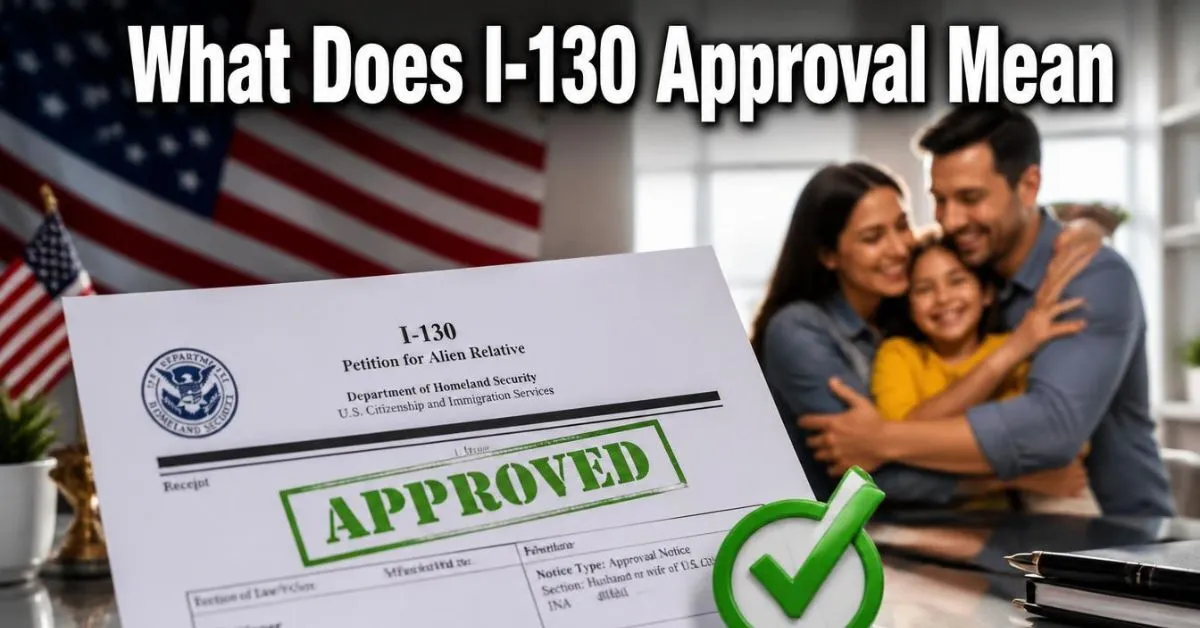
I-130 approval means USCIS has accepted the qualifying family relationship between a U.S. citizen or lawful permanent resident and the relative they are sponsoring. It is an important step toward family-based immigration, but it does not automatically grant a green card, an immigrant visa, or permission to enter the United States.
1. What I-130 Approval Means Plainly
Form I-130 is called the Petition for Alien Relative. It is filed with USCIS by an eligible U.S. citizen or lawful permanent resident who wants to help a qualifying family member immigrate to the United States.
The person who files the petition is the petitioner. The family member who may receive an immigration benefit is the beneficiary.
When USCIS approves the petition, it generally means the agency has recognized that the required qualifying family relationship has been established for the immigration category involved. That approval allows the case to move forward through the applicable immigration process. It does not, by itself, make the beneficiary a lawful permanent resident.
What approval confirms
An approved I 130 generally confirms that USCIS accepted the petition for the qualifying relationship. The next steps depend on the type of relative, the beneficiary’s location, visa availability, and whether other immigration requirements are met.
For example, a U.S. citizen’s spouse may be eligible for a different processing route from an adult sibling sponsored by a U.S. citizen. These relationships fall into different immigration categories, which can affect how soon the beneficiary can move forward.
What approval does not confirm
I-130 approval does not automatically mean:
- The beneficiary has received a green card.
- An immigrant visa has been issued.
- The beneficiary can immediately travel to the United States.
- The beneficiary has permission to work in the United States.
- Every other immigration requirement has been satisfied.
These distinctions matter because family-based immigration usually involves more than one step. USCIS approval is an important milestone, not necessarily the end of the case.
2. A Simple Example of I -130 Approval In Practice
Imagine that Maria is a U.S. citizen and files Form I-130 for her husband, Daniel, who lives abroad.
After reviewing the petition, USCIS approves it. Maria is relieved because the agency has recognized their qualifying relationship for immigration purposes.
However, Daniel does not automatically receive a green card on the day of approval. Because he lives outside the United States, his case will generally proceed through consular processing if that is the appropriate route.
The National Visa Center (NVC) may contact them with instructions about fees, required documents, and the immigrant visa application. Daniel must complete the required steps and attend an interview when scheduled. The consular officer must also determine whether he qualifies for the visa.
If the visa is issued and Daniel meets the entry requirements, he can travel to the United States using that immigrant visa. His permanent resident status generally begins when he is admitted to the country as an immigrant.
Why this example matters
Maria’s case shows the difference between approval of the family petition and approval to immigrate.
The first step establishes the qualifying relationship. The later steps determine whether the beneficiary can receive an immigrant visa or qualify for permanent residence through another available process.
Your own case may follow a different route, but the main point remains the same: an approved I-130 is progress, not an automatic green card.
3. Where You’ll Encounter I 130 Approval
You may see the phrase “I-130 approved” in several places during the immigration process.
USCIS case status
You may see an online case update stating that USCIS approved your petition. This status tells you that a decision was made on Form I-130. Read the formal approval notice as well because it provides the official details of the decision.
Approval notice
The approval notice is an important document for your records. Keep a copy and check that the names, identifying information, and other details appear correct.
National Visa Center correspondence
If your case is moving through consular processing, you may later receive communication from the NVC. This can include instructions for paying fees, submitting civil documents, and completing the immigrant visa application.
Approval does not mean the NVC has completed those steps or that an interview date is already available.
Immigration attorney or representative updates
An attorney may tell you that the petition has been approved while explaining which steps remain. Ask whether the case is waiting for visa availability, document review, an interview, or another action.
Practical example: If your USCIS account says the I-130 was approved but you have not received any information about an interview, that does not necessarily indicate a problem. Your next step depends on the processing route and the current status of your case.
4. Why I-130 Approval Matters Legally
I-130 approval matters because it can establish the family relationship needed to pursue an eligible family-based immigration benefit.
Without an approved petition, a person generally cannot proceed through the ordinary family-based immigrant visa process on the basis of that petition. Once USCIS approves it, the case can move to the next applicable stage, subject to visa availability and other requirements.
Family preference categories
Not every family member has the same immigration timeline.
Certain relatives of U.S. citizens are classified as immediate relatives. These include spouses, unmarried children under 21, and parents of U.S. citizens who are at least 21 years old. Immigrant visas are not subject to the annual numerical limits that apply to family-preference categories for these immediate relatives.
Other eligible relatives fall into preference categories. These categories have annual numerical limits, and a visa may not be available immediately after I-130 approval. The beneficiary may need to wait until the applicable priority date becomes current.
Why the distinction matters
Two people can receive I-130 approval around the same time but have very different next steps.
A person in an immediate-relative category may be able to proceed without waiting for a preference-category visa number. Someone in a family-preference category may need to wait much longer, depending on the category, priority date, and applicable visa availability.
Approval is still meaningful in either situation. It simply does not guarantee the same timeline for every family.
Important legal note: This article provides general information about U.S. immigration procedures, not legal advice. Immigration rules and individual circumstances can differ. Consult a licensed immigration attorney for advice about your specific case.
5. How The Process Typically Works After Approval
After I-130 approval, the next step depends mainly on whether the beneficiary is applying from outside the United States or may qualify to apply for adjustment of status from within the country.
Step 1: Review the approval notice
Check the petition details, save the notice, and confirm which relative and immigration category the approval covers.
Step 2: Identify the correct processing route
If the beneficiary is abroad, the case will generally use consular processing. If the beneficiary is in the United States, adjustment of status may be an option if the person meets the legal requirements.
Step 3: Complete the remaining requirements
Depending on the route, these may include an immigrant visa application, supporting civil records, financial sponsorship documents, or an application for adjustment of status.
Step 4: Complete the required review
The process may include an interview, additional evidence, and checks of the beneficiary’s eligibility. An approved I-130 does not guarantee a final approval.
These are general stages, not a fixed sequence for every case. The official process differs based on the beneficiary’s circumstances and the applicable immigration category.
If your family member lives outside the United States
The case generally proceeds through the NVC and a U.S. embassy or consulate. The applicant may need to complete Form DS-260, submit requested documents, meet financial sponsorship requirements, and attend an immigrant visa interview.
The NVC coordinates important parts of this process, but it does not itself grant a green card. Visa issuance is handled by the appropriate consular authority.
If your family member is already in the United States
The beneficiary may be able to apply for adjustment of status using Form I-485, but eligibility depends on the person’s circumstances and the applicable immigration rules.
An approved I-130 alone does not establish eligibility to file or guarantee approval of Form I-485. Visa availability, immigration history, admissibility, and other legal requirements can matter.
Do not assume that filing an I-130 or receiving its approval extends a person’s authorized stay or gives permission to work. Those questions depend on separate rules and, where applicable, other applications or authorizations.
6. Common Misunderstandings About I-130 Approval
The approval notice is good news, but it is important to understand what it does and does not mean.
“My I-130 is approved, so my green card is approved.”
Not necessarily. Form I-130 establishes the qualifying relationship for the petition. The beneficiary must still complete the appropriate process and meet the requirements for permanent residence.
“I can travel to the United States immediately.”
An approved petition is not a travel document. If the beneficiary lives abroad, they generally need to complete consular processing and receive an immigrant visa before traveling to the United States to immigrate.
“Everyone receives a visa right after approval.”
This is not true. Some beneficiaries can proceed without waiting for a preference-category visa number, while others must wait for one to become available.
“My case has stopped because I have not received another notice.”
A pause in updates does not automatically mean that the case has a problem. Your case may be awaiting transfer, document processing, visa availability, or another action. Check the relevant agency’s official case information before drawing conclusions.
“My I-130 approval gives me permission to work.”
Approval of Form I-130 does not itself authorize employment. Work authorization depends on separate eligibility rules and, when required, the appropriate authorization document.
“I can ignore the approval notice because my online account shows approval.”
Keep the official notice and related correspondence. They can help you confirm the decision and understand what was approved. If details appear incorrect or the next step is unclear, contact the appropriate agency or seek qualified legal help.
USCIS and the Department of State explain that petition approval and the later steps toward permanent residence are separate parts of the immigration process.
7. Related Immigration Terms You Should Know
Understanding these terms can make your next immigration notice easier to read.
- Form I-130: The family petition used to establish a qualifying relationship for certain immigration benefits.
- Beneficiary: The family member named in the petition who may seek an immigration benefit.
- Petitioner: The eligible family member who files Form I-130.
- Priority date: The date used to determine a person’s place in the visa queue when a preference-category limit applies.
- National Visa Center (NVC): The Department of State office that handles important pre-interview steps for many immigrant visa cases.
- Consular processing: The process through which an eligible person outside the United States applies for an immigrant visa through a U.S. embassy or consulate.
- Adjustment of status: The process through which an eligible person already in the United States applies to become a lawful permanent resident without completing the usual immigrant visa process abroad.
- Form I-485: The application generally used to request adjustment of status to permanent resident.
- Form DS-260: The online immigrant visa application used in consular processing.
- Green card: The common name for a Permanent Resident Card, which documents lawful permanent resident status.
These terms describe different parts of the process. For example, an approved I-130 and a pending I-485 are not the same as an approved green card application. Likewise, an NVC case number does not mean an immigrant visa has been issued.
8. When to Talk to an Immigration Attorney
Many families can understand the basic meaning of an I-130 approval notice on their own. However, some situations call for individual legal guidance.
Consider speaking with a licensed immigration attorney if:
- Your approval notice contains incorrect information or you are unsure which category applies.
- Your family member has an immigration court case or a complicated immigration history.
- The beneficiary has prior visa denials, removal orders, or possible grounds of inadmissibility.
- You are unsure whether the beneficiary can apply for adjustment of status in the United States.
- Your case appears to be waiting for an unusually long time, and you cannot identify the next required step.
- You need to understand how a change in marital status, age, citizenship, or family circumstances could affect the petition.
These examples do not mean that your case will fail. They are situations where the right next step may depend on facts that cannot be assessed from an I-130 approval notice alone.
What to prepare before seeking help
Gather your approval notice, receipt notice, relevant immigration applications, and any correspondence from USCIS or the NVC. Write down the date of the latest update and the questions you need answered.
Never share your full receipt number, passport details, or other sensitive personal information in a public forum.
Remember: This is general information, not legal advice. A licensed immigration attorney can review your specific circumstances and explain the options that may be available to you.
🎯 Practical Takeaway
If your I-130 has been approved, save the approval notice and identify the next step for your family member’s case. Check whether the case is moving through consular processing or whether adjustment of status may be available, and confirm whether a visa number is required and available. Do not assume that approval alone grants a green card, work authorization, or permission to travel.
FAQs:
1. Does I-130 approval mean I will get a green card?
Not automatically. I-130 approval confirms the qualifying family relationship for the petition. You must still complete the applicable immigration process, have an immigrant visa available when required, and meet the other requirements for permanent residence. The final decision depends on your circumstances and the relevant immigration rules.
2. How long after I-130 approval will I get my green card?
There is no single timeline for every case. Immediate relatives of U.S. citizens may be able to proceed without waiting for a preference-category visa number, while other family members may face a visa backlog. Document processing, interview scheduling, eligibility reviews, and other factors can also affect the time required.
3. What happens after I-130 is approved for a spouse?
If your spouse is outside the United States, the case generally proceeds through the National Visa Center and then a U.S. embassy or consulate. The process can involve fees, Form DS-260, supporting documents, and an interview. If your spouse is in the United States, adjustment of status may be an option if the legal requirements are met.
4. Can I stay in the United States after my I-130 is approved?
An approved I-130 does not, by itself, give you permission to remain in the United States or extend your authorized stay. Your ability to stay depends on your current immigration status and other applicable rules. If your authorized stay is ending or has already ended, seek qualified legal advice about your situation.
5. Does I-130 approval mean my family member can work in the United States?
No. I-130 approval alone does not grant work authorization. Whether the beneficiary may work depends on their immigration situation and any separate employment authorization or permanent resident status they obtain. Before starting a job, confirm that the person has the required authorization.
6. What does it mean if my I-130 is approved but my case is still pending?
It often means the petition has been approved but another part of the process remains unfinished. Your case may be waiting for transfer to the NVC, visa availability, document review, an interview, or a separate decision on adjustment of status. Check the latest official notice to determine which stage applies to your case.
7. Can an approved I-130 be denied later?
Approval of the petition is a positive decision, but it does not guarantee that a later immigrant visa or adjustment-of-status application will be approved. A later application is reviewed under its own requirements. If you receive a refusal, request for evidence, or other unexpected notice, review it carefully and consider speaking with an immigration attorney.
Conclusion:
Understanding what does I-130 approval mean can help you see where your family stands in the U.S. immigration process. It is an important milestone because USCIS has approved the qualifying family relationship described in the petition.
However, approval does not automatically provide a green card, an immigrant visa, work authorization, or permission to enter the United States.
Your next step depends on several factors, including your family relationship, the beneficiary’s location, visa availability, and eligibility for the appropriate immigration process.
Some families can move forward without waiting for a preference-category visa number, while others may need to wait before completing the next stage.
Keep your approval notice and other immigration records organized. Follow official USCIS or Department of State instructions, and seek help from a licensed immigration attorney if your situation is complicated or you are unsure what to do next.
An approved I-130 is meaningful progress, and understanding what comes next can help you move forward with greater confidence and fewer surprises.

I am Alex Carter, an author at Meaningary.com and an expert in meanings, slang, and everyday expressions. I specialize in explaining name meanings and language in a simple, clear, and reader friendly way.