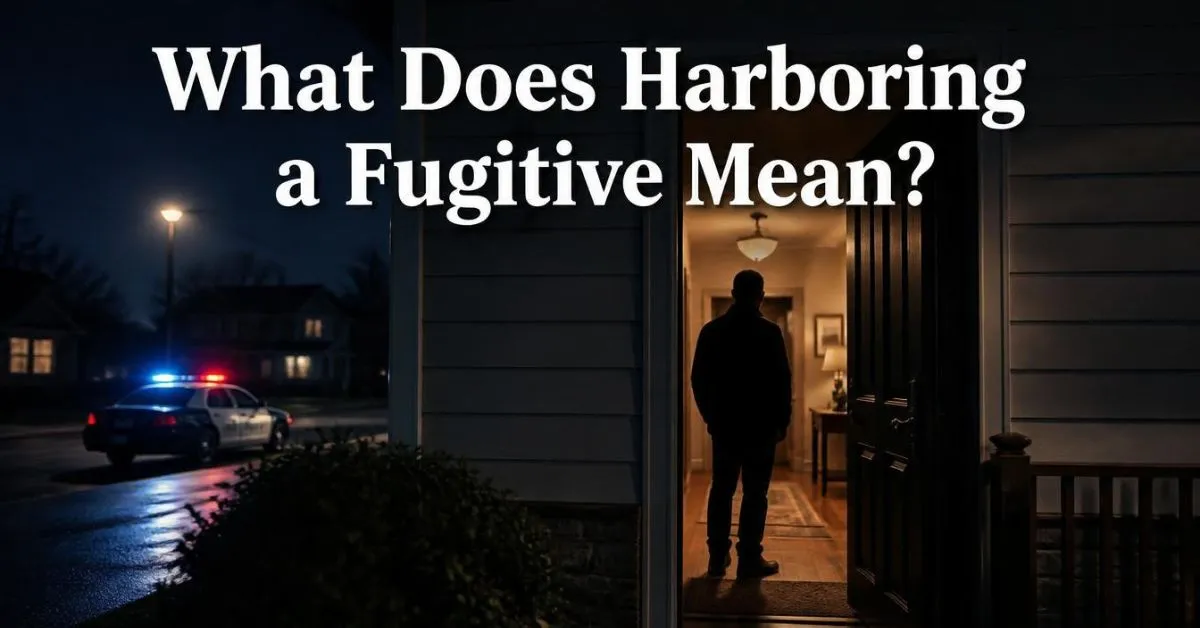
You might hear the phrase “harboring a fugitive” in a crime show, a news report, or a conversation about someone who is avoiding the police.
But what does harboring a fugitive mean in real life? Does it mean giving someone a place to sleep, letting a friend stay at your house, or actively helping someone escape arrest?
The answer depends on what a person does, what they know, and which law applies. Simply knowing someone who is wanted by the police does not automatically mean you are harboring a fugitive.
Legal concerns may arise when someone knowingly hides or protects a person who is trying to avoid arrest or capture.
Understanding this phrase can help you make sense of news stories, court cases, and legal discussions.
In this guide, I will explain the meaning in plain American English, walk through practical examples, discuss possible legal consequences, and clarify common misunderstandings. You will also learn why intent and knowledge can matter when authorities investigate a suspected case.
⚡ Quick Answer
Harboring a fugitive generally means knowingly hiding, sheltering, or helping someone who is wanted by law enforcement avoid arrest or capture. Depending on the circumstances and applicable law, the conduct may be a crime. Merely knowing a wanted person or having an ordinary connection with them does not automatically establish this offense.
What Does Harboring a Fugitive Mean In Plain English?
To harbor a fugitive means to give someone shelter, hide them, or provide certain kinds of help while knowing they are wanted by law enforcement and acting to help them avoid being found or arrested.
The word harboring suggests offering a place of safety or protection. In a legal setting, however, it can describe conduct that interferes with law enforcement’s efforts to locate a person.
A fugitive is generally someone who is fleeing or avoiding legal authorities. The term may refer to a person with an outstanding arrest warrant, someone who has escaped custody, or someone accused of fleeing to avoid prosecution. The exact legal meaning depends on the context.
Examples of conduct that may raise harboring concerns include:
- Knowingly letting a wanted person stay in a hidden room to avoid police.
- Renting a property for someone while knowing the arrangement is meant to help them evade arrest.
- Providing shelter and helping the person stay out of sight.
- Taking steps to hide the person’s presence from authorities.
The legal issue is not simply whether someone helped another person. It is whether the conduct meets the requirements of the applicable law. For example, the federal statute at 18 U.S.C. § 1071 addresses harboring or concealing a person with an arrest warrant to prevent discovery and arrest, with knowledge of the warrant.
This distinction matters because ordinary contact with a wanted person is not automatically the same as committing a harboring offense.
A Simple Example of Harboring a Fugitive
Imagine that a person named Mark has an outstanding arrest warrant. His friend, Daniel, learns about the warrant and agrees to let Mark stay in a locked spare room so officers cannot find him. Daniel also takes steps to keep Mark’s presence secret.
Depending on the facts and the law that applies, Daniel’s actions could be investigated as harboring a fugitive. The important details include what Daniel knew, what he actually did, and whether his actions were intended to prevent Mark’s discovery or arrest.
Now consider a different situation.
Daniel meets Mark for lunch without knowing that Mark is wanted. Later, Daniel hears about the warrant but has no role in hiding Mark or helping him evade authorities. Those facts are different from knowingly providing a hiding place to avoid arrest.
Here are a few other examples:
| Situation | General legal consideration |
| Giving a wanted person a place to hide from police | May raise harboring concerns if the legal requirements are met. |
| Living with someone who has an arrest warrant | The relationship or shared home alone does not settle the legal question. |
| Meeting a wanted person in public | Ordinary contact alone does not necessarily constitute harboring. |
| Providing a room and helping conceal the person’s presence | May be evidence of conduct intended to prevent discovery or arrest. |
| Learning about a warrant after an ordinary visit | Prior innocent contact is different from knowingly hiding someone. |
These examples are educational, not predictions about how a particular case would turn out. Federal and state laws can differ, and small factual details may change the legal analysis.
Where You’ll Encounter This Legal Term
The phrase harboring a fugitive appears in several common settings. Understanding the context can help you tell whether a speaker is using the phrase generally or referring to a specific criminal charge.
1. News reports
News stories may use the phrase when police arrest someone accused of hiding a wanted person. An allegation does not establish guilt, and a news report may use a general description before the legal issues are resolved.
2. Court cases
In court documents, the phrase may describe conduct charged under a statute. The exact law, required elements, and evidence matter more than the label alone.
3. Crime shows and movies
Television programs often show a friend, relative, or partner hiding someone from police. These scenes can illustrate the basic idea, but they may leave out important legal details.
4. Federal criminal law
Under 18 U.S.C. § 1071, federal law addresses concealing a person from arrest when the statutory requirements are met. The law specifically refers to a warrant or other process issued under federal law.
5. State criminal law
States may have their own laws concerning helping wanted people avoid arrest, obstructing law enforcement, or concealing fugitives. The wording and requirements can vary by jurisdiction.
If you encounter this term in an actual legal document, look for the statute number, jurisdiction, and specific charge rather than relying on the phrase by itself.
Why Harboring a Fugitive Matters Legally
Harboring a fugitive matters because deliberately helping someone avoid arrest can interfere with the legal process. Depending on the circumstances, it may lead to criminal charges for the person providing assistance.
There are several important legal issues.
Knowledge of the warrant
Under the federal harboring statute, the government must establish that the person had notice or knowledge that a warrant or other qualifying process had been issued. Courts assess knowledge under the applicable legal standards and the evidence available.
Conduct that helps conceal the person
The authorities may examine whether someone provided shelter or other direct assistance that helped the fugitive avoid detection. The nature of the assistance and its purpose can matter.
Intent to prevent discovery or arrest
Under federal law, the conduct must be connected to preventing the person’s discovery and arrest. A normal social interaction or innocent contact does not automatically establish this element.
Possible criminal penalties
Federal penalties under 18 U.S.C. § 1071 depend on the circumstances specified in the statute. It provides for a fine, imprisonment of up to one year, or both in the general category described there. When the warrant concerns a felony charge, or the person has been convicted of an offense, the statute provides for a possible prison term of up to five years, a fine, or both. These are statutory maximums, not automatic sentences.
State penalties may differ. The actual consequences depend on the applicable law, the evidence, the charge, and the outcome of the case.
Important legal disclaimer: This article provides general legal information, not legal advice. Consult a licensed attorney in the relevant jurisdiction for guidance about a specific situation.
How Harboring a Fugitive Is Typically Applied
The legal process depends on the jurisdiction and the facts. In a federal case under 18 U.S.C. § 1071, the prosecution generally must establish the elements of the offense beyond a reasonable doubt.
Federal law provides a useful example of how the term is applied.
1. A qualifying warrant or process must exist
The federal statute concerns a person for whose arrest a warrant or qualifying legal process has been issued under federal law. A general belief that someone is wanted does not, by itself, establish every required element.
2. The person must have the required knowledge
The government must prove the required knowledge of the warrant or process. Evidence may include direct statements or circumstances from which a jury could draw a reasonable inference, subject to the applicable legal rules.
3. The person must engage in harboring or concealment
Investigators may examine whether the accused provided a hiding place, shelter, or other direct assistance that helped prevent discovery or arrest.
Not every kind of assistance qualifies. The U.S. Department of Justice’s discussion of federal harboring law explains that courts distinguish between acts of concealment and some forms of aid that do not meet the statutory definition.
4. The conduct must meet the law’s purpose-related requirement
For a federal charge under Section 1071, the conduct must be intended to prevent the person’s discovery or arrest. Prosecutors may use the surrounding circumstances to argue that this requirement has been met.
5. The evidence must be assessed under the proper standard
A charge is not the same as a conviction. The prosecution must prove the required elements beyond a reasonable doubt in a federal criminal trial. The accused may challenge the evidence, the interpretation of the law, or whether the required elements have been established.
State cases follow the applicable state statutes and procedures, which may use different language or requirements.
Common Misunderstandings About Harboring a Fugitive
The phrase can sound broad, so it is easy to misunderstand what the law covers. These distinctions are especially important when someone is worried about a friend or family member.
Does knowing a fugitive make you guilty?
No. Knowing someone who has an arrest warrant does not automatically mean you have committed a harboring offense. The relevant law generally requires specific conduct and other legal elements, not merely a personal connection.
Is giving someone food or money always illegal?
No. The legal effect depends on the circumstances and the applicable statute. Federal cases distinguish certain forms of direct assistance that help conceal a person from other types of aid. The purpose and context of the assistance can matter.
Is refusing to tell police where someone is hiding the same thing?
Not necessarily. Under the federal statute, simply knowing where a fugitive is located and failing to volunteer that information is not automatically the same as actively harboring or concealing the person. Other laws or specific circumstances may change the analysis.
Does the law apply only to strangers?
No. A person accused of harboring may be a friend, relative, partner, or someone with no personal relationship to the fugitive. A family relationship does not automatically resolve whether conduct is lawful under the applicable federal or state law.
Is every person with an arrest warrant a fugitive?
The word fugitive is used in different ways. A person may have an outstanding warrant without actively hiding or fleeing. In a legal case, the specific statute and facts determine which requirements must be proved.
The key lesson is that the label alone does not determine guilt. Knowledge, conduct, intent, and the law that applies must be considered together.
Related Legal Terms You Should Know
Understanding these related terms makes it easier to follow news reports and court documents about people who are avoiding arrest.
- Accessory after the fact: A person who helps someone after a crime to hinder that person’s arrest, trial, or punishment may fall under this legal concept, depending on the applicable law.
- Aiding and abetting: Generally refers to intentionally helping or encouraging a crime, subject to the requirements of the relevant statute.
- Obstruction of justice: A broad term for conduct that improperly interferes with a legal investigation or proceeding.
- Outstanding warrant: A warrant that remains in effect and authorizes the action specified in it, such as an arrest.
- Fugitive from justice: A person described as fleeing or avoiding legal authorities; the precise meaning depends on the legal context.
- Concealing an escaped prisoner: A separate federal offense addressed by 18 U.S.C. § 1072, which concerns knowingly harboring or concealing certain escaped prisoners.
These terms are related, but they are not interchangeable.
When To Talk To An Attorney
An attorney can help you understand the law in your state, explain the nature of any investigation, and assess how the known facts may relate to a possible charge.
Legal guidance is especially important if:
- Police have contacted you about a wanted person.
- You have received a subpoena, search warrant, or other legal document.
- You are concerned that providing someone with shelter or assistance could have legal consequences.
- You are unsure how to respond to questions from investigators.
Do not assume that a situation is harmless simply because the person involved is a friend or relative. At the same time, do not assume that ordinary contact automatically makes you guilty.
If you are concerned about your own legal exposure, seek advice from a licensed attorney before making decisions about your case. This is general information, not a substitute for advice based on the facts and law that apply to you.
🎯 Practical Takeaway
Harboring a fugitive generally means knowingly hiding or sheltering a wanted person, or otherwise helping them avoid discovery or arrest in a way that violates the applicable law. The person’s knowledge, actions, and intent can be important, and the rules differ between federal and state jurisdictions. If this term relates to a real legal concern, speak with a qualified attorney rather than relying on a general definition.
FAQs:
1. Is harboring a fugitive a felony or a misdemeanor?
It depends on the law and the circumstances. Under the federal statute, 18 U.S.C. § 1071, the maximum imprisonment is generally one year, but the statute provides for up to five years in specified circumstances involving felony warrants or a prior conviction. State classifications and penalties may differ.
2. Can you be charged with harboring a fugitive if you are related to them?
Yes, a family relationship does not automatically prevent a harboring charge. Whether the conduct violates the law depends on the applicable statute and the evidence. Under federal law, the Department of Justice identifies no general family exception to the relevant harboring statutes.
United States Department of Justice
3. Does harboring a fugitive mean helping someone hide from the police?
Generally, yes, when the help involves concealing or sheltering a wanted person to prevent discovery or arrest and the applicable legal requirements are met. Simply knowing someone who is wanted, however, does not automatically amount to harboring.
4. Can you go to jail for letting a wanted person stay at your house?
Potentially. If you knowingly provide a hiding place to help someone avoid arrest, your actions may violate applicable law. But allowing someone into your home does not automatically establish a crime. The facts, your knowledge, your intent, and the relevant statute all matter.
5. Is harboring a fugitive the same as being an accessory after the fact?
No, although the concepts can overlap. Harboring generally focuses on hiding or sheltering a wanted person to prevent discovery or arrest. Accessory-after-the-fact laws generally concern helping someone after a crime to hinder their apprehension or prosecution. The exact elements vary by jurisdiction.
6. What is the difference between harboring a fugitive and aiding and abetting?
Harboring focuses on conduct that helps a wanted person avoid discovery or arrest. Aiding and abetting generally concerns intentionally assisting or encouraging the commission of a crime. The terms describe different legal concepts, and their precise requirements depend on the law involved.
Conclusion:
Understanding what harboring a fugitive means can help you make sense of criminal charges, news stories, and conversations about people avoiding arrest.
However, the legal meaning goes beyond simply knowing a wanted person. Under federal law, factors such as the existence of a qualifying warrant, knowledge of that warrant, concealment, and the intent to prevent discovery or arrest can matter. State laws may use different definitions and impose different penalties.
It is also important to remember that an allegation is not proof of guilt. Living with someone, being related to them, or having ordinary contact with them does not automatically establish a harboring offense.
If you encounter this phrase in a court document or news report, look at the specific charge and jurisdiction to understand what the law requires. And if the issue affects you personally, a licensed attorney can help you assess your situation.
The simplest point to remember is this: the law looks at what a person knew and did, not merely whom they knew.

I am Alex Carter, an author at Meaningary.com and an expert in meanings, slang, and everyday expressions. I specialize in explaining name meanings and language in a simple, clear, and reader friendly way.