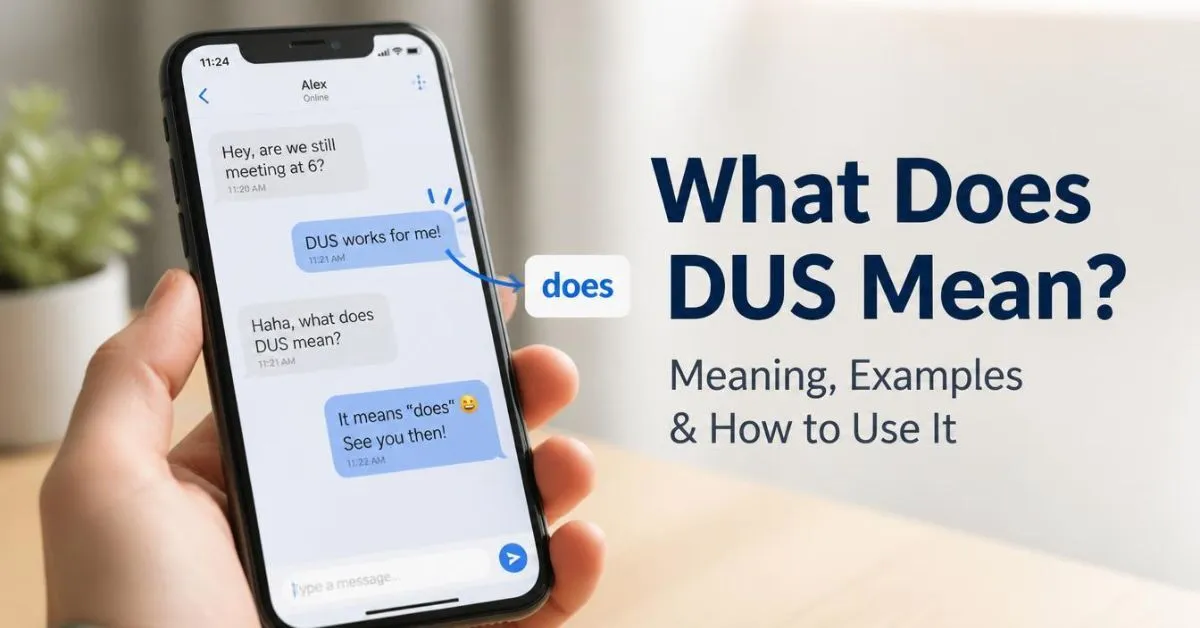
If someone sent you “dus” in a message, you may have paused and wondered whether it was a typo, an abbreviation, or some kind of slang.
Texting often leaves out letters to make messages faster, and DUS is one of those short forms you may see in casual chats.
Several abbreviation sources list DUS as a texting form of “does,” although it is not a standard abbreviation used in every conversation.
The tricky part is context. DUS can also have completely different meanings outside texting, including professional, medical, travel, and geographic uses. So, if you are trying to understand a message, the words around DUS matter more than the letters alone.
Below, I’ll explain what DUS means in texting, show simple examples, and explain how to tell which meaning fits.
⚡ Quick Answer
In texting, DUS usually means “does.” It is an informal shorthand found in online messages and casual chats. For example, “DUS he know?” can be read as “Does he know?” Because DUS is relatively uncommon, always check the surrounding words before assuming this meaning.
What DUS Means In a Text
When DUS appears in a casual text, its documented slang meaning is “does.” Sources that specifically cover texting and internet slang identify this usage. The spelling is informal rather than standard American English. In normal writing, you would use does, not DUS.
For example:
“DUS she like him?”
The intended sentence may be:
“Does she like him?”
The exact meaning still depends on the sentence. Since DUS has many unrelated meanings outside texting, you should not automatically interpret every appearance as “does.”
Where & When People Use DUS
DUS is most relevant in casual digital communication, such as informal texting or online chats. It is not a standard form you would normally expect in school papers, professional emails, resumes, or formal documents. Someone may use unusual shorthand simply because they are typing quickly or following a personal texting style. That does not necessarily give the word a special emotional meaning.
For example:
- “DUS he know?” likely asking, “Does he know?”
- “DUS it work?” potentially meaning, “Does it work?”
- “DUS she live there?” potentially meaning, “Does she live there?”
Because DUS is relatively uncommon, the surrounding sentence is important.
How to Use DUS In a Sentence
If you see DUS being used as “does,” it generally appears where the normal word does would fit grammatically.
Here are simple examples:
“DUS that mean you’re leaving?”
Meaning: “Does that mean you’re leaving?”
“DUS he know about it?”
Meaning: “Does he know about it?”
“DUS this really work?”
Meaning: “Does this really work?”
These examples show why context matters. DUS does not create a new meaning for the sentence. It simply replaces the normal word “does” with informal shorthand.
For formal or professional communication, writing does is clearer and safer.
Different Meanings of DUS by Context
DUS is not limited to texting. The abbreviation has many documented meanings across different fields. Abbreviation databases list uses connected with education, medicine, business, transportation, government, and other areas.
Here are a few examples:
| Context | Possible meaning |
| Texting/slang | Does |
| Travel/aviation | Düsseldorf Airport code |
| Medical | Duplex ultrasound or related ultrasound terminology |
| Education | Director of Undergraduate Studies |
| Business | Dollar Unit Sampling |
| Government/legal contexts | Driving Under Suspension |
These meanings are documented in abbreviation references, but they are not interchangeable.
So if you saw DUS in a text message, the sentence itself is usually the best clue. If you saw it on a flight booking, medical document, or university website, a completely different definition may apply.
Similar Abbreviations & How They Differ
DUS can be confusing because texting contains many shortened words. However, DUS is different from common abbreviations such as:
DM
Meaning: Direct message. It refers to a private message on many social platforms.
IDK
Meaning: “I don’t know.” It expresses uncertainty or lack of knowledge.
WYD
Meaning: “What are you doing?” It is usually a casual question about someone’s current activity.
WYM
Meaning: “What do you mean?” It asks someone to clarify their message.
The key difference is that DUS is generally interpreted as “does” when used in the texting sense, while the other examples represent completely different phrases. DUS is also less familiar than many mainstream texting abbreviations.
How to Reply When Someone Says DUS
If DUS means “does” in the message you received, you can simply answer the question normally.
For example:
Them: “DUS he know?”
You: “Yeah, I told him.”
Or:
Them: “DUS this work?”
You: “Yeah, it worked for me.”
If the message does not make sense, it is perfectly reasonable to ask:
“What do you mean by DUS?”
That is especially useful because DUS has multiple documented meanings outside texting.
You do not need to guess if the surrounding sentence does not make the meaning clear.
Common Mistakes With DUS
One common mistake is assuming that every DUS means “does.” That interpretation fits the texting/slang use, but DUS is also an established abbreviation in several other fields.
Another mistake is treating DUS as standard English. It is better understood as informal shorthand. If you are writing something important, use does instead.
It is also easy to confuse DUS with a typo. Sometimes that may be exactly what happened. If the sentence still sounds strange after replacing DUS with “does,” ask the sender for clarification.
🎯 Practical Takeaway
If you saw DUS in a casual text, try reading it as “does” first. Check the complete sentence before deciding, because DUS has many other meanings outside texting. When writing formally, stick with the standard word does for clarity.
FAQs:
What does DUS stand for in texting?
In texting, DUS is commonly listed as an informal shorthand for “does.” For example, “DUS he know?” can mean “Does he know?” This usage is associated with casual online communication rather than standard formal English.
Is DUS a slang word?
DUS can be described as texting or internet slang when it is used to mean “does.” However, DUS also functions as an abbreviation for unrelated terms in areas such as medicine, education, business, and transportation. The context determines which meaning applies.
Is DUS a common texting abbreviation?
DUS is documented as a texting abbreviation, but it appears to be relatively uncommon compared with widely recognized forms such as IDK or WYD. One texting reference specifically describes DUS as a rare term, so the surrounding message should always be considered.
What does DUS mean in a text from a girl?
If a girl uses DUS in a casual text, it does not have a special meaning simply because she is a girl. In the documented texting usage, it can mean “does.” The rest of her message provides the best clue to what she intended.
What does DUS mean in a text from a guy?
If a guy sends DUS in a casual message, it can likewise mean “does.” There is no separate male-specific definition supported by the texting references. Read the surrounding words to understand the intended sentence.
Can DUS mean something other than “does”?
Yes. DUS has numerous meanings outside casual texting. For example, it can refer to Düsseldorf Airport, certain medical terms, university roles, and other specialized expressions. If DUS appears outside a chat, do not assume it means “does.”
Conclusion:
DUS can be confusing because three letters can point to very different meanings. In casual texting, the documented slang meaning is “does,” so a message such as “DUS he know?” may simply be an informal way of asking, “Does he know?”
Still, context matters. DUS is also used as an abbreviation in areas such as travel, medicine, education, and business, so the texting meaning should not be applied automatically.
If you received DUS in a message, look at the words around it and mentally replace it with “does.” If the sentence makes sense, you probably have your answer.
If it still sounds unclear, simply ask the sender what they meant. A quick clarification is often better than guessing.

I am Cameron James, an author at Meaningary.com and an expert in meanings, slang, and everyday expressions. I specialize in explaining name meanings and language in a simple, clear, and reader friendly way.