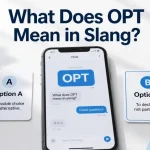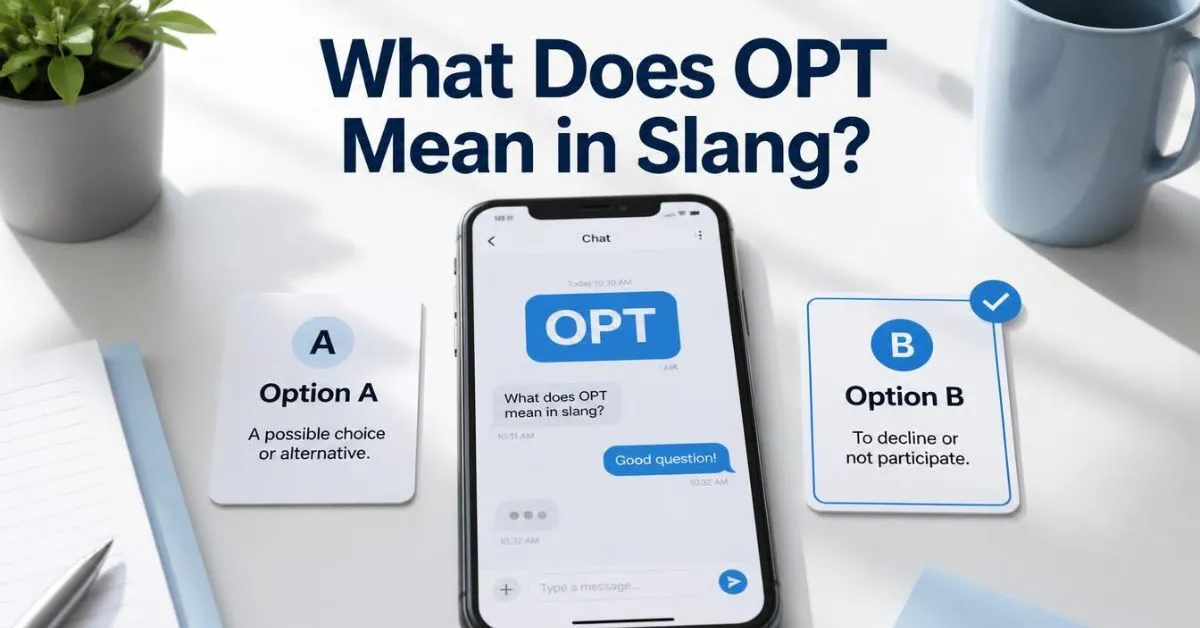
Have you ever seen someone write “I’ll opt for that” or “You can opt out” and wondered what OPT means in slang? Short words like this can be confusing because their meaning changes with the sentence.
You might see OPT in a text, a social media comment, or a conversation about making a choice. Sometimes it is a shortened form of a regular English word, and sometimes it is part of a phrase with a different meaning.
I have found that the easiest way to understand slang is to look at the words around it instead of guessing from the letters alone.
In this guide, I’ll explain what OPT means, how people use it in casual American English, and how to tell whether it means “choose,” “option,” or something else.
By the end, you’ll know how to read it naturally and use it without sounding confused.
⚡ Quick Answer
OPT usually means “choose” or “go with” in casual English. It comes from the verb “opt,” as in “I’ll opt for pizza,” meaning “I’ll choose pizza.” In texting, people may also use OPT as a short form of “option,” but the exact meaning depends on the sentence. It is not a fixed slang abbreviation.
What OPT Means In Slang
OPT is a casual way to say “choose” or “pick” when it is used as a verb. It is not a new slang word with a special hidden meaning. It is a regular English verb that people use in everyday speech, texts, and online conversations.
For example, someone might say:
“I’ll opt for the blue one.”
This means, “I’ll choose the blue one.”
You may also see OPT used as a short form of “option.” That meaning is possible in informal messages, but it is less clear without more context. The word “option” is the usual spelling when someone wants to talk about a choice.
What Does OPT Stand For?
When OPT is used as a verb, it means “choose.” It comes from the word “opt,” which means to make a choice between possibilities.
When someone writes “opt for,” they mean to choose something. When they write “opt out,” they mean to choose not to take part in something.
The difference is simple:
- Opt for = Choose something.
- Opt out = Choose not to participate.
- Option = A choice that is available.
These meanings are related, but they are not interchangeable.
Where People Use OPT In Texting
People may use OPT in texts, social media captions, group chats, and casual conversations. It often appears when someone is talking about a decision, a preference, or a choice.
Here are some situations where you might see it.
Choosing between two things
Someone might say:
“I’ll opt for the cheaper one.”
They mean they will choose the less expensive item.
Talking about plans
A friend might write:
“I think I’ll opt for staying home tonight.”
This means they prefer to stay home rather than go out.
Talking about an online choice
You might see:
“Just opt out if you don’t want the emails.”
Here, “opt out” means to choose not to receive something.
Talking about a possible choice
Someone might write:
“What’s your best opt?”
In this sentence, they may mean “What is your best option?” However, this is not standard English, and “best option” is clearer.
How to Use OPT In a Sentence
The most natural way to use OPT is with “for” or “to.”
Opt for
Use “opt for” when you choose one thing over another.
Examples:
- “I’ll opt for the chicken sandwich.”
- “She opted for a quiet evening.”
- “We decided to opt for the smaller room.”
Each sentence means someone chose something.
Opt to
Use “opt to” when you choose to do an action.
Examples:
- “I opted to walk home.”
- “He opted to stay quiet.”
- “They opted to wait until tomorrow.”
The word after “to” is an action, not a thing.
Opt out
Use “opt out” when you choose not to participate.
Examples:
- “I’m going to opt out of the group chat.”
- “You can opt out of the survey.”
- “She opted out of the event.”
This is one of the most useful forms to recognize because it appears in both casual conversations and everyday online services.
Different Meanings of OPT by Context
The meaning of OPT depends on how it appears in the sentence. Here are the main possibilities.
1. OPT means “choose”
This is the clearest meaning when OPT is used as a verb.
Example:
“I’ll opt for coffee.”
Meaning: “I’ll choose coffee.”
2. OPT means “option”
Some people use OPT as an informal shorthand for “option,” especially in quick messages or notes.
Example:
“What’s the best opt?”
Meaning: “What’s the best option?”
This use is not standard enough to assume every reader will understand it. If you mean “option,” writing the full word is usually better.
3. OPT means “opt out”
Sometimes people write OPT when they are talking about leaving something, declining an invitation, or turning off a service.
Example:
“I’ll opt out this time.”
Meaning: “I’ll choose not to participate this time.”
The word “out” makes the meaning clear.
4. OPT as a typo or personal shorthand
If someone sends only “OPT,” it may be a typo, an abbreviation, or part of a phrase that is missing. There is no single slang meaning that fits every message.
For example, a person might mean “option,” while another person means “opt out.” The surrounding words and the conversation topic matter.
OPT vs. Similar Words & Abbreviations
OPT can look similar to other short words, but each has a different meaning.
| Term | Meaning |
| OPT | Choose, or sometimes informal shorthand for option. |
| Option | A choice that is available. |
| Pick | Choose something in casual speech. |
| Choose | Decide between possibilities. |
| Opt out | Choose not to participate. |
| OP | Often means “original poster” or “overpowered,” depending on context. |
The most important difference is between OPT and OP. If someone writes “OP,” they may be talking about the person who made a post or a powerful character in a game. If they write “opt,” they may be talking about a choice.
Common Mistakes When Using OPT
Mistake 1: Treating OPT as a fixed slang abbreviation
OPT does not always mean one specific phrase. It can be a regular verb, a shorthand for “option,” or part of “opt out.”
Mistake 2: Using OPT instead of OPTION everywhere
Although some people use OPT as shorthand, “option” is the standard word. Use “option” when you want your meaning to be clear.
Mistake 3: Confusing OPT with OP
OP and OPT are different. OP often refers to the original poster online, while OPT usually relates to choosing.
Mistake 4: Assuming the sender is using slang
A person who writes “I opted for pizza” is not necessarily using slang. They may simply be using ordinary English in a casual message.
How to Reply to OPT In a Text
Your reply depends on what the person means. If they are choosing something, you can respond naturally.
If they say: “I’ll opt for pizza.”
You can reply:
“Sounds good!”
If they say: “I’m opting out tonight.”
You can reply:
“No worries, maybe next time.”
If they say: “What’s the best opt?”
You can reply:
“Do you mean the best option?”
If you are not sure what OPT means in a message, ask a short question. There is no need to guess.
🎯 Practical Takeaway
OPT usually means “choose” when it is used as a verb, and “option” is a possible informal shorthand. Look at the words around it to tell which meaning fits. If you want to use the word yourself, “opt for,” “opt to,” and “opt out” are the clearest forms.
FAQs:
What does OPT mean in texting?
OPT usually means “choose” in texting. For example, “I’ll opt for the first one” means “I’ll choose the first one.” Some people may use OPT as shorthand for “option,” but that is not a standard texting abbreviation. The sentence will tell you which meaning fits.
Is OPT a slang word?
OPT is not mainly a slang word. It is a regular English verb that means “choose.” People use it in casual conversations, texts, and online messages. It can sound informal in a chat, but it is also used in formal writing.
What does opt out mean in a text?
Opt out means choosing not to participate in something. For example, “I’m going to opt out of the party” means the person has decided not to attend. It can also refer to turning off emails, notifications, or other services.
What does OPT mean from a girl?
If a girl sends OPT in a casual text, it usually means “choose” or “option,” depending on the sentence. It does not have a special meaning based on who sends it. Look at the words around OPT and the topic of the conversation.
What does OPT mean from a guy?
If a guy uses OPT in a text, it usually has the same meaning as it does in other casual messages. It may mean “choose,” “option,” or part of “opt out.” The sender’s gender does not change the word’s meaning.
Is OPT the same as OP?
No. OPT and OP are different. OPT usually relates to choosing, while OP can mean “original poster” in online discussions or “overpowered” in gaming. If someone sends only “OPT,” the context is needed to understand it.
Conclusion:
So, what does OPT mean in slang? In most casual uses, it means “choose” or “go with.” It can also appear as shorthand for “option,” although that use is less standard.
The most common forms are “opt for,” “opt to,” and “opt out,” each with a slightly different meaning.
If you see OPT in a text, read the full sentence before deciding what the sender means. A message about choosing dinner is different from one about leaving a group or turning off emails.
Once you understand these small differences, OPT becomes easy to recognize. You do not need to memorize a long list of slang meanings.
Just remember that OPT is usually about making a choice, and the words around it will help you understand which choice the person is talking about.

I am Cameron James, an author at Meaningary.com and an expert in meanings, slang, and everyday expressions. I specialize in explaining name meanings and language in a simple, clear, and reader friendly way.