Have you ever opened a message and seen “DWBI” with no explanation? I remember how confusing short texting terms can feel when you know every letter matters, but you are not sure what the sender is trying to say. If you searched what does dwbi mean in text, you are probably trying to figure out whether the message is friendly, dismissive, or simply casual. The good news is that DWBI is usually easy to understand once you look at the conversation around it. It most often expresses reassurance or tells someone not to stress about a small issue. Still, the tone can change depending on who sent it, what happened before the message, and whether they added punctuation or an emoji. This guide explains the meaning, common uses, examples, similar abbreviations, and the best ways to respond without overthinking a short message.
⚡ Quick Answer
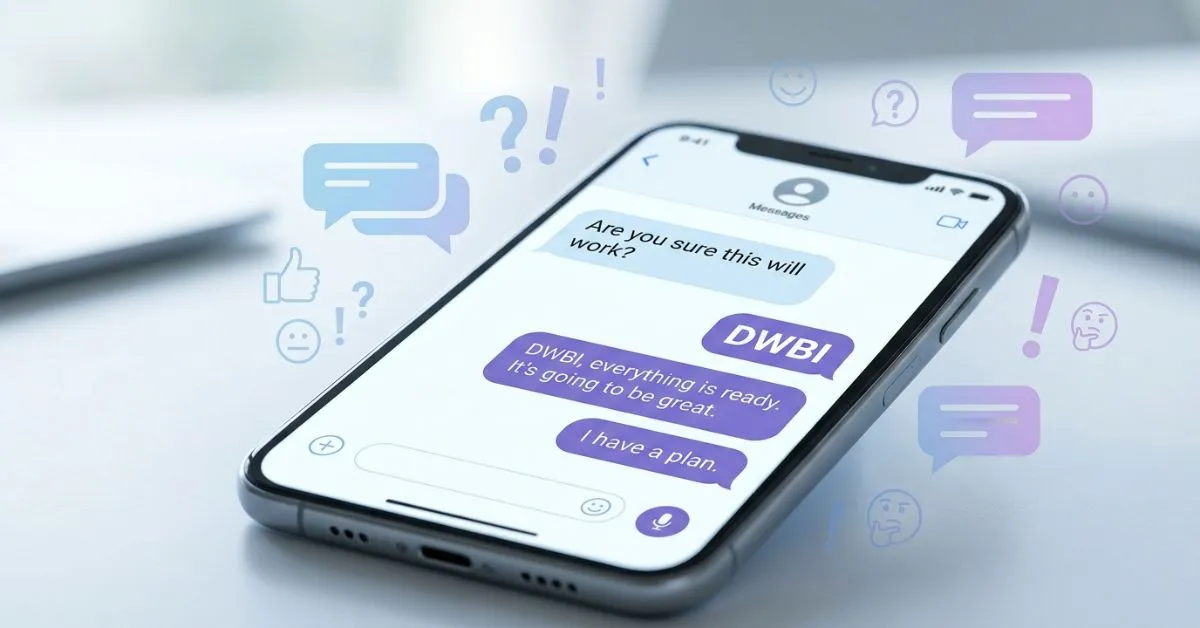
DWBI usually means “Don’t Worry About It” or the more casual “Don’t Worry ’Bout It.” In texting, people use it to reassure someone, accept a small apology, dismiss a minor concern, or say that something is not worth stressing over. Its tone can be friendly or slightly dismissive depending on context.
What Does DWBI Mean In a Text?
DWBI is a casual texting abbreviation for “Don’t Worry About It” or “Don’t Worry ’Bout It.” The second version is more informal because “bout” is a shortened form of “about.”
The basic idea is simple:
DWBI = It’s okay. Don’t stress about it.
People often send it after someone apologizes, worries about a mistake, or feels guilty about a small problem.
For example:
Person A: “Sorry I forgot to call you back.”
Person B: “DWBI, I was busy too.”
Here, the message is clearly reassuring. The sender is saying that the missed call is not a serious problem.
DWBI can also be used to brush aside a question or concern:
Person A: “Where were you last night?”
Person B: “DWBI 😂”
That version may feel more playful, secretive, or dismissive. The surrounding conversation matters.
Texting references consistently give “Don’t Worry ’Bout It” or “Don’t Worry About It” as the main interpretation.
Where & When Do People Use DWBI?
DWBI is mainly suited to casual digital conversations. It can appear in ordinary text messages, group chats, direct messages, and other informal online conversations.
You might see it when someone wants to:
- reassure a friend after a mistake
- respond to an apology
- tell someone not to feel guilty
- dismiss a small inconvenience
- move past a minor issue
- avoid making a simple situation feel more serious
- jokingly refuse to explain something
For example:
“Sorry I ate the last slice.”
“DWBI lol.”
The response suggests the sender is not upset.
Another example:
“I think I accidentally sent you the wrong file.”
“DWBI. Send the right one when you can.”
Again, DWBI reduces the pressure of the situation.
However, it is generally better suited to casual conversations than formal communication. Writing “DWBI” to a manager, customer, professor, or professional contact may sound too informal unless you already have a very relaxed communication style.
How to Use DWBI In a Sentence
DWBI works best when the conversation is already casual. It can stand alone or appear as part of a longer message.
After an apology
“Sorry I was late.”
“DWBI, you made it.”
Here, DWBI means there is no need to feel bad about the delay.
After a small mistake
“I accidentally deleted our old photo.”
“DWBI, I have another copy.”
The abbreviation helps show that the mistake is manageable.
To reassure a friend
“I hope I didn’t bother you.”
“DWBI, you’re good.”
This makes the meaning especially clear.
As part of a longer message
“DWBI about yesterday. We’re completely fine.”
This version is often warmer than sending only four letters.
In a playful conversation
“So where did you disappear to?”
“DWBI 😂”
Here, the sender may be jokingly saying, “Don’t worry about it,” rather than offering serious reassurance.
The key is that DWBI is informal shorthand. If you need to communicate something serious, sensitive, or professional, typing the full phrase can make your meaning clearer.
Different Meanings of DWBI by Context
Although the core meaning stays close to “Don’t Worry About It,” the emotional message can change.
1. Reassurance
This is one of the most straightforward uses.
“Sorry I forgot to text you.”
“DWBI ❤️”
The sender is probably trying to make the other person feel comfortable.
2. Dismissing a small problem
Sometimes DWBI means that something simply is not important enough to discuss.
“I spilled a little water on the table.”
“DWBI, I’ll clean it.”
The speaker is treating the situation as minor.
3. Ending a topic
DWBI can sometimes signal that the sender does not want to keep discussing something.
“Why did you leave early?”
“DWBI.”
This could mean “Don’t worry about it,” but it might also communicate, “I’d rather not talk about that.”
Some slang references specifically note that DWBI can function as a casual dismissal or evasive response.
4. Playful secrecy
Friends sometimes use DWBI jokingly when someone asks a question they do not want to answer.
“Who were you talking to?”
“DWBI 👀”
The emoji changes the feeling. Instead of sounding angry, the message may be teasing.
5. A slightly cold response
A one-word “DWBI.” can sound different from “DWBI 😊” or “DWBI, you’re totally fine.”
If someone is already upset, a very short response may feel dismissive even if the sender intended reassurance.
That is why you should not judge the entire meaning from the abbreviation alone.
Similar Texting Abbreviations & How They Differ
DWBI belongs to the larger group of informal shortcuts people use in digital conversations. Some alternatives are similar, but they do not always carry exactly the same tone.
NBD No Big Deal
Meaning: It tells someone that a problem is minor rather than focusing directly on their worry.
NP No Problem
Meaning: It usually responds to an apology, request, or thanks and sounds straightforward.
NVM Never Mind
Meaning: It usually signals that something should be ignored or dropped, not necessarily that someone should stop worrying.
IDC I Don’t Care
Meaning: It can sound much colder because it focuses on the speaker’s lack of concern.
YW You’re Welcome
Meaning: It responds to thanks rather than reassurance.
LOL Laughing Out Loud
Meaning: It signals amusement and does not normally mean that a concern is unimportant.
DWBI is closest to expressions such as “Don’t worry about it,” “No worries,” and “It’s fine,” but context determines which expression feels most natural.
How to Reply When Someone Says DWBI
Your best response depends on why the person used DWBI.
If they are reassuring you after a mistake, you can simply say:
“Thanks, I appreciate it.”
If they are dismissing a small issue:
“Okay, sounds good!”
If they seem annoyed or unclear:
“Just making sure we’re good.”
If the conversation is playful:
“Lol okay 😂”
If you think they are avoiding an important question, you can gently ask for clarity:
“Got it. I just wanted to make sure everything was okay.”
You do not need to overanalyze every DWBI message. A short response is often enough.
One useful rule is to look at what came immediately before DWBI. If you apologized, it probably means “You’re forgiven” or “It’s not a problem.” If you asked a sensitive question, it may mean “Don’t worry about that” or “I don’t want to discuss it.”
Common Mistakes When Using DWBI
Using it in a formal message
DWBI is casual. It may not fit an email to a client, a formal workplace conversation, or an important school communication.
Assuming it always sounds friendly
The phrase can be reassuring, but a bare “DWBI.” can sometimes feel abrupt.
Treating it as a universal answer
Context matters. Someone might use DWBI to reassure you, joke with you, or shut down a topic.
Using it when a clearer explanation is needed
If someone is genuinely confused or worried, a longer message may communicate your meaning better.
For example, instead of:
“DWBI.”
you could write:
“DWBI, seriously. You didn’t do anything wrong.”
The extra words remove much of the uncertainty.
Assuming capitalization changes the definition
DWBI, dwbi, and Dwbi generally point to the same basic expression. Capitalization usually reflects personal texting style rather than a different meaning.
🎯 Practical Takeaway
Remember that DWBI usually means “Don’t Worry About It” or “Don’t Worry ’Bout It.” Use it in casual conversations when you want to reassure someone, brush off a minor issue, or keep things relaxed. If the topic is serious or the tone could be misunderstood, write the full phrase instead.
FAQs:
What does DWBI stand for in texting?
DWBI usually stands for “Don’t Worry ’Bout It,” with “Don’t Worry About It” as the standard expanded form. It is informal shorthand used in casual messages to reassure someone, dismiss a minor concern, or signal that an issue is not worth stressing over.
Is DWBI rude?
DWBI is not automatically rude. After an apology, it can sound friendly and reassuring. However, a short “DWBI” in response to a serious question can feel dismissive or evasive. The relationship, previous messages, punctuation, and overall tone help determine how the sender intended it.
What does DWBI mean from a girl or guy?
The abbreviation itself does not have a special meaning based on whether a girl or guy sends it. It normally means “Don’t Worry About It.” What it means emotionally depends more on the conversation and relationship than the sender’s gender.
What does DWBI mean on Snapchat?
On Snapchat or another casual messaging platform, DWBI generally means “Don’t Worry About It” or “Don’t Worry ’Bout It.” Someone may use it after an apology, a minor mistake, or a question they would rather brush aside. The platform does not change the basic meaning.
What should I reply to DWBI?
A simple “Okay, thanks!” works in most casual situations. If someone is reassuring you after a mistake, you can say “I appreciate it.” If the message seems cold or unclear, you can politely ask whether everything is okay rather than guessing what they meant.
Is DWBI the same as “no worries”?
They are very similar, but not always identical in tone. Both can reassure someone that a problem is not serious. DWBI more directly comes from “Don’t Worry About It,” while “no worries” can also be used as a casual response to thanks, requests, or apologies.
Conclusion:
DWBI is a simple piece of texting shorthand, but its tone can change with the situation. Most often, it means “Don’t Worry About It” or “Don’t Worry ’Bout It,” and people use it to reassure someone, dismiss a small problem, or move past an apology. In some conversations, though, the same four letters can sound playful, secretive, or slightly dismissive.
The easiest way to understand DWBI is to read the message around it rather than treating the abbreviation as a complete answer by itself. If someone sends it after you apologize, they are likely telling you that everything is okay. If they send it after a serious question, they may be avoiding the topic.
So the next time you see DWBI, you do not need to panic or overthink it. Start with the usual meaning, then let the context tell you what the sender really meant.

I am Cameron James, an author at Meaningary.com and an expert in meanings, slang, and everyday expressions. I specialize in explaining name meanings and language in a simple, clear, and reader friendly way.