If someone suddenly texts you “OMY!”, it can be hard to tell whether they are reacting to something surprising or simply control, a short chat expression. That confusion is understandable because texting abbreviations do not always have one fixed meaning. The letters can also be interpreted differently when the surrounding message changes.
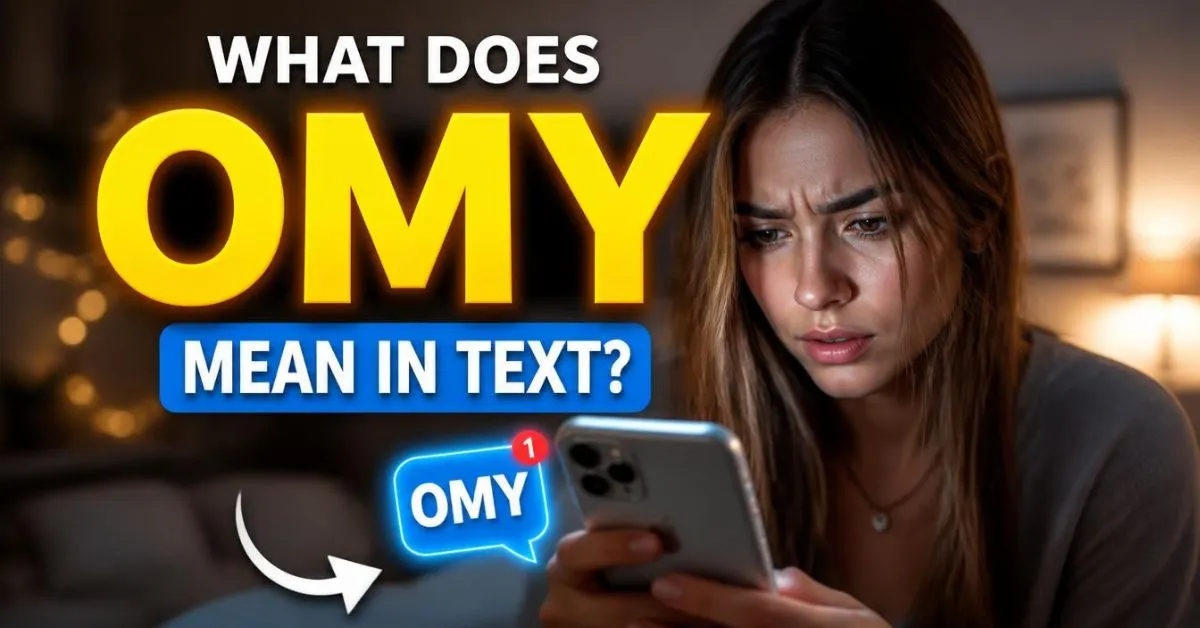
So, what does OMY mean in text? In casual texting, OMY is most commonly used as a shortened form of “Oh my!” It can show surprise, excitement, disbelief, admiration, or mild shock. Some sources also record “on my way” as a possible use, although OMW is the clearer and more established abbreviation for that phrase.
This guide explains how OMY works in real conversations, how to tell its meaning from context, how it differs from similar abbreviations, and what you can say when someone sends it to you.
⚡ Quick Answer
OMY usually means “Oh my!” in casual texts and chats. It is a short reaction used to express surprise, excitement, disbelief, admiration, or mild shock. In some contexts, OMY may mean “on my way,” but OMW is much clearer for that meaning.
📱 What OMY Means in a Text
In most casual texting situations, OMY means “Oh my!” It works as a quick emotional reaction rather than a complete sentence.
Someone may type OMY after seeing something surprising, funny, impressive, cute, unexpected, or slightly shocking. For example:
“OMY! That dress looks amazing.”
Here, OMY expresses admiration and surprise.
The tone depends heavily on what comes after it. “OMY 😳” may sound shocked or embarrassed, while “OMY 😂” can make the reaction playful. A message such as “OMY, you actually did it!” may communicate surprise mixed with excitement.
This meaning is supported by slang references that define OMY as “oh my” and describe it as an informal exclamation used in casual conversation and texting.
OMY is also less intense than some stronger reactions. A person may choose it when they want to sound surprised without making the message feel overly dramatic.
Example
Friend: “I just found out we got tickets for the concert!”
You: “OMY! Seriously?”
In this case, OMY is clearly an emotional reaction.
💬 Where & When People Use OMY
OMY fits best in informal digital conversations. You may see it in text messages, group chats, comments, or private messages.
It can work when friends are sharing news, photos, jokes, gossip, surprising events, or something impressive.
For example:
Friend: “Look at this puppy!”
You: “OMY 😍 So cute!”
Or:
Friend: “I accidentally sent the message to the wrong person.”
You: “OMY 😂 What happened?”
The abbreviation keeps the response short while still showing emotion.
OMY is generally not a good choice for formal writing. In a business email, school assignment, professional report, or serious message, writing “Oh my” or giving a complete response is usually clearer.
Another important point is that OMY is not as universally recognizable as abbreviations such as LOL, OMG, or BRB. If the context is unclear, the safest approach is to look at the words around it instead of assuming one meaning.
✍️ How to Use OMY In a Sentence
OMY normally appears at the beginning of a reaction, although informal texting has flexible punctuation and capitalization.
Here are some natural examples:
- “OMY, that was unexpected!”
- “OMY! You look so different.”
- “OMY 😳 I can’t believe that happened.”
- “OMY, that puppy is adorable.”
- “OMY 😂 You really said that?”
The meaning is usually easy to understand when the rest of the message describes the reason for the reaction.
You can also send OMY by itself:
Friend: “Guess who I saw today?”
You: “OMY 👀”
In that case, the abbreviation shows that you are surprised or interested and want to hear more.
OMY vs. a full “Oh my”
The difference is mostly style.
“Oh my!” sounds more like ordinary written English, while “OMY!” feels shorter and more like chat shorthand.
🔎 Different Meanings of OMY by Context
Although “Oh my” is the safest interpretation in casual texting, context matters because OMY can occasionally be used differently.
1. “Oh My”
This is the main texting interpretation.
It expresses reactions such as:
- surprise
- excitement
- disbelief
- admiration
- mild shock
Example:
“OMY, that impulsive was unbelievable!”
The sender is reacting emotionally to something they just saw or heard.
2. “On My Way”
Some online sources use OMY as a shortened form of “on my way.”
For example:
Person A: “Are you coming?”
Person B: “OMY.”
Here, the intended meaning could be that the person is heading toward the location.
However, this interpretation can cause confusion because OMW is the clearer and more familiar abbreviation for “on my way.” Several current explanations specifically distinguish OMY from OMW for this reason.
How to tell the difference
Look at the sentence around OMY.
If someone writes:
“OMY! That is adorable.”
They almost certainly mean “Oh my!”
If someone writes:
“OMY, be there soon.”
They may mean “On my way.”
The surrounding words usually reveal the intended meaning.
🔄 Similar Abbreviations & How They Differ
- OMW
Meaning: “On my way.” It is the clearer choice for telling someone you are traveling somewhere. - OMG
Meaning: “Oh my God.” It usually expresses a stronger reaction than OMY. - LOL
Meaning: “Laughing out loud.” It focuses on amusement rather than surprise. - WOW
Meaning: “Wow.” It is usually written as a reaction to something impressive, surprising, or remarkable. - BRB
Meaning: “Be right back.” It tells someone you are temporarily leaving the conversation. - OMY
Meaning: Usually “Oh my!” It works mainly as a short emotional reaction.
The biggest potential confusion is OMY vs. OMW. If you are telling someone that you are physically heading toward them, OMW is the more immediately understandable option.
💬 How to Reply to OMY
Your response depends on what the sender is reacting to.
If they seem surprised, you can explain what happened:
“Haha, I know! I wasn’t expecting it either.”
If they are reacting to a photo or compliment:
“Right? I love it too!”
If they seem shocked:
“I know 😳 It was wild.”
If you think OMY means “on my way,” you can respond naturally:
“Okay, see you soon!”
If the meaning is genuinely unclear, simply ask:
“Do you mean ‘oh my’ or ‘on my way’?”
That is especially useful when the message is only “OMY” with no surrounding context.
⚠️ Common Mistakes With OMY
One common mistake is assuming that every OMY means the same thing. Text abbreviations depend on context, and OMY has been documented with more than one interpretation.
Another mistake is treating OMY and OMW as interchangeable. If your intended meaning is “on my way,” OMW is generally clearer.
It is also easy to read too much emotion into the abbreviation. OMY can express surprise, but the exact feeling might be excitement, admiration, disbelief, amusement, or mild shock. The emoji, punctuation, and surrounding message help establish the tone.
Finally,Avoid assuming OMY is appropriate everywhere. It is casual chat language, so a professional or formal message usually calls for clearer standard wording.
🎯 Practical Takeaway
When you see OMY in a casual text, start with “Oh my!” as the likely meaning, especially if the message is reacting to news, a photo, or something surprising. If the conversation is about someone traveling or arriving, Consider “on my way,” but remember that OMW is clearer for that meaning. When you’re control, OMY yourself, keep it for relaxed conversations where the context makes your meaning obvious.
FAQs:
What does OMY stand for in text?
OMY most commonly stands for “Oh my!” in casual texting. It is a short emotional reaction that can show surprise, excitement, disbelief, admiration, or mild shock. Some people also use it to mean “on my way,” but that interpretation is less clear because OMW is the more recognizable abbreviation for that phrase.
What does OMY mean from a girl?
If a girl sends OMY in a casual conversation, it usually means “Oh my!” and reflects her reaction to something surprising, exciting, funny, or impressive. The abbreviation itself does not indicate a specific romantic feeling. The surrounding message, emojis, and conversation are more important for understanding her tone.
Is OMY the same as OMG?
No. OMY usually means “Oh my,” while OMG means “Oh my God.” Both can express surprise or excitement, but OMG often sounds stronger or more dramatic. OMY can feel like a lighter reaction. The exact tone still depends on the conversation and the way the sender writes it.
Can OMY mean “on my way”?
Yes, some people use OMY to mean “on my way,” especially in quick messages about meeting or traveling. However, OMW is much clearer for that meaning. If someone sends only “OMY,” check the surrounding conversation before deciding whether they are reacting to something or telling you they are heading somewhere.
Is OMY a slang word?
OMY is best understood as informal texting shorthand, rather than a standard English word. It is mainly useful in casual digital conversations. The full expression “oh my” is ordinary English, but shortening it to OMY gives the message a more informal, chat-style feel.
What is the difference between OMY and OMW?
OMY is usually interpreted as “Oh my,” while OMW commonly means “On my way.” This one-letter difference can completely change the message. If you’re telling someone you’re heading to a location, OMW is the safer and clearer abbreviation to use.
Conclusion:
So, what does OMY mean in text? In most casual conversations, it means “Oh my!” It is a quick way to react to something surprising, exciting, funny, impressive, or unexpected. The feeling can range from simple surprise to admiration or disbelief, depending on the conversation.
There is one important detail to remember: OMY can sometimes be used for “on my way.” That meaning is possible, but OMW is generally clearer when someone is talking about traveling or arriving. Context is therefore your best guide.
If you receive a message containing only “OMY,” look at what came before and after it. A reaction to a photo or surprising story likely means “Oh my,” while a message about meeting somewhere may point toward “on my way.”
Once you know that distinction, OMY is much easier to understand—and much less likely to cause a texting mix up.

I am Logan Reed, an author at Meaningary.com and an expert in meanings, slang, and everyday expressions. I specialize in explaining name meanings and language in a simple, clear, and reader friendly way.