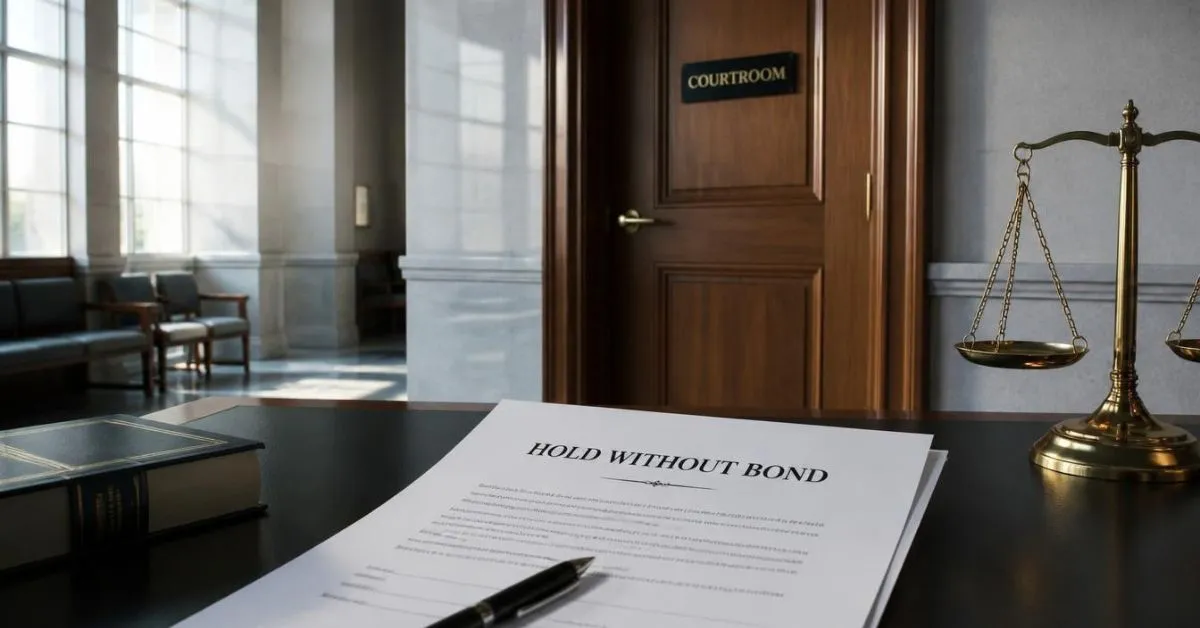
Seeing the words “hold without bond” on a jail or court record can be confusing, especially if you expected a bond amount to be listed. The phrase generally relates to a person being kept in custody without a regular option to post a listed bail or bond for release.
However, the exact reason for the hold can vary by state, court, warrant, or case. People often search this phrase after seeing it next to an arrest, warrant, probation issue, or another court matter.
Understanding the wording can help you read a court or jail record more clearly without assuming what will happen next. In this guide, we’ll explain what hold without bond means in plain American English, where you may see it, why it matters, and how it differs from an ordinary bond.
Because bail rules differ across the United States, the details of a particular case depend on the state and court involved.
⚡ Quick Answer:
“Hold without bond” generally means a person is being kept in custody and cannot simply post a listed bond to obtain release at that time. It may mean the person must remain in custody until a judge reviews the matter, or until another legal hold, warrant, or court order is resolved.
What Does “Hold Without Bond” Mean Plainly.
A hold without bond usually means that a person is being held in custody and there is no current bond amount that can simply be paid to secure release.
For example, a jail record might show a bond amount of $5,000 for one charge but say “hold without bond” for another matter. The person may not be able to leave custody by paying the $5,000 alone if the separate hold remains active.
The phrase can have different practical meanings depending on the jurisdiction. In some situations, it means a judge has ordered continued detention without bail. In others, it can indicate that a person must first appear before a judge or resolve a separate legal issue before bond is considered.
That distinction matters. “Without bond” does not automatically tell you why the person is being held or how long the hold will last.
A court record from Maryland, for example, can display “Hold Without Bond” with a $0 bond amount. Other jurisdictions use the wording in connection with warrants, probation matters, or a required appearance before a judge.
What “hold without bond” does not automatically mean
It does not necessarily mean:
- The person has been convicted.
- The person will remain in jail permanently.
- The person can never receive a bond.
- The person has already been sentenced.
- Every charge in the case has a no-bond status.
The exact meaning comes from the court order, warrant, docket, and applicable state law.
A Simple Example of This in Practice.
Imagine someone is arrested and the jail record shows two separate matters:
- Charge A: Bond set at $2,500
- Charge B: Hold without bond
The person might be able to address the $2,500 bond, but that does not necessarily result in release if Charge B or another legal hold is keeping the person in custody.
Another common situation involves a warrant connected to probation or parole. A person may be arrested on a new allegation while an existing warrant or supervision-related hold is also active. In such a situation, the hold may need to be addressed before ordinary release on the new charge is possible. A Texas legal example describes a parole-related warrant creating a hold where the person was not automatically entitled to bond on that warrant.
The important point is that the words on the jail record are only one part of the picture. The underlying warrant or court order usually explains more.
Where You’ll Encounter “Hold Without Bond”.
You may see this wording in several places, including:
- Jail or inmate records
- Criminal court dockets
- Arrest or warrant records
- Probation-related records
- Parole-related records
- Court bond documents
- Pretrial custody records
Some court systems use the phrase as a specific bond setting. For example, public court records can show “Hold Without Bond” and a bond amount of $0.00.
You may also see related wording such as “held without bond,” “no bond,” “hold until court,” or “hold without bail.” These phrases can be similar but should not automatically be treated as identical in every jurisdiction.
A particularly important detail is whether the record identifies a judge, warrant, probation violation, parole issue, another jurisdiction, or future court appearance. That information can help explain the reason for the hold.
Why It Matters Legally.
A person who is held without bond may not have the normal option of paying a bond and leaving custody.
That can affect the person’s ability to:
- Return home
- Go to work
- Care for family
- Prepare for a court case
- Contact an attorney
- Attend to ordinary responsibilities
However, being held without bond is generally a pretrial or custody status, not by itself a finding that the person is guilty. Federal law recognizes circumstances in which pretrial detention can occur, while the exact rules and procedures vary between jurisdictions. The U.S. Supreme Court addressed federal pretrial detention in United States v. Salerno.
The legal reason behind a particular hold can be very different from case to case. It might involve a warrant, a supervision issue, a court order, another jurisdiction, or a statutory restriction on release.
That is why it is risky to look at the phrase alone and assume you know what caused it.
General information, not legal advice: Bail and detention rules vary significantly by jurisdiction and case. For a specific person’s situation, a licensed attorney or public defender can review the actual court record and explain the applicable procedure.
How It’s Typically Applied.
There is no single nationwide process for every hold without bond situation.
In some circumstances, the person may need to appear before a judge before the court decides whether bond should be available. A published Colorado bond schedule, for example, contains circumstances where a defendant is held without bond until appearing before a judge or magistrate.
In another situation, a hold may be connected to a separate warrant or supervision matter. A Tennessee legal explanation notes that “no bond” can sometimes refer to a temporary situation in which a person must first have a judge address a warrant, probation violation, or other legal hold.
So, when someone sees this status, useful questions include:
- What case or warrant created the hold?
- Which court issued it?
- Is a judge’s hearing required?
- Is the hold connected to probation or parole?
- Is there another case or jurisdiction involved?
- Does local law provide a procedure for reviewing the hold?
The answers can change what happens next.
Common Misunderstandings About “Without Bond”.
“Without bond” always means permanent detention
Not necessarily. A person may remain in custody until a judge reviews the matter or until a specific legal issue is resolved.
It means the person has been found guilty
No. A custody or bond decision is not automatically a criminal conviction. Pretrial detention and guilt are separate legal questions.
Paying another bond always gets someone released
Not necessarily. A separate hold can prevent release even when another charge has an established bond amount.
Every state uses the phrase in exactly the same way
No. Bail and detention procedures are largely controlled by state and local law, with federal rules applying in federal cases.
“$0 bond” always means the person is free
No. A $0 amount can appear alongside a hold without bond status. Public court records demonstrate that these entries can represent continued custody rather than automatic release.
Related Legal Terms.
| Term | Meaning |
| Bond | A financial or court-approved arrangement connected to release from custody. |
| Bail | The process or amount used to secure release while a case is pending. |
| No bond | A status indicating that ordinary bond-based release is not currently available. |
| Hold | A legal or administrative restriction that may keep someone in custody. |
| Warrant | A court-authorized order that can direct law enforcement to arrest or detain someone. |
| Pretrial detention | Keeping an accused person in custody while the criminal case is pending. |
| Probation violation | An alleged failure to follow conditions imposed during probation. |
The precise effect of each term depends on the jurisdiction and the document where it appears.
When to Talk to an Attorney.
If “hold without bond” appears on an actual jail, warrant, or court record involving you or someone you know, the most useful next step is to identify what created the hold.
A criminal defense attorney or public defender can review the docket, warrant, bond order, and related records. This is especially important if the hold appears alongside a probation or parole matter, another pending case, or a warrant.
If the person is already in custody, the attorney may also be able to explain whether a court hearing is required and what procedures apply in that jurisdiction.
Because the rules differ by state and case, avoid assuming that information from another state applies to your situation.
This article provides general legal information, not legal advice. For advice about a specific case, speak with a licensed attorney in the relevant jurisdiction.
🎯 Practical Takeaway
“Hold without bond” generally means a person cannot simply post a listed bond to secure release at that moment. The hold may require a judge’s review or may relate to a warrant, probation, parole, another case, or another legal issue. If you see this phrase on a real court or jail record, look for the case number, warrant information, issuing court, and reason for the hold. Those details are much more useful than the phrase by itself.
FAQs:
What does “hold without bond” mean in jail?
It generally means the person is being kept in custody without a current bond amount that can simply be posted for release. Depending on the jurisdiction, the person may need to appear before a judge or resolve another legal hold first. The exact procedure depends on the court, warrant, and applicable law.
Does hold without bond mean you cannot get out of jail?
It means ordinary bond-based release is not currently available, but it does not necessarily mean release is impossible. A judge may later review the matter, change the custody status, or address the legal issue causing the hold. The specific process depends on state and local law.
Why would someone be held without bond?
Possible reasons vary by jurisdiction and case. A hold can be connected to a warrant, probation or parole matter, another pending case, or a court order requiring the person to remain in custody until a judge reviews the issue. You need the underlying record to know the actual reason.
Is “held without bond” the same as “no bail”?
The phrases are often used to describe a similar custody situation: the person cannot simply post ordinary bail for release at that time. However, court terminology varies, so the exact legal effect should be confirmed from the applicable court order or local law.
Can a judge later set a bond after someone is held without bond?
In some circumstances, yes. A hold may exist until a judge reviews the matter, and the court may then determine the appropriate release conditions under applicable law. Other situations may involve a separate legal restriction. The answer depends on the jurisdiction and reason for the hold.
Does hold without bond mean the person is guilty?
No. A person can be detained before trial without that detention itself establishing guilt. The purpose and legal standards for pretrial detention are separate from the question of whether the person is ultimately convicted.
Conclusion:
The phrase “hold without bond” usually means that a person is being kept in custody without a regular bond option that can simply be paid for release.
But the phrase alone does not tell you why the hold exists or how long it will last. The underlying warrant, court order, case history, and state law are important.
A hold may be connected to a pending court appearance, warrant, probation or parole issue, another case, or another legal restriction. It also does not, by itself, mean that the person has been convicted.
If you encounter this wording on a real court or jail record, focus on the details surrounding the hold rather than assuming what the phrase means in every situation. A licensed attorney or public defender can explain the specific rules that apply.
Understanding the wording is the first step; understanding why the hold was placed is what makes the record meaningful.

I am Owen Parker, an author at Meaningary.com and an expert in meanings, slang, and everyday expressions. I specialize in explaining name meanings and language in a simple, clear, and reader friendly way.