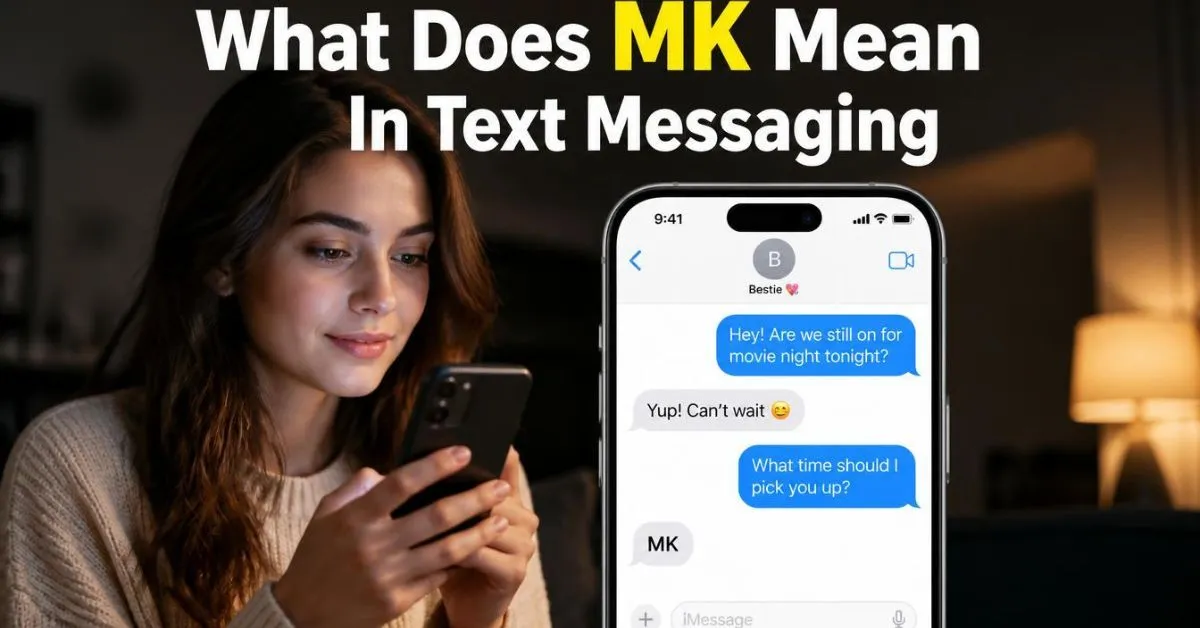
Have you ever received a short “MK” in a text and wondered whether the person simply meant “okay” or something more? Short replies can be confusing because tone is harder to read through a screen. A two-letter message may sound friendly, neutral, annoyed, or simply rushed depending on the conversation around it.
If you are searching what does mk mean in text messaging, you are probably trying to understand the sender’s exact tone and intention. In everyday texting, MK commonly works as a short form of “okay” or “OK.” It can be used to acknowledge information, agree to something, or show that the person understands.
Still, context matters. The same two letters can feel different depending on punctuation, the previous message, and your relationship with the sender. This guide explains the meaning of MK, shows natural examples, compares it with similar texting shortcuts, and explains how you can respond without overthinking it.
⚡Quick Answer
MK usually means “okay” or “OK” in text messaging. It is a brief way to acknowledge something, agree with a message, or show that the sender understands. The tone can be neutral, casual, friendly, or slightly dry depending on the conversation and how the message is written.
What Does MK Mean In a Text?
In everyday texting, MK generally means “okay.” It is a shortened, casual response that can confirm the sender has received or understood something.
For example:
“I’ll call you after work.”
A reply such as:
“MK”
can simply mean:
“Okay.”
It does not automatically carry a negative meaning. The sender may just prefer short messages or may be responding quickly.
The tone depends heavily on context. Compare these:
- “mk 😊” can feel relaxed or friendly.
- “MK!” may sound energetic or simply emphatic.
- “mk.” can feel more serious or dry because of the period.
- “mk” is often casual and neutral.
That does not mean punctuation always reveals someone’s feelings. Text messages do not provide facial expressions, voice tone, or body language, so it is better to look at the whole conversation rather than interpret two letters alone.
Is MK an abbreviation?
Yes, MK can function as a shortened texting form of “okay.” It is informal rather than something you would normally use in a formal email, school paper, business letter, or professional document.
The spelling is also sometimes connected with casual forms such as “mkay” or “m’kay,” although those forms can have a different playful or sarcastic feel depending on the speaker.
Where & When Do People Use MK?
You may see MK in casual text messages, private chats, group conversations, and other informal online communication.
Someone might use it when they want to acknowledge a message without writing a full response.
For example:
Person A: “Don’t forget we’re meeting at 6.”
Person B: “MK”
Here, the reply likely means:
“Okay, I understand.”
Another example:
Person A: “Can you send me the address?”
Person B: “MK, one sec.”
Here, MK works as a quick acknowledgment before the person takes action.
MK can be useful when:
- You agree with a simple request.
- You understand what someone said.
- You want to acknowledge information.
- You are replying quickly.
- The conversation is already casual.
Because it is so short, it may not add much emotion to the conversation. If you want to sound warmer, a longer response can make your meaning clearer.
For example, instead of:
“MK”
you could say:
“Okay, sounds good!”
That gives the other person more information about your tone.
How to Use MK in a Sentence
Using MK is simple, but it usually works best in short, informal conversations.
Example 1: Agreeing
Friend: “Let’s meet at the coffee shop at 4.”
You: “MK, see you then.”
Here, MK means that you agree with the plan.
Example 2: Acknowledging information
Friend: “Your package should arrive tomorrow.”
You: “MK, thanks.”
The response shows that you received the information.
Example 3: Responding to a request
Friend: “Please bring your charger.”
You: “MK.”
The sender can understand this as “Okay.”
Example 4: Casual planning
Friend: “I’ll text you when I get there.”
You: “MK!”
The exclamation mark can make the reply appear more upbeat, although punctuation alone does not prove the sender’s emotion.
Example 5: A longer response
Friend: “Can you wait five minutes?”
You: “MK, take your time.”
Here, the meaning is clear because the second part explains the response.
Different Meanings of MK by Context
Although MK usually means “okay” in texting, context can change how the message feels.
1. Simple agreement
Sometimes MK is just a quick “okay.”
“MK, I’ll be there at 8.”
The sender is agreeing to the plan.
2. Acknowledgment
MK can mean that someone has read and understood your message.
“The meeting moved to Friday.”
“MK.”
This does not necessarily mean excitement or strong agreement. It may simply mean “I got it.”
3. Quick or rushed reply
A person may send MK because they are busy and do not have time for a longer response.
For example:
“Can you call me later?”
“MK, busy rn.”
The second message gives you more context about why the reply is short.
4. Dry or distant tone
In some conversations, a bare “MK” may feel less warm than “Okay!” or “Sounds good.”
That does not automatically mean the person is angry. It may simply be their normal texting style.
If you are concerned about the tone, look at the messages before and after MK instead of treating the abbreviation as a hidden message.
5. Playful usage
Friends may sometimes use MK in a joking conversation.
For example:
“You’re definitely going to be late again.”
“MK 😂”
The emoji and surrounding conversation can make the response playful rather than serious.
Similar Abbreviations & How They Differ
Short texting replies can look similar but carry slightly different tones.
| Texting term | Basic meaning | Typical difference |
| OK | Okay | Standard and widely understood |
| K | Okay | Very short and can sometimes feel blunt |
| MK | Okay | Casual acknowledgment |
| Mhm | Yes / agreement | Often sounds more conversational |
| Sure | Yes / okay | Can show willingness to do something |
| Yep | Yes | Casual agreement |
| Gotcha | I understand | Shows understanding more directly |
The important point is that MK does not have a fixed emotional tone.
For example, “K” may feel shorter than “MK,” while “sounds good” usually gives more positive information. But individual texting habits differ, so these impressions should not be treated as universal rules.
How to Reply to MK
Your reply depends on what the person is acknowledging.
If they simply said “MK” after you gave them information, you may not need to respond at all.
For example:
You: “The movie starts at 7.”
Them: “MK.”
The conversation can naturally end there.
If you want to continue the conversation, you could reply:
- “Sounds good!”
- “Thanks!”
- “See you then.”
- “Perfect.”
- “Cool.”
If the conversation feels unclear, you can also ask a direct question.
For example:
Them: “MK.”
You: “Does that work for you?”
This is better than guessing what the person meant emotionally.
If MK seems cold
Suppose you send someone a longer message and they answer only:
“MK.”
It may feel a little dry. Still, that does not prove they are upset.
They could be:
- Busy
- Distracted
- In a hurry
- Naturally brief when texting
- Unsure what else to say
Look at their normal communication style before drawing conclusions.
Common Mistakes When Using MK
Assuming MK always means someone is angry
A short reply can feel cold, but MK alone does not prove anger or annoyance. The surrounding conversation matters.
Using MK in formal communication
MK is casual texting language. It is usually better to write “okay,” “understood,” or another clear phrase in professional communication.
Treating MK as having only one emotional tone
The meaning can stay the same while the tone changes. “MK” from a close friend may feel completely different from “MK” during a serious conversation.
Confusing MK with other meanings
Letters can have different meanings outside texting. If you see MK in a username, product name, location, technical context, or another specialized setting, it may not mean “okay” at all. The safest approach is to consider the context in which the letters appear.
🎯 Practical Takeaway
In casual texting, MK generally means “okay” and is usually used to acknowledge or agree with something. It is not automatically rude, angry, or dismissive. If the tone seems unclear, read the surrounding messages and consider the person’s usual texting style before assuming what they feel.
FAQs:
What does MK mean in texting?
MK usually means “okay” in casual texting. Someone may use it to acknowledge information, agree with a plan, or show that they understand what you said. The exact tone depends on the conversation, punctuation, and the sender’s usual communication style.
Is MK rude in a text?
MK is not inherently rude. However, a very short reply can sometimes feel dry, especially after a long or emotional message. Whether it sounds rude depends on context and the relationship between the people texting. A person may simply have a brief texting style.
What does MK mean from a girl?
If a girl texts “MK,” it generally means “okay” in casual conversation. It does not have a special universal meaning based on the sender’s gender. To understand the tone, consider what you said before the reply and how she normally communicates through text.
What does MK mean from a guy?
If a guy sends “MK,” it generally means “okay” or a quick acknowledgment. There is no universal special meaning attached to MK based on gender. His tone may be clearer from the rest of the conversation, his punctuation, or whether he adds another message.
What is the difference between MK and K in texting?
Both can mean “okay,” but they can create different impressions. K is extremely brief and may sometimes feel blunt, while MK can feel slightly more conversational. These are general texting patterns, not fixed rules, because people have different habits.
Does MK mean okay or something else?
In casual text messaging, MK commonly means “okay.” However, letters can have other meanings in different settings. If the message appears in a specialized conversation, username, product name, or another context, check the surrounding information before assuming it means “okay.”
Should I reply to someone who texts MK?
You do not always need to reply. If MK simply acknowledges information, the conversation can naturally end there. If you need to continue the discussion, respond to the actual topic, such as “Sounds good,” “See you then,” or a follow-up question.
Conclusion:
If you were wondering what does mk mean in text messaging, the simplest answer is that it usually means “okay.” It is a short, informal way to acknowledge a message, agree to something, or show that you understand.
The tricky part is tone. A simple “MK” can be completely neutral in one conversation and feel a little dry in another. Punctuation, emojis, the previous message, and the person’s normal texting habits can all affect how it comes across.
You also do not need to assume that a short MK means someone is upset. Texting removes many of the clues we get from voice and body language, so context is important.
For everyday casual chats, MK is easy to understand and widely useful as a quick acknowledgment. If you want to sound warmer or make your meaning clearer, a phrase like “Okay, sounds good!” gives the other person more emotional context.
Sometimes, two letters really are just two letters: MK = okay.
Files, images, and data analysis are unavailable until usage resets at 5:31 PM. Continue chatting with text only, or upgrade for more access.
Upgrade to Plus

I am Cameron James, an author at Meaningary.com and an expert in meanings, slang, and everyday expressions. I specialize in explaining name meanings and language in a simple, clear, and reader friendly way.