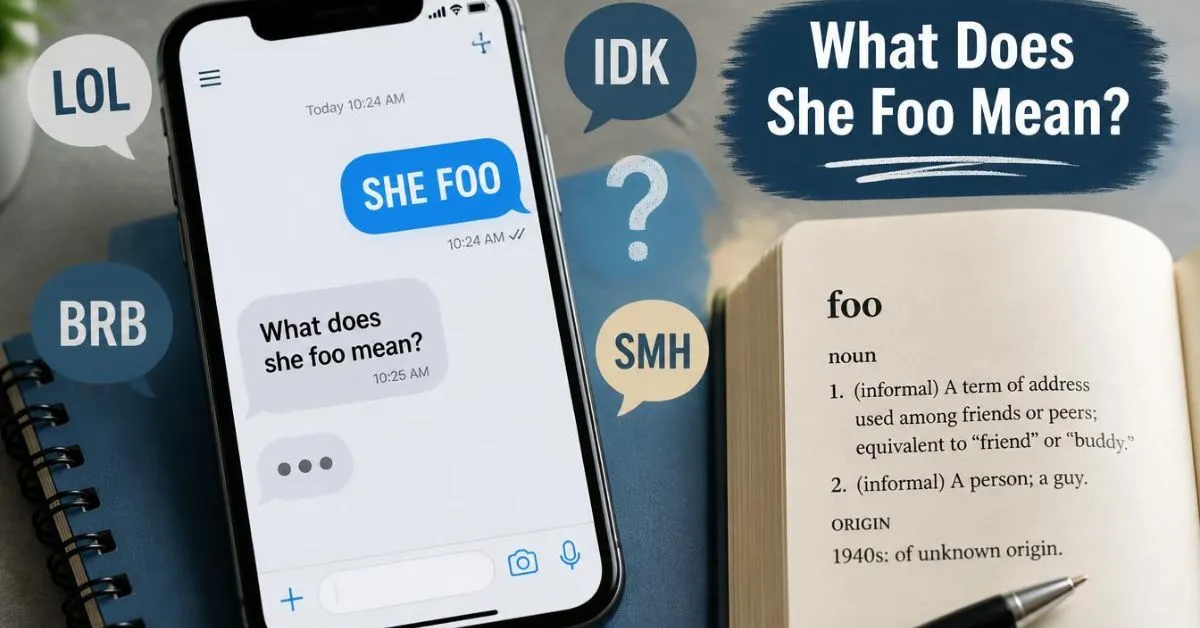
Have you seen someone write “she foo” and wondered whether it is an insult, a joke, or a phrase with a hidden meaning? The confusion makes sense because foo has more than one use in American English. It can be casual slang for a person, while in other settings it is simply a placeholder word.
There is also another phrase that sounds very similar: “shee foo.” That version has become especially confusing because of the TV series Mo, where a character uses the phrase as part of a running joke. The spelling you saw and the place where you heard it can change the answer.
This guide breaks down what does she foo mean, how “foo” works in slang, what it can mean in a text, and why “shee foo” should not automatically be treated as the same expression.
⚡ Quick Answer
“She foo” does not have one fixed dictionary meaning as a complete phrase. In casual slang, foo can refer to a person, often similar to “dude,” “guy,” or “fool,” depending on context. If you actually mean “shee foo,” especially from Mo, it has a separate pop-culture meaning.
What Does She Foo Mean?
The exact phrase “she foo” is not a standard English expression with one universal definition. The important word is foo.
In American slang, foo can be used as an informal way to refer to a person. Cambridge Dictionary describes it as U.S. slang used for a friend or someone from a neighborhood, particularly in a Latino-American cultural context.
Other slang references record foo as a pronunciation spelling of fool, showing how the word can carry a teasing or insulting meaning in some conversations.
So if someone says something like:
“She foo.”
the meaning cannot be determined from those two words alone. It may be slang based on foo, but the surrounding conversation, speaker, tone, and community matter.
For example, someone might use foo in a friendly way:
“That foo is my friend.”
Here, it may sound closer to “that guy” or “that dude.”
In another context, foo may be connected to “fool” and sound more teasing.
That is why translating foo into one English word every time can create the wrong meaning.
Where & When People Use “Foo”
Foo is informal language, so it usually belongs in relaxed conversations rather than professional writing.
You may encounter it in:
- Text messages between friends
- Casual conversations
- Social media comments
- Memes
- Hip-hop and street-influenced speech
- Online communities
- Some Latino-American slang contexts
The tone can change based on who is speaking and who is being addressed.
Cambridge notes that foo is particularly associated with young Latino men in a specific U.S. slang context, while broader online sources also document other uses.
That cultural context matters. A word that sounds friendly among people who regularly use it may sound strange or disrespectful when copied by someone unfamiliar with the speech community.
So if you hear someone say “foo,” do not assume it is automatically rude. Listen to the whole sentence and consider the relationship between the speakers.
How to Use “Foo” In a Sentence
If you already understand the speaker’s slang community, foo can work as a casual noun for a person.
For example:
“That foo is always late.”
Depending on the speaker and tone, this might mean something like:
“That guy is always late.”
Another example:
“Hey, foo, what are you doing?”
Here, it can work as a casual form of address.
However, this does not mean foo is interchangeable with “friend” in every situation. Some speakers may use it more like “guy,” while others may connect it with “fool” or use it as a playful insult.
There is also a completely different use in technology. In programming, foo is commonly used as a placeholder name for an unspecified variable, function, or object.
So the sentence around the word is essential.
Different Meanings by Context
The meaning of foo can shift considerably depending on where you see it.
1. Casual slang
In casual U.S. slang, foo can refer to a person. It may be similar to “dude,” “guy,” or “man,” depending on the speaker.
2. Playful insult
Because foo can also be used as a pronunciation spelling of fool, it may describe someone as foolish or gullible in certain contexts.
3. Programming
In computer science, foo is a placeholder name. For example, a programming tutorial may use foo for a variable when the actual name does not matter. This meaning has nothing to do with the slang use.
4. “Shee foo” from Mo
This is where many people get confused.
The phrase “shee foo” appears in Mo, and available script material shows Hameed using it repeatedly. A script for the pilot specifically explains the joke behind his pronunciation and meaning.
That pop-culture phrase should not automatically be treated as ordinary American slang.
What Does “Shee Foo” Mean?
If your search for “what does she foo mean” actually comes from hearing “shee foo,” the answer is different.
In the Netflix series Mo, “shee foo” is a recurring phrase associated with the character Hameed. The pilot script explains that Hameed thinks a phrase that sounds like “shee foo” means “yes.”
Later episode transcripts show Hameed continuing to say “shee foo” in different situations, often as a playful response or catchphrase.
This is important because some websites describe “shee foo” as a normal Arabic phrase. The available Mo script evidence supports a different explanation for the show’s joke: it is based on Hameed’s misunderstanding of an English phrase, rather than a straightforward Arabic translation.
At the same time, do not confuse “shee foo” with the real Levantine Arabic expression shu fi?
Shu fi? is a genuine colloquial expression used in Levantine Arabic. Depending on context, it can mean “what’s going on?”, “what happened?”, or “what’s wrong?”
The similar sound is one reason people can become confused.
A simple distinction
| Phrase | General meaning/context |
| foo | Informal slang for a person, or “fool” in some contexts |
| she foo | Not a fixed standard English phrase; meaning depends on context |
| shee foo | Pop-culture phrase strongly associated with Hameed in Mo |
| shu fi? | Levantine Arabic expression meaning roughly “what’s going on?” |
The spelling matters more than it may seem.
Similar Slang Words & How They Differ
If someone uses foo as casual slang, several English words may sound similar in meaning, but they are not exact replacements.
Dude
Meaning: A very common casual word for a person, especially a man or friend.
Bro
Meaning: Casual address for a male friend or someone treated like a friend.
Guy
Meaning: A neutral informal word for a male person.
Fool
Meaning: A person who is acting foolishly; unlike “foo,” it is a standard English word.
Homie
Meaning: An informal word for a close friend, often carrying a stronger friendship sense than “foo.”
The key difference is tone. Foo is strongly dependent on the speaker’s slang style and cultural context, so replacing it with “bro” or “dude” may change the feel of the sentence.
How to Reply to “She Foo”
If someone sends you “she foo” in a text, do not assume it has one hidden meaning.
First, look at the rest of the message.
If they are using foo casually to refer to someone, you can simply respond to the actual topic.
For example:
Person: “That foo really did that?”
Reply: “Yeah, I couldn’t believe it either.”
If the message is unclear, asking a simple question is often better:
“What do you mean by foo here?”
If the person is referencing Mo and says “shee foo,” you can treat it as a playful reference to the show rather than assuming they are using a serious Arabic expression.
The safest approach is to match the context instead of guessing.
Common Mistakes With “She Foo”
Mistake 1: Assuming “foo” always means “fool”
It can be connected to “fool” in some slang usage, but that is not the only meaning.
Mistake 2: Assuming “foo” always means “friend”
In some U.S. slang contexts it can refer to a friend or person, but the exact social meaning depends on the speaker.
Mistake 3: Treating “she foo” as a standard phrase
There is no single widely accepted dictionary definition for the complete phrase “she foo.” Context is needed.
Mistake 4: Confusing “shee foo” with “shu fi”
These sound somewhat similar when heard quickly, but they refer to different things. Shu fi? is a real Levantine Arabic expression used to ask what is happening or what is wrong.
Mistake 5: Using slang without understanding its cultural setting
A word can sound harmless in one group and awkward in another. If you are unfamiliar with the community using it, listening first is usually the better choice.
🎯 Practical Takeaway
If you saw “she foo,” do not assume it has one fixed meaning. Foo can be casual slang for a person, can carry a “fool” sense in some usage, and can also be a programming placeholder. If you actually meant “shee foo” from Mo, that is a different pop-culture expression tied to Hameed’s character. And if you heard “shu fi,” that is a real Levantine Arabic expression meaning roughly “what’s going on?” or “what’s wrong?”
FAQs:
What does “foo” mean in slang?
In U.S. slang, foo can refer informally to a person, friend, or guy, depending on the speaker and context. Some slang usage also connects it with “fool.” Cambridge documents a U.S. slang use associated with a friend or someone from the speaker’s neighborhood.
Is “foo” a bad word?
Not automatically. Foo can be casual slang and may sound friendly, teasing, or disrespectful depending on how it is used. It is also a standard placeholder term in programming, where it has no insulting meaning at all. Context determines which sense applies.
What does “she foo” mean from a girl?
If a girl writes “she foo,” the phrase still does not have one special meaning simply because she is a girl. The meaning depends on what she is referring to, her slang style, and the surrounding conversation. The word “foo” itself does not automatically create a romantic or flirty meaning.
What does “shee foo” mean in Mo?
In Mo, “shee foo” is Hameed’s recurring phrase. Script material explains that he believes the phrase means “yes,” creating a running joke around his misunderstanding of English. Later episodes continue the phrase as part of his speech.
Is “shee foo” Arabic?
Be careful with this one. “Shee foo” as used in Mo is not best understood as a straightforward Arabic translation. The show’s script explains the phrase through Hameed’s misunderstanding of English. A similar-sounding expression, shu fi?, is genuine Levantine Arabic and means roughly “what’s going on?” or “what’s wrong?”
What does “shu fi” mean?
Shu fi? is a colloquial Levantine Arabic question. Depending on the situation, it can mean “What’s going on?” “What happened?” or “What’s wrong?” It can express simple curiosity, concern, or surprise.
Can “foo” mean fool?
Yes, in some slang usage foo is used as a pronunciation spelling of fool. That meaning is different from the U.S. slang use where foo refers casually to a person or friend. The surrounding sentence and speaker’s community help identify which meaning is intended.
Conclusion:
The phrase “she foo” can be confusing because foo has several meanings across different settings. In casual U.S.
slang, it can refer to a person or friend, while some slang usage connects it with “fool.” In technology, foo is simply a placeholder name, so the word itself does not always carry a social meaning.
If you actually heard “shee foo,” especially while watching Mo, the context changes. The show’s script presents it as Hameed’s mistaken phrase meaning “yes,” rather than a normal Arabic translation.
And if what you heard was “shu fi,” that is a different phrase from Levantine Arabic meaning something like “what’s going on?” or “what’s wrong?”
So the best way to understand she foo is simple: check the spelling, look at the surrounding words, and consider where you heard it. A tiny difference in sound can point to a completely different meaning.

I am Alex Carter, an author at Meaningary.com and an expert in meanings, slang, and everyday expressions. I specialize in explaining name meanings and language in a simple, clear, and reader friendly way.