If you have ever watched a guitar video, adjusted an amplifier, or talked with someone about metal and rock guitar tones, you may have heard the phrase “scoop the mids.”
At first, it can sound like an odd expression. You might wonder what exactly is being scooped and why anyone would want to remove part of a guitar’s sound.
The phrase is actually about equalization, or EQ. It describes lowering the midrange frequencies of a guitar, bass, or other audio signal.
Many amplifiers have separate controls for bass, mids, and treble, making it easy to shape the sound this way.
People often search for this phrase because they hear it while learning guitar, trying to copy a certain tone, or experimenting with an amplifier or EQ pedal. Understanding it can make amp settings much easier to follow.
Below, we will explain what the mids are, what happens when you scoop them, why musicians use the technique, and when it may not work well.
❤️Quick Answer
“Scoop the mids” means lowering the midrange frequencies in an audio signal, usually with an amplifier or EQ. This can make bass and treble feel more prominent and create a wider, sharper, or more aggressive tone. It is especially associated with some rock and metal guitar sounds.
❤️What Does “Scoop the Mids” Mean?
Scooping the mids means reducing the midrange frequencies of a sound.
To understand the phrase, it helps to break it into two parts.
Mids is short for midrange frequencies. In a simple three-band EQ, sound is often divided into:
- Bass : lower frequencies
- Mids : middle frequencies
- Treble : higher frequencies
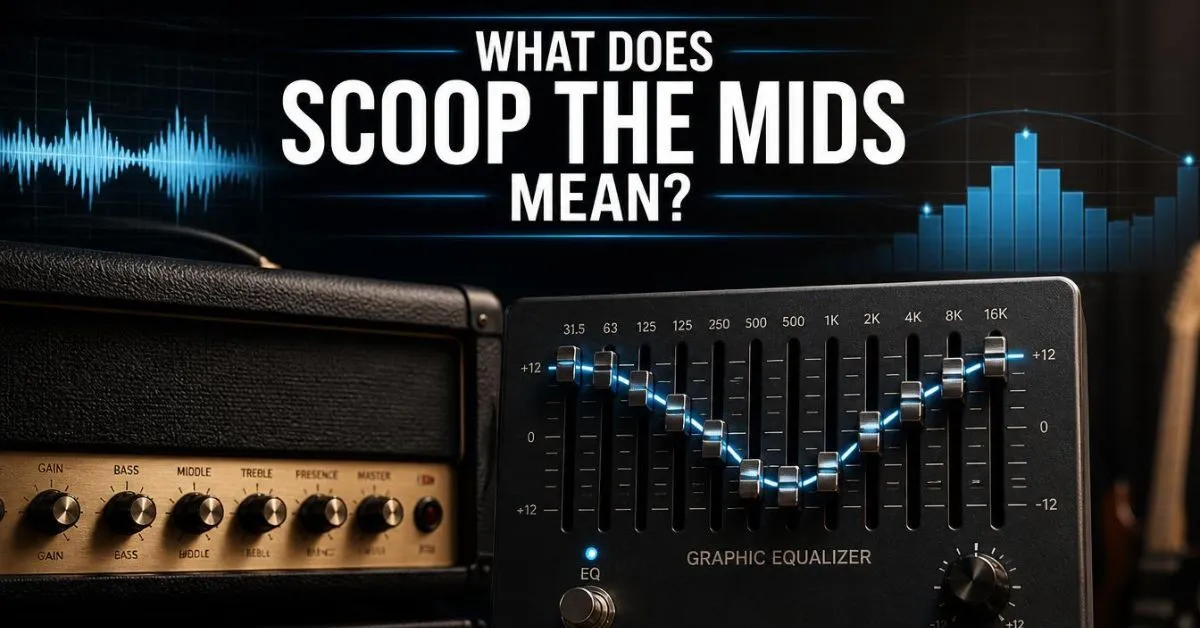
An amplifier may have separate knobs labeled Bass, Middle, and Treble. If you turn the middle control down significantly, you are reducing part of the midrange.
That is what musicians mean when they say “scoop the mids.”
The word “scoop” comes from the way the EQ curve can look. If the bass and treble remain higher while the middle frequencies are lower, the graphic can resemble a V shape or a smile. The middle appears to have been “scooped out.”
It does not mean physically removing sound from a recording. It is simply an EQ adjustment.
The exact frequencies affected depend on the amplifier, pedal, equalizer, speakers, and settings being used. There is no single universal frequency range that every amp calls “the mids.”
🎉Where You’ll Commonly Hear This Phrase
You will most often hear “scoop the mids” in conversations about music production, guitar equipment, bass, amplifiers, pedals, and EQ settings.
Guitarists may use the phrase when discussing a particular tone they want to create. It often comes up in conversations about heavier guitar sounds, especially metal and hard rock.
For example, a guitarist might say:
“Try scooping the mids for a heavier rhythm tone.”
That does not mean the guitarist wants to remove all middle frequencies. It usually means reducing them enough to change the balance of the sound.
You may also see the phrase in:
- Guitar amplifier tutorials
- EQ pedal discussions
- Recording guides
- Guitar forums
- Bass tone discussions
- Metal and rock gear conversations
- Music-production videos
The phrase can apply beyond electric guitar, too. Midrange EQ changes can affect bass and full mixes as well.
👍What Does a Scooped Tone Sound Like?
A scooped tone generally has less midrange presence, which allows the low and high parts of the sound to stand out more.
Many listeners describe a heavily scooped guitar tone as:
- Big
- Bright
- Aggressive
- Sharp
- Spacious
- Powerful when played alone
The exact result depends heavily on the equipment and how much the mids are reduced.
For example, imagine an amplifier with bass, mids, and treble controls. If the bass and treble are turned up while the mids are turned down, the sound may feel more dramatic and separated.
A graphic EQ can make this especially easy to see. The settings may form something resembling a V, with the middle sliders lower than the outer sliders.
However, a tone that sounds exciting when you play alone may behave differently when other instruments are added.
Midrange frequencies can help guitars remain noticeable in a full band. If too much midrange is removed, the guitar can lose some of its presence and become harder to hear clearly in the overall mix.
So, “scooped” does not automatically mean “better.” It simply describes a particular tonal shape.
😎Why Do Guitarists Scoop the Mids?
There is no single reason every guitarist uses this technique.
One reason is tone preference. Some players simply like the sound created by reducing the middle frequencies.
Another reason is genre. Scooped sounds have been associated with certain heavy guitar tones, particularly in metal and hard rock.
A guitarist may also want to create more space for other instruments. For example, reducing some frequencies can change how the guitar sits beside vocals, bass, drums, or another guitar.
But there is an important trade-off.
The midrange contains a large part of the character and presence of many guitar sounds. Reducing it too much can make the guitar feel distant, hollow, or less defined in a full arrangement.
This is why experienced players often adjust EQ according to the entire mix rather than judging a guitar tone only when playing alone.
A setting that sounds huge through headphones or in a bedroom may not have the same effect when played with a complete band.
⭐️How Do You Scoop the Mids?
The simplest way is to use the mid control on an amplifier or EQ.
For an amplifier with separate bass, middle, and treble knobs, lowering the middle control reduces the midrange portion of the tone.
You can also use an EQ pedal or graphic equalizer. With a graphic EQ, you reduce selected middle-frequency sliders instead of using one general mid knob.
A simple example might look like this:
Bass: higher
Mids: lower
Treble: higher
On a graphic EQ, that can create a rough V-shaped curve.
However, there is no universal setting that works for every guitar, amplifier, speaker cabinet, room, or recording. Different equipment responds differently, and even the same setting can sound different at different volumes.
It is usually better to make small changes while listening rather than automatically turning the mids all the way down.
If your goal is a specific song or genre, listen to the complete tone and adjust from there.
👀What Happens If You Scoop Too Much?
Scoop the mids too aggressively, and the sound can lose some of its body and definition.
You may notice that the guitar sounds impressive by itself but becomes less noticeable once drums, bass, vocals, and other guitars enter the mix.
This happens because midrange frequencies can play an important role in helping instruments maintain presence and character. Reducing too much of that range can leave the guitar sounding thin, distant, or hollow depending on the rest of the EQ.
For example, imagine recording a heavy rhythm guitar part. Alone, an extremely scooped setting might sound huge. But once the bass and drums are added, the guitar may no longer have enough midrange information to remain clearly defined.
That does not make scooping the mids “wrong.” It means the setting needs to fit the complete arrangement.
Some players prefer a small mid cut rather than a dramatic one. Others may boost certain mids while cutting different parts of the midrange.
The best setting depends on the sound you want and the role of the instrument.
😎Scooped Mids vs. Boosted Mids
These two approaches create very different EQ shapes.
Scooped mids means reducing some middle frequencies.
Boosted mids means increasing some middle frequencies.
A scooped setting can make the lows and highs feel more noticeable by comparison. A boosted-mid setting can make the instrument feel more forward, focused, or prominent.
Neither approach is automatically correct.
For example, a rhythm guitar might use some mid reduction to create a particular texture, while another guitar or lead part may use stronger mids to remain prominent.
The important point is that EQ is about balance.
A guitarist should not assume that every heavy guitar sound needs the mids removed. Modern guitar tones can use many different combinations of bass, mids, treble, gain, speakers, pickups, and effects.
Even within the same genre, players can use very different EQ choices.
👍Common Misunderstandings About Scooped Mids
“Scooping the mids means removing all mids.”
Not necessarily. The phrase usually means reducing the midrange, not completely eliminating every middle frequency.
“Scooped mids always sound better.”
No. EQ is a creative choice. A setting that sounds great alone may not work as well in a full mix.
“You have to turn the mids all the way down.”
You do not. A slight reduction can also create a scooped character. The amount depends on the sound you want.
“Scooped mids are only for guitars.”
No. The concept can also apply to bass and other audio signals. Bass players, producers, and audio engineers can make midrange cuts for different tonal purposes.
“Mids always mean one exact group of frequencies.”
Not exactly. The specific frequencies affected by a “mid” control vary between equipment and EQ designs.
“A V-shaped EQ always means the same sound.”
Not necessarily. The exact position and depth of the cuts and boosts matter, as do the instrument, speakers, amplifier, room, and other processing.
🎯 Practical Takeaway
If you hear someone say “scoop the mids,” think “turn down some of the midrange frequencies.” It is an EQ technique used to shape tone, often creating a sound where the bass and treble feel more prominent. If you are experimenting with an amp or EQ, start with a modest mid cut and listen to the result both by itself and with the full mix. The goal is not simply to remove mids, but to create a tone that works for the music you are playing.
❤️FAQs:
What does “scoop the mids” mean in guitar?
In guitar terminology, “scoop the mids” means lowering the midrange portion of the guitar’s EQ. Players can do this with an amplifier’s mid control, an EQ pedal, or a graphic equalizer. The result can emphasize the perceived bass and treble and create a particular aggressive or spacious guitar tone.
What does scooped mids sound like?
Scooped mids can sound bigger, brighter, sharper, or more aggressive, especially when the bass and treble are also emphasized. The exact result depends on the equipment and settings. Too much midrange reduction can make a guitar sound hollow or less present when other instruments are playing.
Why do metal guitarists scoop the mids?
Some metal guitarists use a scooped EQ because it can create a particular heavy and aggressive tone. The technique has become associated with certain styles of heavy guitar. However, not every metal guitarist uses heavily scooped mids, and the best EQ depends on the song, arrangement, equipment, and desired sound.
Does scooping mids make a guitar sound better?
Not automatically. It changes the guitar’s tonal balance, but “better” depends on the musical situation. A tone that sounds powerful when playing alone may become difficult to hear in a full band if too much midrange is removed.
Should I turn my mids all the way down?
Not necessarily. Turning the mids all the way down creates a very strong mid cut and may make the guitar lose some body or presence. A smaller reduction can often be more useful. Experiment gradually and judge the sound with the rest of the instruments.
Is scooping mids the same as a V-shaped EQ?
They are closely related. A V-shaped EQ generally has stronger low and high frequencies with reduced middle frequencies. This visual shape is one reason musicians use the word “scoop” to describe the midrange cut.
Can you scoop mids with an EQ pedal?
Yes. A graphic EQ pedal can reduce selected midrange frequencies. An amplifier with a dedicated mid control can also create a mid-scooped sound. The exact adjustment depends on the equipment and the tone you want.
Conclusion:
So, what does scoop the mids mean? It means reducing the midrange frequencies of an audio signal, usually to change the tonal balance of a guitar, bass, or other instrument.
When bass and treble remain stronger, the resulting EQ can create the familiar V shaped or “scooped” sound. The technique is often discussed in guitar and heavy music because it can produce a bold, aggressive character.
Still, more extreme settings can reduce the instrument’s presence and make it harder to hear clearly in a full mix.
The main idea is simple: scooping is an EQ choice, not a rule. Try small adjustments, listen to the complete mix, and let the music guide the setting.
Once you understand what the mids do, the phrase “scoop the mids” becomes much less mysterious and much more useful when shaping your own sound.

I am Lucas Bennett, an author at Meaningary.com and an expert in meanings, slang, and everyday expressions. I specialize in explaining name meanings and language in a simple, clear, and reader friendly way.