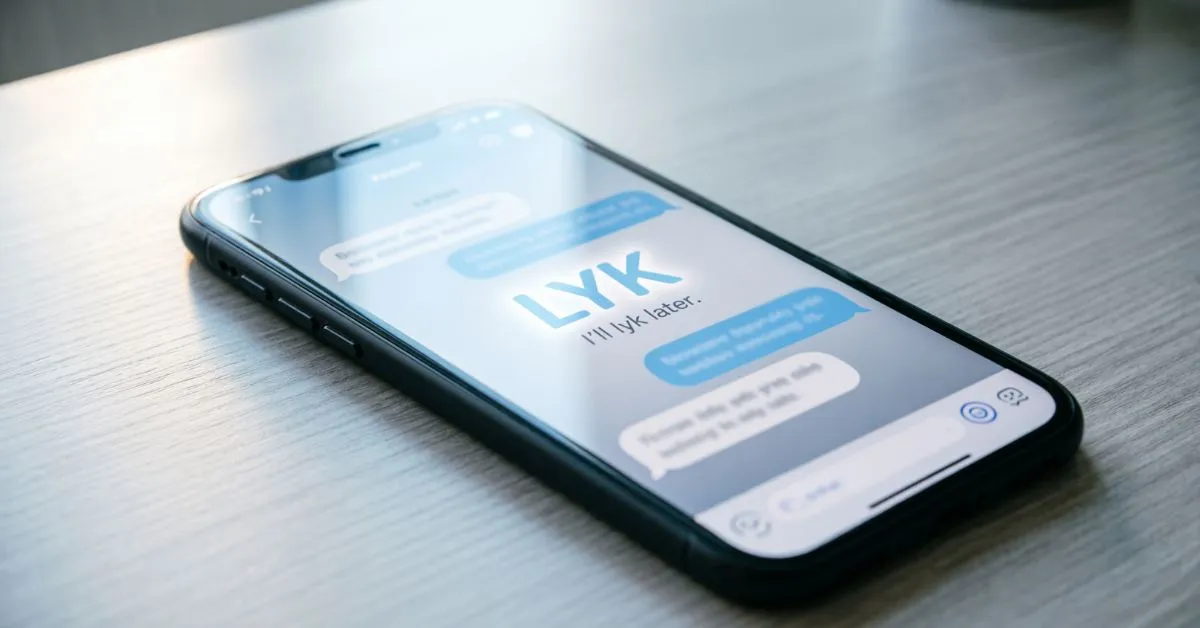
Have you ever received a message ending with “LYK” and wondered what the person was trying to say? Texting shortcuts can make a simple message feel confusing, especially when an abbreviation has more than one possible meaning. If you searched what does lyk mean in text, you are probably looking for a quick answer before deciding how to respond.
In everyday texting, LYK usually means “let you know.” People use it as a short way to say they will give you information later, update you about something, or tell you their decision once they know it. The meaning is usually easy to understand from the rest of the conversation.
This guide explains how LYK works in texts, where you may see it, how to use it naturally, and what similar abbreviations mean. A few examples will also show how the tone can change depending on the situation.
⚡ Quick Answer
LYK usually means “let you know” in texting and online chats. Someone might write “I’ll lyk tomorrow” to mean “I’ll let you know tomorrow.” It is casual, convenient, and commonly used when a person does not have an answer yet but plans to provide an update later.
What It Means in a Text
LYK means “let you know.”
It is mainly used when someone wants to tell you that they will provide an answer, update, or decision later. Instead of writing the full phrase, they shorten it to three letters.
For example:
“I’ll lyk when I get home.”
This means:
“I’ll let you know when I get home.”
Another example is:
“I’ll lyk if I can come.”
The person has not decided yet. They are saying they will tell you once they know whether they can attend.
LYK is casual, so it fits best in texts, DMs, group chats, and informal online conversations. In a formal email or professional document, writing “let you know” is usually clearer.
Common examples
- “I’ll lyk later.” I’ll let you know later.
- “Lyk when you’re free.” Let me know when you’re free.
- “I’ll lyk tomorrow.” I’ll let you know tomorrow.
- “Lyk what you decide.” Let me know what you decide.
- “I’ll lyk if anything changes.” I’ll let you know if anything changes.
The exact wording around LYK can vary, but the basic idea stays the same: someone will provide information or an update.
Where & When People Use It
You may see LYK in casual conversations where people are making plans or waiting for information.
It can appear in:
- Text messages
- Instagram DMs
- Snapchat conversations
- Group chats
- Online messages
- Casual gaming chats
- Other informal conversations
For instance, imagine two friends planning dinner:
Alex: “Are you coming tonight?”
Sam: “Not sure yet. I’ll lyk by 6.”
Sam means, “I’ll let you know by 6.”
LYK is also useful when someone needs time before giving an answer.
“I need to ask my parents first. I’ll lyk.”
Here, the sender is not ignoring the question. They simply do not have the information yet.
The abbreviation can also be used as a request:
“Lyk when you arrive.”
That means “Let me know when you arrive.”
So, the surrounding words matter. LYK can describe either promising to give an update or asking someone to provide one.
How to Use It in a Sentence
Using LYK is simple. In most casual messages, you can place it where “let you know” would naturally appear.
Example : Giving an update
“I’ll lyk when I find out.”
Meaning: You will give the other person an update after receiving the information.
Example : Making plans
“I’ll lyk if I can make it.”
Meaning: You will tell the person later whether you can attend.
Example : Asking for information
“Lyk what time you’re leaving.”
Meaning: Tell me what time you are leaving.
Example : Keeping someone updated
“I’ll lyk if anything changes.”
Meaning: You will tell them if new information comes up.
Example : Short and casual
“I’ll lyk.”
Meaning: I will let you know.
One important point is that texting abbreviations are informal. If you are writing to a teacher, employer, customer, or someone in a formal setting, the full phrase is usually the better choice.
Different Meanings by Context
Although “let you know” is the usual texting meaning of LYK, the way it functions can change slightly depending on the sentence.
1. “I’ll lyk” I’ll let you know
This is probably the clearest use.
“I’m not sure yet. I’ll lyk.”
The sender plans to provide an answer later.
2. “Lyk” as a request let me know
Sometimes LYK is used without “I’ll.”
“Lyk when you get there.”
Here, it means “Let me know when you get there.”
3. “I’ll lyk tomorrow” future update
The sender is giving you a time for an expected update.
“I’ll lyk tomorrow after I talk to him.”
This suggests the person needs more information before answering.
4. “Lyk ASAP” let me know soon
In a casual message, someone might combine LYK with another abbreviation.
“Lyk ASAP if you’re coming.”
The sender wants an answer as soon as possible.
5. A different meaning outside texting
Abbreviations can have different meanings in other fields or communities. However, if you see LYK in an ordinary personal text, “let you know” is the natural interpretation.
If the message seems confusing, look at the words before and after LYK rather than assuming every use has exactly the same grammatical role.
Similar Abbreviations and How They Differ
Several texting shortcuts are related to LYK, but they do not mean exactly the same thing.
| Abbreviation | Meaning | How it differs |
| LMK | Let me know | Usually asks the other person to provide information. |
| FYI | For your information | Shares information rather than requesting an update. |
| IDK | I don’t know | Says the sender does not currently have the answer. |
| BTW | By the way | Introduces an additional or side point. |
| IKR | I know, right? | Shows agreement or shared reaction. |
| WYD | What are you doing? | Asks about someone’s current activity. |
The closest comparison is LMK.
LMK: “Let me know when you get home.”
LYK: “I’ll let you know when I get home.”
The difference is small but important. LMK usually asks the other person for an update, while LYK often tells them that the sender will provide one.
How to Reply to LYK
Your reply depends on what the sender is saying.
If someone writes:
“I’ll lyk tonight.”
You can simply respond:
- “Okay!”
- “Sounds good.”
- “Sure, let me know.”
- “No problem.”
- “Alright, thanks.”
If someone writes:
“Lyk when you get home.”
You could answer:
- “Will do.”
- “Sure!”
- “I will.”
- “Okay, I’ll let you know.”
You do not need a special response just because someone uses an abbreviation. Treat LYK as the shortened form of an ordinary phrase.
If you are unsure whether the sender means “let you know” or something else, you can ask:
“Do you mean let you know?”
That is especially useful if the surrounding message does not make the meaning clear.
Common Mistakes
Mistake 1: Thinking LYK is a completely different slang word
LYK is generally a shortened texting phrase rather than a special slang term with a complicated meaning.
Mistake 2: Confusing LYK with LMK
These are easy to mix up because both involve “let me know.”
Remember:
LYK: I’ll let you know.
LMK: Let me know.
Mistake 3: Using it in formal writing
LYK works naturally in casual messages, but it may look too informal in a business email, school assignment, application, or official communication.
Mistake 4: Assuming every abbreviation has one meaning everywhere
Context always matters with short forms. If LYK appears in a specialized setting rather than a normal conversation, check the surrounding information before deciding what it means.
Mistake 5: Reading too much emotion into it
LYK itself does not automatically sound rude, cold, excited, or romantic. The tone usually comes from the complete message and the relationship between the people talking.
🎯 Practical Takeaway
If someone uses LYK in a normal text, read it as “let you know” unless the surrounding context suggests otherwise. Pay attention to whether the sender is promising to update you or asking you to provide an update. For formal communication, use the full phrase instead of the abbreviation.
FAQs:
What does LYK mean in texting?
LYK usually means “let you know” in texting and online chats. It is a casual abbreviation used when someone plans to give you an update later. For example, “I’ll lyk tonight” means “I’ll let you know tonight.”
What does LYK mean from a girl?
If a girl texts LYK, it usually means “let you know.” The abbreviation itself does not indicate flirting, romantic interest, or a specific emotion. Its tone depends on the full message, the situation, and how you normally communicate with each other.
What does LYK mean from a guy?
If a guy uses LYK in a text, he usually means “let you know.” For example, “I’ll lyk when I’m free” means he will give you an update when he knows. The abbreviation alone does not reveal his feelings or intentions.
What is the difference between LYK and LMK?
LYK usually means “let you know,” while LMK means “let me know.” For example, “I’ll lyk
tomorrow” means “I’ll let you know tomorrow,” while “LMK tomorrow” asks the other person to provide information.
Is LYK rude or disrespectful in texting?
No. LYK is normally a casual and neutral texting abbreviation. It is not rude by itself. However, the overall tone can change depending on the words around it, punctuation, and the relationship between the people chatting.
Can LYK have another meaning in text?
LYK can have other meanings in specialized settings, but “let you know” is the usual interpretation in ordinary texting. If that meaning does not fit the sentence, check the surrounding conversation or ask the sender what they intended.
How do you use LYK in a text message?
You can use LYK when you want to tell someone that you will give them information later. For example, “I’ll lyk after work” means “I’ll let you know after work.” It is best used in casual texts rather than formal messages.
Conclusion:
Understanding what does lyk mean in text is usually simple once you see how the abbreviation works. In everyday texting, LYK generally means “let you know.” It can be used when someone promises to give an update, such as “I’ll lyk later,” or when asking another person to share information, such as “Lyk when you arrive.”
The most useful distinction to remember is between LYK and LMK. LYK commonly points to the speaker giving an update, while LMK asks the other person for one. The surrounding sentence helps confirm which meaning fits.
LYK is best suited to casual conversations, texts, and online chats. If you are communicating formally, writing the full phrase is clearer. Once you know these simple patterns, seeing LYK in a message should no longer be confusing it is usually just a quick way of saying “let you know.”

I am Alex Carter, an author at Meaningary.com and an expert in meanings, slang, and everyday expressions. I specialize in explaining name meanings and language in a simple, clear, and reader friendly way.