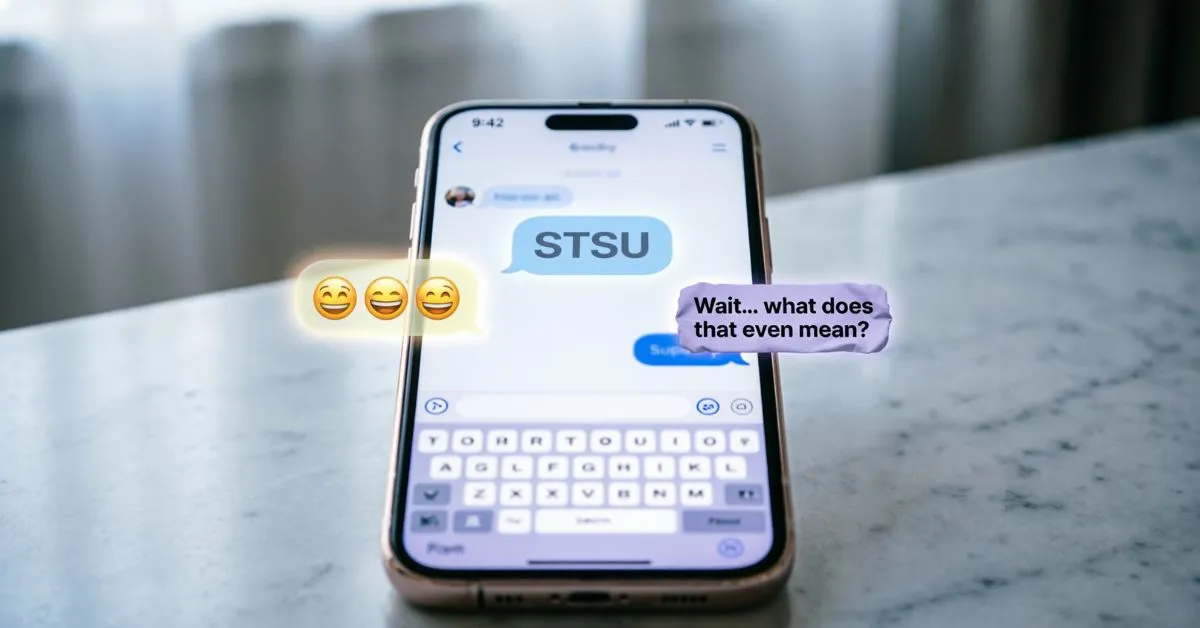
If you are searching what does STSU mean, the key thing to know is that STSU is not a universally standardized texting abbreviation like LOL, BRB, or IDK.
Current slang references commonly connect it with variations of “shut that [expletive] up,” “shut the stuff up,” or similar “shut up” expressions. Some sources also report other meanings, which makes context especially important.
That uncertainty is actually useful to understand. STSU can sound playful between close friends, show disbelief after surprising news, or feel genuinely rude during an argument.
In this guide, you’ll learn how to read the tone, recognize the likely meaning, use it carefully, and respond without creating unnecessary drama.
⚡ Quick Answer
STSU is an informal texting abbreviation with no single universally accepted definition. In many casual conversations, it is used as a variation of a “shut up” expression, such as “shut that [expletive] up” or the softer “shut the stuff up.” Depending on context, it can express surprise, teasing, disbelief, annoyance, or anger.
What It Means in a Text
The safest answer to what does STSU mean in text is that it is an informal and context-dependent slang abbreviation.
Several current slang references connect STSU with a variation of “shut that [expletive] up” or “shut the stuff up.” The basic idea is usually telling someone to stop talking, stop saying something, or stop going on about a particular subject.
The important difference is that STSU does not always function as a literal command.
For example:
“STSU 😂 no way you actually did that!”
Here, the sender may not seriously want the other person to stop talking.
Instead, STSU can act like an exaggerated reaction meaning:
“Stop, I can’t believe you just said that!”
The same four letters can feel very different in another conversation:
“STSU. I’m trying to talk.”
This version sounds much more direct and irritated.
That is why simply expanding the letters is not enough. You also need to read the tone, relationship, punctuation, emojis, and surrounding messages.
Some online sources give STSU completely different expansions, while others say it has no confirmed standard meaning. That disagreement is a good reason not to present one expansion as an official definition.
The simplest way to understand it
Think of STSU as a strong, informal “shut up” reaction whose exact wording may vary by person or community.
It can communicate:
- disbelief
- playful teasing
- embarrassment
- annoyance
- surprise
- genuine anger
The relationship between the people often matters just as much as the abbreviation itself.
Where & When People Use It
STSU is mainly associated with casual digital communication, including text messages, group chats, DMs, gaming conversations, and social-media comments. Current references describe it appearing in informal online spaces rather than formal writing.
Friends joking around
A friend might tell you something unbelievable:
“I accidentally sent the screenshot to the person we were talking about.”
You might reply:
“STSU 😭😂”
The response could mean something like, “No way! You actually did that?”
The language is sharp, but the emojis and friendship make the intention playful.
Reacting to surprising news
Someone might write:
“I just met my favorite actor at the airport.”
A friend could respond:
“STSU, seriously?”
In this setting, the phrase can work as an exaggerated expression of disbelief.
Teasing someone
STSU may also appear during playful arguments:
“You have bought five pairs of the same shoes.”
“STSU, they were on sale 😂.”
Neither person may be angry. The abbreviation simply adds dramatic humor.
During a real argument
The same expression can become much harsher:
“STSU and let me finish.”
Without laughing emojis or friendly context, this is much more likely to sound like a genuine demand to stop talking.
Professional communication
STSU is generally a poor choice for professional emails, workplace messages, school communication, customer support, or other formal situations. Even when used jokingly, its association with profanity and confrontation can make the message inappropriate or easy to misunderstand.
How to Use STSU in a Sentence
If you decide to use STSU, the surrounding words should make your intended tone clear.
Playful reaction
“STSU 😂 you really said that?”
This can communicate surprise while keeping the mood light.
Friendly disbelief
“STSU 😭 I cannot believe you actually went through with it.”
The extra wording makes it clear that the sender is reacting dramatically rather than demanding silence.
Teasing
“STSU, you did NOT buy another one 😂.”
The situation provides the context.
Serious use
“STSU. I’m trying to explain something.”
This sounds much more confrontational.
That last example shows why STSU should be used carefully. A short abbreviation can remove the softer cues that would normally appear in spoken conversation.
A person might say “Oh, stop!” while smiling, but a four-letter abbreviation can look much harsher on a screen.
Lowercase versus uppercase
You may see:
stsu
or
STSU
Capitalization alone does not prove someone’s emotional state. One current reference notes that relaxed chats may use lowercase while uppercase can add emphasis, but context remains more useful than capitalization by itself.
Different Meanings by Context
This is the section to remember if you want to understand STSU meaning in text correctly.
There is no reliable universal expansion that applies to every STSU message. Current online references disagree. Some identify a “shut up” variation as the main slang usage, while others list alternative expansions or describe STSU as a personal or group-specific abbreviation.
Because of that, context should guide your interpretation.
1. Playful “shut up” reaction
This is one of the strongest current interpretations found in slang references.
Example:
“I got tickets to the concert.”
“STSU 😭 NO WAY!”
Here, the phrase is likely an exaggerated expression of excitement or disbelief.
2. Genuine request to stop talking
In a tense conversation, STSU may function much more literally.
Example:
“STSU and listen to me.”
The sender is probably not joking.
3. A softer or censored version
Some references describe STSU as “shut the stuff up,” a cleaner interpretation that keeps the basic “stop talking” idea without spelling out profanity.
4. A private or group-specific abbreviation
Because STSU is not standardized, someone may create their own meaning for it.
For example, a gaming group, workplace team, or friend circle could use STSU as an inside abbreviation that has nothing to do with “shut up.”
One recent reference specifically warns that STSU may be a personal shorthand or context-based expression.
5. A typo or mistaken abbreviation
It is also possible that the person simply typed the wrong letters or intended another acronym.
This matters because STSU is much less standardized than widely recognized abbreviations such as LOL or BRB.
Bottom line: If the surrounding message does not make sense with the “shut up” interpretation, do not force that meaning onto it.
Similar Abbreviations & How They Differ
STFU
Meaning: “Shut the [expletive] up.”
Meaning: STFU is a more established and generally harsher “shut up” abbreviation; STSU may be a softer or altered variation.
SMH
Meaning: “Shaking my head.”
Meaning: SMH usually expresses disappointment, disbelief, or frustration without directly telling someone to stop talking.
SMDH
Meaning: “Shaking my damn head.”
Meaning: SMDH adds stronger emphasis to the disappointment or disbelief expressed by SMH.
NGL
Meaning: “Not gonna lie.”
Meaning: NGL introduces an honest opinion or admission rather than a command or reaction to someone’s speech.
IKR
Meaning: “I know, right?”
Meaning: IKR shows agreement with something another person has said.
LOL
Meaning: “Laughing out loud.”
Meaning: LOL usually signals amusement and can soften the tone of an otherwise blunt message.
The key difference is that STSU can carry a direct “stop talking” feeling, while these other abbreviations usually describe the sender’s reaction, agreement, or emotional response.
How to Reply to STSU
Your best reply depends on the tone.
If a close friend says:
“STSU 😂”
you can match the playful energy:
“You STSU 😂”
or:
“I knew you’d say that.”
If the person seems surprised rather than angry, you might simply continue the conversation:
“I’m serious! It actually happened.”
If the message appears hostile, you do not need to respond with the same energy.
You can say:
“Are you joking or are you actually upset?”
That gives the other person a chance to clarify.
If you do not know what STSU means in that particular conversation, a simple question works:
“What do you mean by STSU?”
There is no need to guess.
If someone uses STSU flirtatiously
STSU can sometimes appear in playful or flirty exchanges.
For example:
“You looked really good today.”
“STSU 😭”
Here, the recipient may be pretending to reject the compliment while actually enjoying it.
But do not assume that STSU automatically means flirting. The same response could simply show embarrassment, surprise, or joking disbelief.
Look at the rest of the conversation rather than treating the abbreviation as proof of romantic interest.
Common Mistakes
Assuming STSU has one official meaning
It does not have the same standardized status as common abbreviations such as LOL or IDK. Current sources give different interpretations, so context matters.
Assuming it is always rude
STSU can sound rude, but friends may use it as exaggerated humor.
An “STSU 😂” reaction is very different from “STSU.” during an argument.
Assuming it is always friendly
The opposite mistake is also possible. A joking use between friends does not mean every STSU message is harmless.
If someone sends it during a heated disagreement, take the tone seriously.
Confusing it with STFU
STSU and STFU are closely related in some online usage, but they should not automatically be treated as identical. STSU can target something someone said or a particular topic, while STFU is more directly aimed at telling the speaker to stop talking.
Using it with strangers
A joke that works with a close friend may sound disrespectful to someone you barely know.
Using it at work
Abbreviating profanity does not necessarily make it professional.
Believing every online expansion
Some websites list highly unusual meanings for STSU. Because current sources disagree, unusual definitions should be treated cautiously unless the conversation clearly supports them.
🎯 Practical Takeaway
If you see STSU in a text, first consider the surrounding conversation. A common current interpretation is a variation of “shut that/the [expletive] up,” often used playfully for disbelief or teasing, but the abbreviation is not standardized. If the tone is unclear, ask the sender rather than assuming they are angry or joking.
FAQs:
What does STSU mean in text messages?
STSU is an informal abbreviation whose meaning depends on context. Current slang references commonly associate it with a variation of “shut that [expletive] up” or “shut the stuff up.” It can be playful, sarcastic, annoyed, or genuinely confrontational depending on the conversation and relationship.
Is STSU the same as STFU?
They can be used in similar situations, but they are not necessarily identical. STFU is a more established abbreviation for telling someone to stop talking and generally carries a stronger tone. STSU is sometimes used as a variation that focuses on what someone is saying or a particular topic.
Is STSU rude?
It can be. Between close friends, STSU may be playful, especially when paired with laughing or crying emojis. In an argument, however, it can sound disrespectful or aggressive. The words around it, punctuation, relationship, and situation help determine whether the sender is joking or genuinely annoyed.
What does STSU mean from a girl?
There is no special meaning that automatically applies when a girl uses STSU. She may be using it as a playful reaction, a way to express disbelief, or a genuine request for someone to stop talking. Her wording and the surrounding conversation matter more than her gender.
What does STSU mean from a guy?
The same basic rule applies when a guy uses STSU. It can express joking disbelief, teasing, annoyance, or a direct command to stop talking. Do not assume it is friendly or hostile based only on who sent it. Read the rest of the conversation for clues.
Can STSU be used jokingly?
Yes. Current examples show STSU being used as an exaggerated reaction to surprising or unbelievable comments. Emojis such as 😂 or 😭 and a friendly relationship can make the intent clearly playful. Without those clues, however, the same abbreviation may sound much more serious.
What should I say if I don’t understand STSU?
You can simply ask, “What do you mean by STSU?” This is often the best option because STSU does not have one universally accepted meaning. A private joke, typo, or group-specific abbreviation may be involved, so the sender’s intended meaning is more reliable than a random online definition.
Conclusion:
So, what does STSU mean? The most useful answer is that STSU is an informal, context-dependent texting abbreviation. Current online slang references commonly connect it with variations of “shut that [expletive] up” or “shut the stuff up,” but there is no single standardized expansion that everyone uses.
That distinction matters because STSU can carry very different emotions. A friend might type “STSU 😂” after hearing an unbelievable story, using it as a playful way to say, “No way!” Someone in an argument might use the same letters as a genuine command to stop talking. The surrounding words, emojis, punctuation, and relationship help reveal which meaning is intended.
It is also worth remembering that some online sources give STSU other expansions. Because usage is inconsistent, do not assume every instance means the same thing.
The safest rule is simple: read the context first, and ask if you’re unsure. That small step can prevent a lot of unnecessary misunderstandings in online conversations.
I am Alex Carter, an author at Meaningary.com and an expert in meanings, slang, and everyday expressions. I specialize in explaining name meanings and language in a simple, clear, and reader friendly way.