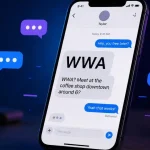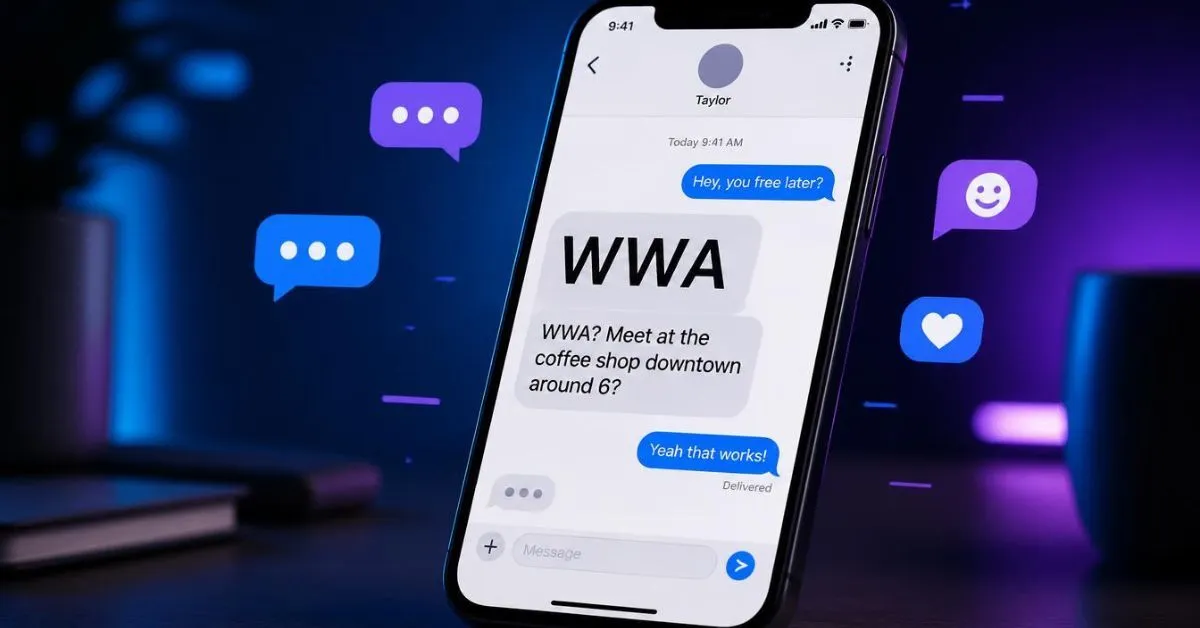
Have you ever received a short message like “WWA?” and had no idea what the sender meant? Three letters can be surprisingly hard to decode because texting slang often depends on the conversation around it.
If you searched what does WWA mean in text slang, you may have already noticed that different websites give different answers.
That confusion is understandable. WWA is not an abbreviation with one universally fixed meaning in casual texting. Current online references commonly associate it with phrases such as “Where We At?” or “What We At?”, while other sources give different context-based meanings.
So, instead of guessing, it helps to look at the message, the conversation, and the reason the person sent it. Below, you’ll see the main interpretations, simple examples, and easy ways to reply.
⚡ Quick Answer
WWA usually means “Where We At?” or “What We At?” in casual texting. It can ask where people are, what the current plan is, or what is happening. Because WWA has no single universal definition, the exact meaning depends on the surrounding conversation and how the sender normally uses abbreviations.
What WWA Means In a Text
In casual texting, WWA can mean “Where We At?” This is a shortened way to ask about someone’s location, the group’s location, or the current status of a plan. Several current slang references identify this as a common interpretation.
For example:
“WWA? The movie starts soon.”
The sender may be asking, “Where are we?” or “Where is everyone?”
WWA can also be understood as “What We At?” in some informal conversations. In that use, the person may be asking what is happening or what the plan is. A current texting reference lists both “What We At?” and “Where We At?” as interpretations.
The important point is that WWA is context-dependent. It is not as standardized as abbreviations such as “LOL” or “BRB,” so you should not automatically assume one meaning every time you see it. Current references disagree on its exact expansion, which supports checking the surrounding conversation first.
Where & When People Use WWA
WWA is mainly suited to casual digital conversations rather than formal communication. You might see it in a text message, group chat, direct message, or casual online conversation.
People may use it when they want to keep a message short.
Making Plans
Someone might send:
“WWA tonight?”
Depending on the conversation, this could mean “Where are we at tonight?” or “What are we doing tonight?”
Checking a Group’s Location
A friend who is arriving late might write:
“WWA rn?”
Here, the intended meaning may be close to “Where are we at right now?”
Checking the Status of a Plan
WWA can also be used as a quick status check:
“WWA with the party?”
The sender may simply want to know what is happening with the plan.
Because WWA is relatively ambiguous, it is better suited to conversations where both people already understand the context.
How to Use WWA In a Sentence
If you already know what WWA means in your conversation, you can use it as a quick question.
Here are a few natural examples:
Example 1:
“WWA? I’m already downtown.”
Here, WWA can mean “Where are we?” or “Where is everyone?”
Example 2:
“WWA for dinner?”
This can be understood as asking about the dinner plan.
Example 3:
“WWA? We need to leave soon.”
The sender is likely checking the group’s current location or status.
Example 4:
“WWA tonight?”
This may ask what the group is doing or what the plan is.
One useful rule is to avoid using WWA with someone who may not know the abbreviation. Since it is not universally standardized, writing the full question can prevent confusion.
Different Meanings of WWA by Context
WWA can change meaning based on the words around it. Current online references give several competing expansions, so treating one definition as universally correct would be misleading.
1. “Where We At?”
This is one of the clearest casual-chat interpretations.
Example:
“WWA? I’m five minutes away.”
The sender is likely asking where everyone is or where the group is meeting.
2. “What We At?”
Some texting references describe WWA as a shortened version of “What We At?” This can be used to ask about a plan or what is happening.
Example:
“WWA tonight?”
The intended idea may be “What are we doing tonight?”
3. A Context-Specific Abbreviation
WWA can also be a personal shorthand, inside joke, or community-specific abbreviation. One current reference notes that the letters may have different meanings depending on the platform and people involved.
This matters in group chats because friends sometimes create their own abbreviations that outsiders would not recognize.
4. Other Reported Expansions
Some online slang references give alternatives such as “What Was That?” or “What’s Wrong Again?”
These should not automatically be treated as the intended meaning. If the message does not clearly support one interpretation, the safest option is to ask the sender.
Similar Abbreviations & How They Differ
WWA can be confused with other short texting expressions. The surrounding words usually tell you which one fits.
- WYA “Where You At?” It directly asks about someone’s location.
- WYD “What You Doing?” It asks what someone is doing.
- WBU “What About You?” It turns a question back to the other person.
- WYM “What You Mean?” It asks someone to explain or clarify.
- WYA RN “Where You At Right Now?” It is more specific about current location.
These abbreviations are not interchangeable. For example, WYA clearly focuses on a person’s location, while WWA can be broader and may refer to a group, plan, or situation.
How to Reply to WWA
Your best reply depends on what you think the sender is asking.
If they mean “Where We At?”,
you can answer with your location:
“We’re at the coffee shop.”
If they are asking about plans:
“Still going to the movies.”
If you’re unsure:
“Do you mean where we are?”
That last response is perfectly reasonable. Since WWA can have multiple meanings, asking for clarification is often better than guessing.
If the conversation already makes the meaning obvious, you do not need to overthink it. Just answer the underlying question.
Common Mistakes With WWA
One common mistake is assuming that WWA has one official slang definition. Current online references do not agree on a single expansion, so context matters.
Another mistake is using WWA in a formal setting. Short forms like this can be unclear in work emails, school assignments, customer messages, or other situations where precise wording matters.
It is also easy to misunderstand the tone. WWA by itself does not automatically sound rude, romantic, angry, or friendly. The punctuation, previous messages, and relationship between the people can change how it feels.
Finally, do not assume that a meaning found on one website must match the message you received. If the surrounding conversation points somewhere else, context should guide your interpretation.
🎯 Practical Takeaway
WWA does not have one fixed meaning in texting. “Where We At?” and “What We At?” are common interpretations, but the exact meaning depends on the conversation. If the message is unclear, look at what was said before it or simply ask the sender what they mean.
FAQs:
What does WWA stand for in texting?
WWA can stand for “Where We At?” or “What We At?” in casual texting. It may be used to ask about a location, group status, or plans. Because the abbreviation is not universally standardized, the surrounding conversation is important for identifying the intended meaning.
Is WWA a common texting abbreviation?
WWA is less standardized than widely recognized texting shortcuts such as LOL, BRB, or OMG. Current online references give different meanings for it, which suggests that people may use it differently. If someone sends only “WWA,” checking the context is the safest way to understand it.
What does WWA mean from a guy?
If a guy sends “WWA,” the meaning cannot be determined simply from the fact that he is a guy. In casual texting, it may refer to “Where We At?” or “What We At?” The conversation, previous messages, and the topic being discussed provide much stronger clues than the sender’s gender.
What does WWA mean from a girl?
A girl using WWA does not give the abbreviation a special universal meaning. It may still mean “Where We At?” or “What We At?” depending on the conversation. If she uses WWA in a personal or group chat, read the messages around it before deciding what she intended.
Is WWA rude in a text?
WWA is not automatically rude. It is simply a short, informal abbreviation, and its tone depends on context. A message such as “WWA?” may sound neutral, while punctuation, previous comments, or an argument could make the same letters feel more impatient or demanding.
Does WWA mean “Where We At?”
Yes, “Where We At?” is one commonly reported meaning of WWA in casual texting. It can be used to ask where people are, where a group is meeting, or what the current status is. However, it is not the only interpretation reported online.
What should I reply if I do not understand WWA?
Ask for clarification rather than guessing. A simple response such as “What do you mean by WWA?” works well. If the surrounding conversation suggests they are asking about location or plans, you can answer that part directly and avoid unnecessary confusion.
Conclusion
So, what does WWA mean in text slang? The answer depends on context, but “Where We At?” and “What We At?” are two commonly reported interpretations in casual online communication.
You may see WWA when friends are checking a location, asking about plans, or trying to find out what is happening. In other conversations, the same three letters may have a different meaning or even be a personal abbreviation.
That is why context matters more than simply memorizing a definition. Look at the messages before and after WWA, consider what the conversation is about, and pay attention to how the sender normally writes. If the meaning is still unclear, asking directly is usually the easiest answer.
Texting slang is meant to make communication faster, not harder. Once you understand the context, WWA is much easier to read naturally.

I am Logan Reed, an author at Meaningary.com and an expert in meanings, slang, and everyday expressions. I specialize in explaining name meanings and language in a simple, clear, and reader friendly way.