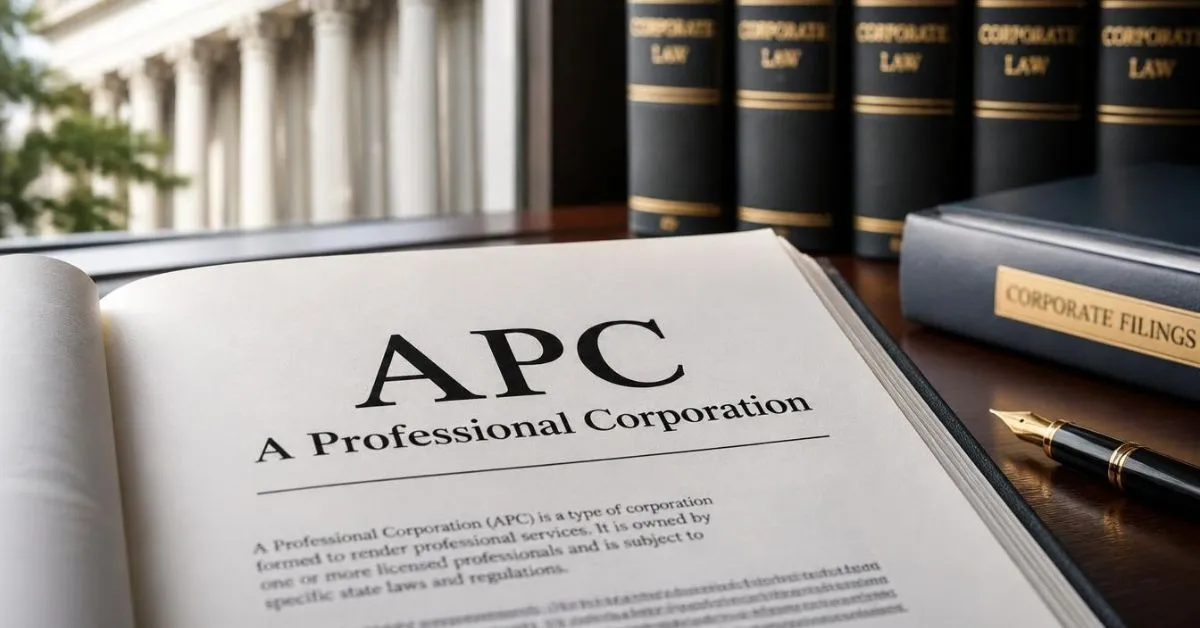
Seeing APC after a law firm’s name can raise a simple question: what do those letters actually mean? If you have noticed a name such as “Smith Law Firm, APC” on a legal letter, court filing, website, or attorney record, APC is usually connected to the firm’s business structure rather than your case itself.
In many U.S. legal settings, APC means “A Professional Corporation.” California is a clear example. The State Bar of California lists APC and A.P.C. among the corporate ending designations that may be used by law corporations.
Understanding the abbreviation can help you read legal documents more confidently. It can also help you tell the difference between a law firm’s formal business name and an abbreviation that describes a legal procedure, claim, or court action.
Because business-entity rules differ by state, however, the exact meaning of APC should always be considered in context.
⚡ Quick Answer
APC commonly means “A Professional Corporation” when it appears after the name of a U.S. law firm. It identifies the firm’s organizational structure, not a lawsuit, court procedure, or type of legal claim. California specifically recognizes APC and A.P.C. as acceptable corporate ending designations for law corporations.
What Does APC Mean in Law Plainly?
In the context of a law firm’s name, APC generally stands for “A Professional Corporation.” A professional corporation is a business structure that can be used by licensed professionals. When a law practice operates through this type of entity, the corporate designation may appear at the end of the firm’s official name.
For example:
Smith Legal Group, APC
Here, APC is part of the firm’s business name. It does not describe the type of case the attorneys handle.
This distinction is important. Someone unfamiliar with legal abbreviations might assume APC refers to a court process, a legal motion, or a special attorney certification. In this context, it does not.
California’s State Bar specifically lists A Professional Corporation, A Professional Law Corporation, Professional Corporation, Law Corporation, APC, A.P.C., PC, P.C., and other designations among acceptable corporate endings for law corporations.
The exact rules are jurisdiction-specific, so APC should not automatically be given the same meaning in every legal document or every state.
A Simple Example of APC In Practice
Suppose you receive a letter that says:
Johnson Family Law, APC
You might wonder whether APC refers to something happening in your divorce or family-law case.
Usually, it is simply part of the firm’s formal name.
For example:
Johnson Family Law, APC
Attorney: Jane Johnson
In this example, “Family Law” describes the firm’s practice area, while APC identifies its corporate designation.
You may also see APC in a court filing:
Attorney for Defendant:
Johnson & Smith, APC
The abbreviation generally identifies the law firm representing the party. It does not mean the defendant has received an APC, filed an APC, or faces an APC-related legal claim.
California attorney records provide real examples of law firms using APC in their registered names, including firms listed as “Safa Law Firm APC” and “The Pisikian Law Firm, APC.”
Where You’ll Encounter APC
Law Firm Names
The most straightforward place to see APC is at the end of a law firm’s name.
It may appear on:
- A law firm’s website
- Business cards
- Letterhead
- Engagement agreements
- Invoices
- Attorney directories
- Court filings
- Legal correspondence
When APC follows the firm’s name, it commonly functions as a corporate designation.
Court Documents
You may encounter APC in a case caption, attorney identification section, signature block, or other filing.
For example:
Attorney for Plaintiff:
Brown & Miller, APC
The letters are generally part of the firm’s name rather than a description of the lawsuit.
Legal Contracts
A legal services agreement may use the firm’s complete registered name. If the practice is organized as a professional corporation, APC may appear in that name.
State Bar Records
State bar directories can also show APC as part of a firm’s registered name. California’s attorney database, for example, currently includes multiple attorneys whose listed firms use the APC designation.
Why APC Matters Legally
APC matters because it can tell you something about how a law practice is organized.
A professional corporation is not simply a nickname for a lawyer. It is a formal business entity subject to applicable corporate and professional rules.
For example, California requires corporations practicing law to satisfy statutory requirements, obtain certification from the California Secretary of State, and register with the State Bar.
California also requires a law corporation to practice under the name registered with the Secretary of State and approved by the State Bar. The corporation must also follow applicable professional rules and laws.
That means APC can provide useful information about the firm’s organizational status.
However, APC does not tell you whether a lawyer is experienced, successful, certified in a specialty, or suitable for your particular legal matter. The abbreviation itself should not be treated as a quality rating.
How APC Is Typically Applied
The way professional corporations operate depends on the jurisdiction.
California provides a useful example of how this works.
A law corporation practicing in California must meet applicable requirements and register with the State Bar. Its name must also include an appropriate corporate designation.
In simple terms, the process involves several ideas:
1. Forming a Business Entity
The professional practice is organized under applicable corporate law.
2. Meeting Professional Requirements
Because the business provides legal services, additional professional rules may apply.
3. Registering Where Required
Some jurisdictions require a professional legal corporation to obtain specific approval or registration before practicing law.
4. Using an Approved Name
The firm’s official name may need to contain a corporate designation such as APC or another permitted ending.
5. Following Professional Rules
The corporation and its lawyers remain subject to applicable legal and professional requirements.
The California rules illustrate why simply seeing APC is not enough to understand every legal detail about a firm. The designation identifies the entity structure, while separate laws and professional rules govern how that entity may operate.
Common Misunderstandings About APC
APC Does Not Mean a Special Court Procedure
If you see APC after a law firm’s name, it generally does not mean the court has taken a special action.
It is usually a business-entity designation.
APC Does Not Mean a Lawyer Is Certified
The letters do not automatically indicate board certification, specialization, advanced training, or a particular professional achievement.
A lawyer’s qualifications should be verified separately through the relevant licensing authority or professional organization.
APC Does Not Describe the Lawyer’s Practice Area
An APC law firm might handle family law, personal injury, estate planning, business matters, immigration, or another area.
The suffix alone does not tell you what type of lawyer the firm employs.
APC Does Not Mean Every Law Firm Uses It
Professional-entity naming rules differ between jurisdictions. Some practices may use PC, P.C., Professional Corporation, Professional Association, Law Corporation, or another permitted designation instead. California’s rules specifically list several acceptable endings.
APC Does Not Have One Meaning in Every Context
This is one of the most important points.
If APC appears after a law firm’s name, A Professional Corporation is a strong interpretation.
But if you find APC inside a statute, court opinion, government document, or another specialized legal record, the abbreviation may have a different meaning.
Always consider the surrounding words and the jurisdiction.
Related Legal Terms
Professional Corporation
A business entity used by certain licensed professionals, including lawyers where permitted by state law.
Law Corporation
A corporation organized to provide legal services under applicable professional and corporate requirements.
PC or P.C.
An abbreviation that can also stand for Professional Corporation. Its precise use depends on the jurisdiction.
A.P.C.
A punctuated form of APC that may be used as a corporate designation where permitted.
Professional Association
A professional business structure used in some jurisdictions by licensed professionals.
These terms can look similar, but their exact legal treatment depends on the applicable state law and professional rules.
When To Talk to an Attorney
If you simply want to know why APC appears after a law firm’s name, identifying the jurisdiction and looking at the surrounding text will often answer the question.
You may want legal help if APC appears in a document that affects your rights or obligations, such as a lawsuit, settlement, contract, court order, corporate filing, or legal agreement.
An attorney can explain how a particular entity is organized and whether that structure has any effect on the specific legal issue you are dealing with.
This article provides general legal information, not legal advice. Laws and professional-corporation requirements vary by jurisdiction. For advice about your specific situation, consult a licensed attorney in the relevant jurisdiction.
🎯 Practical Takeaway
If APC appears after a U.S. law firm’s name, it commonly means “A Professional Corporation.” California expressly recognizes APC and A.P.C. as acceptable corporate ending designations for law corporations. The key is context. If APC appears somewhere other than a firm’s name, check the document and jurisdiction before assuming what the abbreviation means.
FAQs:
What does APC stand for in law?
APC commonly stands for “A Professional Corporation” when it appears as part of a law firm’s name. It identifies the firm’s business structure rather than a lawsuit, legal claim, or court procedure. California specifically includes APC and A.P.C. among acceptable corporate ending designations for law corporations.
What does APC mean after a lawyer’s name?
When APC appears after a lawyer’s firm name, it commonly identifies the law practice as a professional corporation. It is part of the firm’s formal business name. It does not, by itself, indicate that the individual lawyer has earned a special certification or legal specialty.
Is APC the same as a professional corporation?
In a law-firm context, APC commonly means A Professional Corporation. The exact rules for creating and operating such an entity depend on state law. California, for example, recognizes APC as one permitted corporate ending designation for law corporations.
Is APC a type of law firm?
APC is not a type of legal practice such as criminal law, family law, or personal injury law. Instead, it can identify the firm’s organizational structure. A law firm using APC may work in many different areas of law.
Does APC mean the lawyer is certified?
No. APC generally describes the firm’s corporate structure when used in its name. It does not automatically mean that an attorney has a special certification, professional ranking, or particular level of experience.
Can APC mean something else in law?
Yes. Abbreviations can change meaning based on context. If APC appears inside a statute, court opinion, agency document, or specialized legal material rather than after a firm’s name, you should not automatically assume it means “A Professional Corporation.”
Does every state use APC for law firms?
No. Professional-entity naming rules vary by jurisdiction. Different states may allow different designations, including forms such as PC, P.C., Professional Corporation, Professional Association, or Law Corporation. California specifically lists APC among its permitted law-corporation endings.
Conclusion:
So, what does APC mean in law? When you see APC after the name of a U.S. law firm, it commonly means “A Professional Corporation.”
In that setting, the abbreviation identifies the firm’s organizational structure rather than a court action, legal charge, lawsuit, or attorney certification.
California offers a clear example. Its State Bar permits APC and A.P.C. among the corporate ending designations used by law corporations and requires law corporations practicing in the state to satisfy registration and professional requirements.
The most important thing to remember is that context matters. APC does not necessarily have the same meaning every time it appears in a legal document.
If you see it after a firm’s name, it likely refers to the firm’s corporate structure. If it appears elsewhere, check the surrounding language and jurisdiction before relying on that interpretation.
General legal information only not legal advice. For a specific legal matter, consult a licensed attorney.

I am Alex Carter, an author at Meaningary.com and an expert in meanings, slang, and everyday expressions. I specialize in explaining name meanings and language in a simple, clear, and reader friendly way.