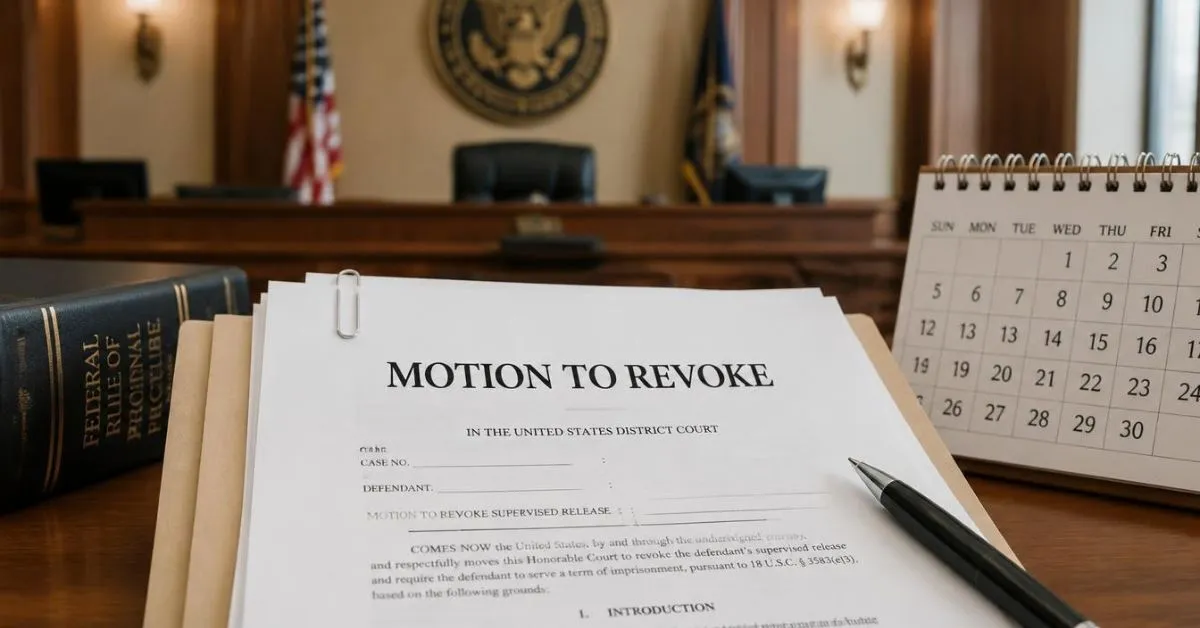
Seeing the words “motion to revoke” on a court document can be confusing, especially if you are not sure whether it means you have already lost your probation or whether you still have a chance to respond.
The important point is that a motion to revoke is generally a request made to a court, not the final decision itself.
In many criminal cases, the phrase refers to a request to revoke probation or another form of court-ordered supervision because someone is accused of violating one or more conditions.
Those alleged violations can involve things such as missing required appointments, failing a court-ordered condition, or being accused of a new offense.
If you found this phrase on a docket, warrant record, notice, or court paper, the exact meaning depends on the jurisdiction and the type of supervision involved.
This guide explains the term in plain English, what usually happens after a motion is filed, and what the phrase does not automatically mean.
⚡ Quick Answer
A motion to revoke is generally a formal request asking a judge to end or change probation, supervised release, or another court-ordered form of supervision because someone allegedly violated its conditions. Filing the motion does not automatically mean revocation has occurred. A court process usually follows, and the judge decides what action is appropriate.
What Does a Motion to Revoke Mean In Plain English?
A motion to revoke is a written request asking a court to take action against a person who is already under some type of court-ordered supervision.
In many criminal cases, the supervision is probation. Probation allows a person to remain in the community while following conditions ordered by the court. Those conditions can vary by case and jurisdiction. They may include reporting to a probation officer, obeying the law, completing programs, submitting to testing, following travel restrictions, or meeting other court requirements.
If the government believes a person has violated one or more conditions, it may file a motion asking the court to revoke probation.
The word “revoke” means to withdraw, cancel, or end something that was previously granted. So, in this setting, revocation can mean ending probation and potentially imposing another consequence allowed by law.
However, a motion is a request. It is not the same thing as a judge’s final order.
For example, if a court record says:
“Motion to Revoke Probation Filed”
that generally means someone has asked the court to revoke the person’s probation. It does not, by itself, mean the judge has already decided that probation is revoked.
Federal law illustrates this distinction. Under 18 U.S.C. § 3565, if a person violates a condition of federal probation, the court may continue probation, modify its conditions, or revoke probation and resentence the person, after the required hearing.
State courts have their own laws and procedures, so the exact meaning and possible outcomes can differ.
A Simple Example Of A Motion to Revoke In Practice
Imagine someone is placed on probation after a criminal conviction.
One condition says the person must report to a probation officer every month. The person allegedly misses several required appointments.
The probation department may report the alleged violation. Depending on the jurisdiction and circumstances, the prosecutor may then file a motion to revoke probation, asking the judge to take action.
At that point, several things are possible.
The person might receive notice to appear in court. In some situations, a judge may issue a warrant. The case may then proceed to a hearing where the alleged violation is considered.
The judge could ultimately decide that the violation was not established, continue probation, change the conditions, or revoke probation if the applicable legal requirements are met.
Federal law specifically allows a court, after a probation violation hearing, to either continue probation with changed or extended conditions or revoke probation and resentence the defendant.
So a motion to revoke should generally be understood as the beginning or continuation of a court process, rather than proof that the final outcome has already been decided.
Where You Might Encounter a Motion to Revoke
You may see this phrase in several places, including a court docket, probation paperwork, a hearing notice, or another official court record.
The exact wording can vary. You might see:
- Motion to Revoke Probation
- Motion to Revoke Community Supervision
- Motion to Revoke Supervised Release
- Probation Violation
- Revocation Hearing
- Motion to Revoke Deferred Adjudication
These phrases can be related but are not always legally identical.
For example, probation and federal supervised release are different forms of supervision. Federal law separately addresses revocation of probation under 18 U.S.C. § 3565 and revocation of supervised release under 18 U.S.C. § 3583.
The location of the case also matters. A phrase used in a Texas court, for example, may operate under different rules from the same phrase in a federal court or another state’s court.
That is why the title of the filing should not be viewed by itself. The allegations, underlying sentence, court orders, and local law all matter.
Why a Motion to Revoke Matters Legally
A motion to revoke matters because the court may have authority to change the person’s supervision or impose another consequence if a violation is established.
The possible result depends heavily on the type of supervision, the alleged violation, the governing law, and the judge’s authority.
Under federal probation law, a court can continue probation with modified or enlarged conditions or revoke probation and resentence the defendant. Federal law also identifies certain circumstances in which revocation is required, subject to the statute’s terms.
For federal supervised release, 18 U.S.C. § 3583 allows a court to revoke supervised release if the court finds by a preponderance of the evidence that a condition was violated, subject to the statute’s rules and limits.
This does not mean every motion results in jail or prison.
Depending on the law and circumstances, a court may have options that include continuing supervision, changing conditions, or revoking supervision. The available choices can be different from one jurisdiction to another.
A motion also matters because there may be important deadlines, hearings, notices, and possible custody issues. If you have received an actual motion, summons, or warrant, the document itself is more important than a general definition found online.
How a Motion to Revoke Is Typically Applied
Although procedures vary, a simplified process often looks like this:
1. An alleged violation is reported
Someone under probation or supervised release is accused of breaking a condition.
The alleged violation could involve a supervision requirement, a testing requirement, a new criminal allegation, or another condition imposed by the court. The exact conditions are found in the person’s sentencing or supervision documents.
2. A motion or other filing may be submitted
The government or another authorized party may ask the court to revoke or otherwise address the supervision.
The filing normally identifies the alleged violation and asks the judge to take a particular action.
3. The person may receive notice or be brought before the court
Depending on the jurisdiction and circumstances, the court may issue a summons or warrant.
Federal Rule of Criminal Procedure 32.1 provides procedures for people accused of violating federal probation or supervised release, including initial appearances and revocation hearings.
4. A hearing may take place
A revocation hearing is different from the original criminal trial.
Under the federal rule, a person is generally entitled to written notice of the alleged violation, disclosure of evidence, an opportunity to appear and present evidence, and an opportunity to question adverse witnesses subject to the rule’s limitations. The rule also addresses the right to counsel.
5. The judge decides what happens
The final result depends on the applicable law and facts.
The court may have authority to continue supervision, modify conditions, or revoke supervision. In some circumstances, revocation can lead to incarceration or another sentence-related consequence.
For federal probation, § 3565 expressly gives the court authority to continue probation with changed conditions or revoke probation and resentence after the required hearing.
For federal supervised release, § 3583 contains separate rules governing revocation and possible imprisonment.
This is why you should not assume that seeing “motion to revoke” on a docket tells you the final result.
Common Misunderstandings About Motions to Revoke
“A motion to revoke means my probation is already revoked.”
Not necessarily. A motion is generally a request for court action. Whether probation or another form of supervision is actually revoked depends on what happens in the court process.
“A motion to revoke always means jail.”
No. The possible outcome depends on the jurisdiction, supervision type, alleged violation, prior orders, and applicable law. Federal probation law, for example, allows a court to continue probation with modified conditions as an alternative to revocation.
“A new criminal charge automatically proves a probation violation.”
Not necessarily. A new arrest, charge, or allegation can be the basis for a claimed supervision violation, but the legal process still matters. The effect depends on the applicable law and the specific conditions of supervision.
“A motion to revoke is the same as a normal criminal trial.”
No. Revocation proceedings are generally different from the original criminal prosecution. Federal Rule 32.1 sets out a separate process for probation and supervised-release revocation hearings.
“Every state uses the same rules.”
No. State probation laws and court procedures vary. Federal rules apply to federal cases, while state courts generally follow their own statutes, rules, and case law.
“If the probation period is almost over, a violation automatically disappears.”
Not necessarily. Timing rules can be complicated. For federal probation, § 3565 provides that the court’s revocation authority can extend beyond the supervision period for certain matters if a warrant or summons was issued before the period expired.
Related Legal Terms You May See
- Probation: Court-ordered supervision that allows a person to remain in the community subject to stated conditions.
- Probation violation: An alleged failure to follow a condition of probation.
- Revocation hearing: A court proceeding where alleged violations and possible consequences are considered.
- Supervised release: A period of federal supervision that generally follows imprisonment for a federal offense.
- Summons: A court document directing a person to appear rather than immediately requiring an arrest.
- Warrant: A legal order that can authorize law enforcement to take a person into custody, depending on the circumstances and jurisdiction.
- Motion to modify: A request asking the court to change existing conditions rather than necessarily end supervision.
The exact legal meaning of these terms can change depending on the court and case.
When Should You Talk To An Attorney?
If you have personally received a motion to revoke, probation-violation notice, summons, or warrant, getting advice from a licensed attorney can be important.
A lawyer can review the actual filing, identify the alleged violations, check the conditions that applied to you, and explain the procedure in your jurisdiction.
This is especially important if the document includes a hearing date, states that a warrant has been issued, or alleges a new criminal offense.
Federal Rule 32.1 provides for notice of the right to retain counsel or request appointed counsel in relevant revocation proceedings. The exact availability and appointment of counsel can depend on the case and applicable law.
Do not rely only on a general online explanation if a real court deadline or hearing is involved.
This article is general legal information, not legal advice. For a specific case, consult a licensed attorney in the relevant jurisdiction.
🎯 Practical Takeaway
A motion to revoke generally means someone has formally asked a court to revoke probation, supervised release, or another form of supervision because of an alleged violation. It is serious, but it does not automatically mean the court has already revoked your supervision or ordered incarceration.
If you see this phrase in your own court records, read the entire filing, check the hearing or response date, and consider speaking with a licensed attorney who can evaluate your specific situation.
FAQs:
What happens after a motion to revoke is filed?
The next step depends on the jurisdiction and case. The court may issue a summons or warrant and schedule a hearing. At a revocation hearing, the alleged violation is considered and the court determines what action is permitted under the applicable law. Federal Rule 32.1 sets out procedures for federal cases.
Does a motion to revoke mean you are going to jail?
Not automatically. A motion is a request asking the court to take action. Depending on the law and circumstances, the court may have options besides incarceration, such as continuing supervision or changing its conditions. Federal probation law expressly allows continued probation with modified conditions in appropriate cases.
What is the difference between a motion to revoke and a probation violation?
A probation violation is the alleged failure to follow a condition of probation. A motion to revoke is a formal court filing asking the judge to respond to that alleged violation, potentially by revoking probation. The two terms describe different parts of the legal process.
Can a judge deny a motion to revoke?
In general, a judge may deny a request for revocation if the applicable legal requirements for revocation are not met. The exact standard and possible outcomes depend on the jurisdiction and type of supervision. A court may also have authority to continue supervision with changed conditions instead of revoking it.
Can a motion to revoke be filed for missing probation?
It can be possible for missing a required probation appointment or failing another supervision condition to become the basis for a violation proceeding. However, whether a motion is filed and what happens afterward depends on the specific probation terms, circumstances, and local law.
Is a motion to revoke the same as a warrant?
No. A motion to revoke is generally a request asking the court to take action. A warrant is a separate court order that may authorize an arrest. A motion can sometimes be followed by a warrant, but the two documents are not the same thing.
Does a motion to revoke stay on your court record?
Court records and retention rules vary by jurisdiction. A filing may appear on a court docket even if the requested revocation is later denied or the case is resolved another way. For a specific record, check the court’s docket or ask a lawyer familiar with that court’s procedures.
Conclusion:
Understanding what does motion to revoke mean starts with one important distinction: a motion is a request to the court, not necessarily the court’s final decision. In many criminal cases, it asks a judge to revoke probation or another form of supervision because a violation is alleged.
What happens next can vary widely. A person may receive notice, a summons, or potentially a warrant, followed by a hearing where the alleged violation and possible consequences are considered. Federal law provides specific procedures for these proceedings, while state laws can differ.
If this phrase appears in your own court documents, the most useful next step is to look at the actual filing and identify the alleged violation, hearing date, and court involved. Because even small details can change the legal picture, specific questions should be reviewed with a licensed attorney in the relevant jurisdiction.
A motion to revoke may be serious, but understanding the difference between an allegation, a motion, a hearing, and a final court order can make the situation much easier to understand.

I am Lucas Bennett, an author at Meaningary.com and an expert in meanings, slang, and everyday expressions. I specialize in explaining name meanings and language in a simple, clear, and reader friendly way.