Reading a court document can feel confusing when it includes Latin phrases that are rarely used in everyday English.
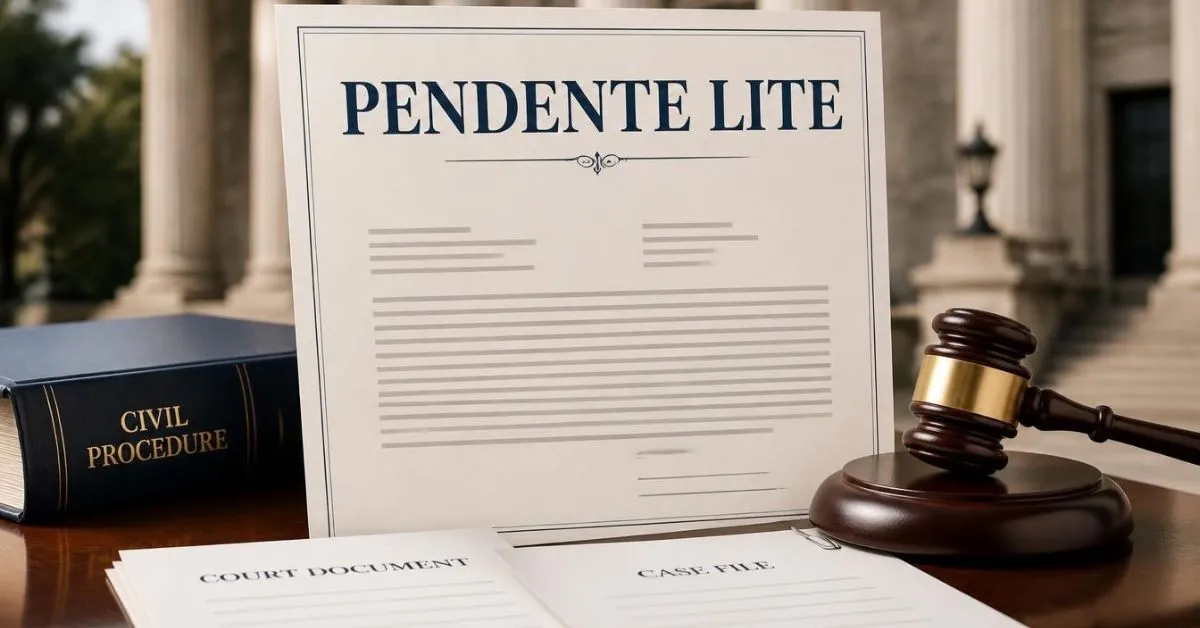
What does pendente lite mean? This is a common question when the phrase appears in a divorce case, custody dispute, support matter, or another legal proceeding.
Pendente lite is used to describe something that happens while a lawsuit or legal proceeding is still pending.
In family law cases, for example, it can refer to temporary arrangements involving child support, custody, visitation, spousal support, or other issues that need attention before the case reaches a final resolution.
Understanding the phrase can help you read a legal document more clearly. It is also important to know what the term does not automatically tell you.
Pendente lite does not, by itself, mean that a particular request was granted, that the case is finished, or that the temporary arrangement will become the final result.
This guide explains the term in plain American English, gives a simple example, and shows how it differs from related legal phrases.
⚡ Quick Answer:
Pendente lite is a Latin legal phrase meaning “pending the litigation” or “while the lawsuit is pending.” It usually describes temporary relief, an order, or an arrangement used during an active legal case before the court reaches a final resolution.
⚖️ What Pendente Lite Means Plainly
Pendente lite is a Latin phrase used in legal settings to mean that something is happening during a pending lawsuit or proceeding.
A simple way to remember it is:
Pendente lite = while the legal case is still pending.
The phrase often appears next to another legal concept. For example, a document might refer to a pendente lite order, pendente lite support, or alimony pendente lite.
The exact relief involved depends on the type of case and the law of the jurisdiction.
For example, in a family-law case, a court may need to address immediate practical issues before the final hearing. Those issues can include child custody, child support, visitation, or spousal support. Maryland court materials specifically use “pendente lite” for temporary arrangements involving these types of family-law matters.
The key idea is interim relief.
It gives the court a way to address certain issues while the larger dispute continues rather than requiring everyone to wait until the entire case is finished.
📝 A Simple Example of Pendente Lite In Practice
Imagine that two people are going through a divorce.
Their divorce case may take time to resolve, but they still need to make decisions about everyday matters. Their children need care, bills still have to be paid, and one spouse may request financial support.
One party could ask the court for temporary relief while the divorce is pending.
Depending on the state’s law and the circumstances, a court might enter an order addressing issues such as:
- temporary child support
- temporary custody
- visitation
- temporary spousal support
- use of the family home
Maryland’s court materials give examples of pendente lite arrangements involving child custody, child support, visitation, alimony, and use or possession of family property before a final hearing or trial.
Simple example
Suppose a divorce case is still pending and one parent asks the court for temporary child support.
If the court enters a temporary support order, that order can govern the parties while the case continues.
That does not automatically mean the court has made its final decision about the entire divorce or every financial issue.
This distinction matters because a pendente lite arrangement is generally about the period during the ongoing litigation.
🏛️ Where You’ll Encounter Pendente Lite
You may encounter pendente lite in several types of legal documents. The phrase is especially common in family-law contexts, although its broader meaning is not limited to divorce.
Divorce and family law
Family-law cases may involve requests for temporary support, custody, visitation, or other relief while the case is pending. Cornell’s Legal Information Institute specifically identifies pendente lite custody and child-support motions as examples.
Spousal support
You may see the phrase alimony pendente lite. In that context, it refers to alimony or spousal support during the pending proceeding when recognized by applicable law. Federal legal definitions also recognize alimony pendente lite as a form of alimony subject to state law.
Child-related matters
Temporary child support, custody, and visitation arrangements can sometimes be described as pendente lite relief. The exact rules depend on the jurisdiction and the type of proceeding.
Other civil litigation
The broader idea of temporary relief during litigation also exists outside family law. Courts can use provisional remedies before a final judgment to protect rights or preserve the situation while a case moves forward.
So, seeing pendente lite does not automatically mean that the case is about divorce.
The surrounding words are important.
⚠️ Why Pendente Lite Matters Legally
A legal case can take time, but important issues may need an answer before the final judgment.
That is where temporary relief can become important.
For example, if two parties are involved in a dispute over property, money, family responsibilities, or another legal issue, waiting until the end of the case may create practical problems. Courts can sometimes use interim or provisional measures to address issues before the final outcome.
In family law, Cornell’s Legal Information Institute explains that pendente lite relief can help parties proceed with a case while temporary needs are addressed.
Temporary does not mean optional
One of the most important points is that temporary does not necessarily mean voluntary.
If a court actually enters an enforceable order, the people covered by that order may have legal obligations while it remains effective.
For example, a current court order could require a person to make certain support payments or follow a temporary custody arrangement.
The exact consequences of violating an order depend on the order and the applicable law.
Temporary does not always mean insignificant
A pendente lite order may affect someone’s finances, living arrangements, parenting schedule, or other important parts of daily life.
For that reason, a person should not ignore a legal document simply because it uses the word “temporary.”
📋 How Pendente Lite Is Typically Applied
There is no single nationwide procedure for every pendente lite request in the United States. State laws, court rules, and the type of case can change the process.
In general, the concept may work like this:
1. A legal case is pending
There is an active lawsuit, divorce, custody proceeding, or another court matter.
2. A party asks for temporary relief
A person may ask the court to address an issue that cannot reasonably wait until the case ends.
3. The court reviews the request
The judge considers the applicable law, evidence, procedural requirements, and circumstances of the case.
4. The court may issue temporary relief
If the legal requirements are met, the court may enter an appropriate temporary order.
5. The underlying case continues
The pendente lite order addresses the interim period while the main case moves forward.
6. The temporary arrangement may later change
A later order, settlement, or final judgment may modify, replace, or end the temporary arrangement, depending on the circumstances and applicable law.
Recent court decisions also show how the phrase is used in actual proceedings. For example, New York court decisions in 2026 refer to pendente lite maintenance and other temporary arrangements during divorce litigation.
That illustrates an important point:
The phrase identifies the timing and interim nature of the relief, but the exact legal effect comes from the actual order and governing law.
❌ Common Misunderstandings About Pendente Lite
Does pendente lite mean the case is over?
No. The phrase generally refers to the period while litigation is still pending. It points to an interim stage rather than automatically indicating that the case has reached its final resolution.
Is a pendente lite order always permanent?
No. Pendente lite relief is generally temporary or interim. A later court order or final resolution may change what applies.
Does “temporary” mean you can ignore the order?
No. If the court has issued an enforceable order, its temporary nature does not automatically make compliance optional.
Does pendente lite only apply to divorce?
No. Divorce and family law are common contexts, but the broader concept concerns matters arising during pending litigation.
Does pendente lite mean alimony?
Not by itself. Pendente lite is a broader phrase. Alimony pendente lite is a specific expression for spousal support during pending litigation where applicable law recognizes it.
Is pendente lite the same as lis pendens?
No. The phrases are different. Lis pendens generally concerns pending litigation affecting an interest in real property and may refer to a notice recorded in the property’s chain of title.
🔎 Related Legal Terms
Temporary order
Meaning: A court order designed to apply for a limited period while a legal matter continues.
Interim relief
Meaning: Temporary legal relief provided before the court reaches a final resolution.
Provisional remedy
Meaning: A court-ordered measure used before final judgment to protect rights or preserve the situation during litigation.
Alimony pendente lite
Meaning: Spousal support provided during pending litigation when recognized under applicable law.
Final judgment
Meaning: A court’s final resolution of the issues decided in the case.
Lis pendens
Meaning: A legal notice associated with pending litigation that may affect an interest in real property.
These terms can appear in related legal documents, but they should not be treated as interchangeable.
👩⚖️ When To Talk To an Attorney
If you found pendente lite in your own court papers, the most useful next step is to read the entire sentence or section where the phrase appears.
For example, there is a major difference between:
- a request for pendente lite relief
- a proposed order
- an order already signed by a judge
- a final judgment
The specific meaning and consequences can also depend on your state and the type of case.
Consider speaking with a licensed attorney in your jurisdiction if you need help understanding what a particular order requires, how to respond to a motion, whether an order can be changed, or what deadlines apply.
This article provides general legal information, not legal advice. It does not create an attorney-client relationship and cannot determine what the law requires in your specific situation.
🎯 Practical Takeaway
The easiest way to remember pendente lite is: “while the case is pending.” It usually describes temporary or interim relief during an active legal proceeding, such as temporary support or custody arrangements in a family law case.
If the phrase appears in your own court documents, do not rely on the phrase alone. Read the surrounding language and determine whether the document is asking for relief or ordering you to do something. For case-specific questions, a licensed attorney can explain how the term applies under your state’s law.
FAQs:
What does pendente lite mean in simple terms?
Pendente lite simply means while a lawsuit or legal proceeding is still pending. Lawyers and courts use the phrase when describing something that applies during the case before the final resolution. It is often connected with temporary relief, such as support or custody arrangements in family-law proceedings.
What is a pendente lite order?
A pendente lite order is generally a temporary court order addressing an issue while a legal case is still pending. In family-law cases, it may address matters such as support, custody, visitation, or use of property. The exact issues covered depend on the jurisdiction and the court’s authority.
What does pendente lite mean in a divorce?
In a divorce, pendente lite generally refers to temporary arrangements or relief that apply while the divorce case is pending. Depending on state law, these arrangements may address spousal support, child support, custody, visitation, or other immediate issues before the final judgment.
Is alimony pendente lite the same as alimony?
Not exactly. Alimony pendente lite refers to spousal support during pending litigation, while alimony can refer more broadly to support obligations recognized under applicable law. The rules governing eligibility, amount, duration, and termination vary by jurisdiction.
Can a pendente lite order be changed?
It may be possible for a temporary order to be modified, replaced, or ended, but the procedure depends on the jurisdiction, type of order, and circumstances. A person should not assume that an order automatically changes because circumstances have changed; the applicable court process matters.
Is pendente lite a final judgment?
Generally, no. Pendente lite describes the period while litigation is pending and is commonly associated with interim or temporary relief. A final judgment addresses the court’s ultimate resolution of the relevant issues.
What is the difference between pendente lite and lis pendens?
Pendente lite generally describes something occurring during pending litigation, often temporary relief. Lis pendens is a separate legal concept commonly involving notice of pending litigation that may affect an interest in real property. The two Latin phrases therefore have different legal uses.
Conclusion:
If you searched what does pendente lite mean, the simplest answer is “while the litigation is pending.” It is a legal phrase used to describe temporary or interim matters during an active case rather than automatically describing the final outcome.
You may see it in family-law documents involving temporary support, child custody, visitation, or other arrangements. The broader idea can also apply to interim relief in other types of litigation.
One detail is especially important: temporary does not mean unimportant or optional. If a court has issued an enforceable order, the people covered by it may have obligations while that order remains in effect.
If you see pendente lite in your own legal paperwork, look at the words around it. Determine whether the document is requesting temporary relief, describing an existing order, or setting out an obligation. Because legal rules vary by state and case type, specific questions should be discussed with a licensed attorney.
Once you remember “pendente lite = during the pending case,” the phrase becomes much easier to understand.

I am Cameron James, an author at Meaningary.com and an expert in meanings, slang, and everyday expressions. I specialize in explaining name meanings and language in a simple, clear, and reader friendly way.