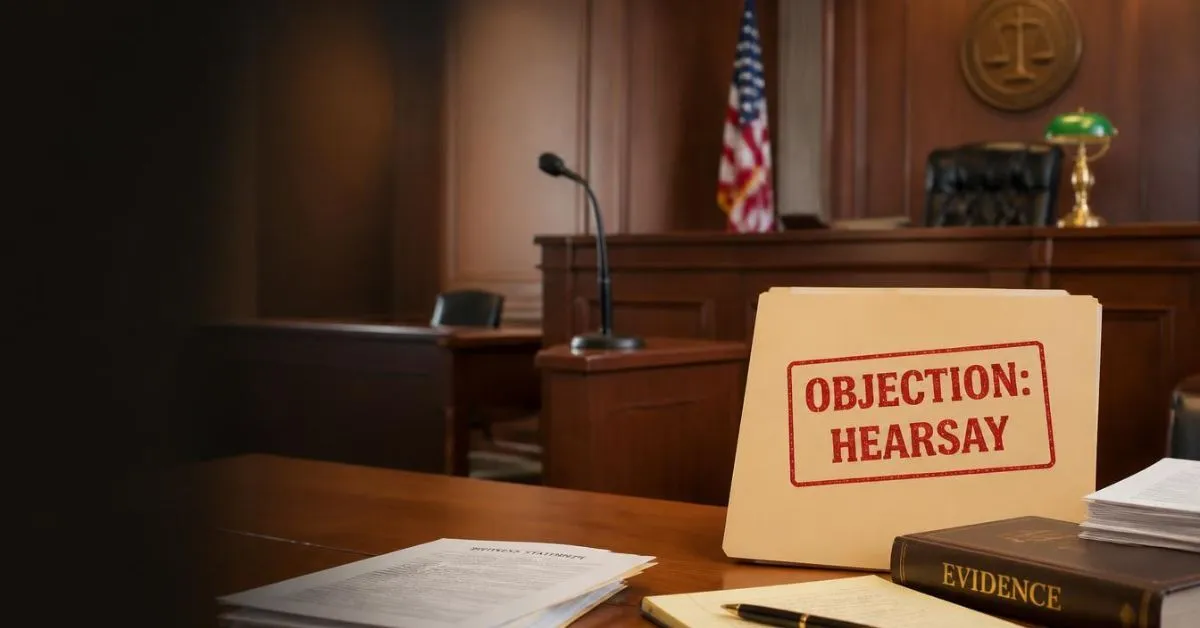
If you have watched a courtroom scene and heard a lawyer suddenly say, “Objection, hearsay,” you may wonder what that phrase actually means.
It can sound complicated, but the basic idea is easier to understand than it first appears. A hearsay objection is generally raised when one side believes a statement is being offered as evidence even though the person who originally made the statement is not testifying in the current proceeding.
Under the Federal Rules of Evidence, hearsay involves an out-of-court statement offered to prove the truth of what the statement says.
However, the rules contain important exclusions and exceptions, so not every statement made outside court is automatically hearsay.
This guide explains what objection hearsay means, gives a simple courtroom example, and shows why the objection matters.
⚡ Quick Answer
“Objection, hearsay” means a lawyer is arguing that a statement should not be admitted because it is an out-of-court statement being offered to prove that what it says is true. Hearsay rules have exceptions and exclusions, so the judge must consider the circumstances before deciding whether the evidence can be used.
What “Objection, Hearsay” Means Plainly
An objection is a formal protest made during a legal proceeding. A lawyer may object when they believe a question, answer, document, or other evidence violates a rule of evidence.
Hearsay is a specific type of evidence issue.
Under Federal Rule of Evidence 801, hearsay generally involves two key points:
- Someone made a statement outside the current trial or hearing.
- A party is offering that statement to prove the truth of what it claims.
For example, imagine a witness says:
“My neighbor told me that the defendant broke the window.”
If the statement is being offered to prove that the defendant actually broke the window, the opposing lawyer might say:
“Objection, hearsay.”
The lawyer is essentially asking the judge to prevent that statement from being used for its truth unless a rule allows it.
That does not necessarily mean the witness is lying. It also does not automatically mean the evidence will be excluded.
The judge has to determine whether the statement actually qualifies as hearsay and, if so, whether an exception or other rule permits it.
A Simple Example Of This In Practice
Imagine a criminal trial involving a store robbery.
A witness takes the stand and says:
“John told me that Sarah stole the money.”
The attorney asks the witness to repeat John’s statement because the attorney wants the jury to believe Sarah stole the money.
The other attorney could respond:
“Objection, hearsay.”
Why?
John is not the person currently testifying about the alleged theft. The witness is repeating something John said outside the courtroom, and the statement is being offered to establish that Sarah actually stole the money.
Under the federal evidence rules, that can raise a hearsay issue.
But the analysis does not necessarily end there.
Suppose the same statement is offered for a different purpose rather than to prove that Sarah stole the money. The hearsay analysis can change depending on why the statement is being introduced.
Also, certain statements fall outside the hearsay definition, while others may qualify under recognized exceptions.
Where You’ll Encounter A Hearsay Objection
You may hear “Objection, hearsay” during a trial, deposition, or another legal proceeding where evidence rules apply.
The Federal Rules of Evidence govern evidence in federal courts, while states can have their own evidence rules. The basic concept is similar, but the exact rules and exceptions can differ depending on the jurisdiction and proceeding.
A hearsay objection may arise when someone attempts to introduce:
- A statement another person made.
- A written statement from someone who is not currently testifying.
- A recording containing an out-of-court statement.
- A witness’s description of what another person previously said.
- Certain documents or statements offered to establish the truth of their contents.
The key question is usually why the statement is being offered.
A statement can sometimes be relevant for one purpose without being offered to prove that the statement itself is true.
Why It Matters Legally
Evidence rules are designed to help courts determine what information can properly be considered during a proceeding. The federal courts describe their evidence rules as a framework intended to help trials rely on evidence that is relevant, reliable, authentic, and not unfairly prejudicial.
Hearsay rules matter because an out-of-court statement may not provide the same opportunity for testing the statement through courtroom procedures, including questioning the person who originally made it.
For example, if John says something outside court and another person simply repeats it during trial, John’s statement may raise questions about context, accuracy, memory, or reliability.
That is one reason the law places restrictions on certain hearsay evidence.
However, the law also recognizes situations in which an out-of-court statement can be admitted. Federal Rule of Evidence 803, for example, lists several exceptions to the general hearsay rule.
How a Hearsay Objection Is Typically Applied
When a lawyer says “Objection, hearsay,” the judge may need to decide several questions.
1. Is there actually a statement?
The evidence rules define a statement broadly enough to include oral assertions, written assertions, and certain nonverbal conduct intended as an assertion.
2. Was it made outside the current proceeding?
If the statement was made by someone while testifying in the current trial or hearing, the analysis may be different from an earlier statement made outside that proceeding.
3. Is it being offered for its truth?
This is a major part of the hearsay analysis.
A statement may be introduced for another legally relevant purpose rather than to prove that the statement is true.
4. Does an exclusion or exception apply?
Even if a statement appears to fit the basic hearsay definition, another rule may permit it.
Federal Rule of Evidence 803 includes categories such as present-sense impressions, excited utterances, and certain statements concerning a person’s then-existing condition.
5. What does the judge decide?
The judge may sustain or overrule the objection.
A sustained objection means the judge agrees with the objection and disallows the challenged evidence or response. An overruled objection means the judge rejects the objection, allowing the evidence or answer to proceed.
Common Misunderstandings About Hearsay
Hearsay does not simply mean “something someone heard.”
In everyday speech, people often use hearsay to mean information received from another person. Legal hearsay has a more specific meaning.
The legal question includes how the statement is being used as evidence.
Hearsay does not automatically mean false.
Calling something hearsay is not the same as accusing someone of lying.
A statement may be truthful and still raise a hearsay objection if it is being offered in a way covered by the hearsay rule.
Not every out-of-court statement is excluded.
Federal evidence rules contain exclusions and exceptions. For example, Rule 801 identifies certain statements that are not treated as hearsay, while Rule 803 provides multiple exceptions.
Saying “objection” does not automatically remove evidence.
The lawyer makes the objection, but the judge decides whether it is sustained or overruled.
Hearsay rules can vary by jurisdiction.
Federal courts follow the Federal Rules of Evidence, while state courts may use their own evidence rules. The exact treatment of a statement can therefore depend on where the case is being heard.
Related Legal Terms You Should Know
Hearsay
An out-of-court statement offered to prove the truth of what it asserts, subject to exclusions and exceptions.
Declarant
The person who made the statement being discussed as evidence.
Objection
A formal protest that a party raises about a question, evidence, or procedure.
Sustained
A judge’s ruling that agrees with the objection.
Overruled
A judge’s ruling that rejects the objection.
Hearsay exception
A rule allowing certain statements to be admitted even though they would otherwise raise a hearsay problem. Rule 803 contains several federal examples.
Hearsay within hearsay
A statement containing another statement that may itself raise a hearsay issue. Federal Rule 805 addresses this situation.
When To Talk To an Attorney
This article provides general legal information, not legal advice. Evidence questions can depend heavily on the facts, the type of case, the court, and the jurisdiction.
If you are involved in an actual civil or criminal case and a hearsay issue could affect your evidence, testimony, or legal rights, consider speaking with a licensed attorney who can evaluate the specific circumstances.
A lawyer can also determine whether a particular statement falls under an exclusion, exception, or another evidence rule. That analysis cannot safely be made from the phrase “hearsay” alone.
🎯 Practical Takeaway
“Objection, hearsay” is a lawyer’s formal challenge to an out-of-court statement being offered as evidence for its truth. Remember that a hearsay objection does not automatically mean the statement is excluded; the judge must consider the applicable evidence rules and any exceptions.
If you are dealing with a real case, focus on the exact statement, why someone wants to introduce it, and the rules of the court handling the case.
FAQs:
What does “objection, hearsay” mean in court?
“Objection, hearsay” means a lawyer is challenging a statement because it may be an out-of-court statement offered to prove the truth of what it says. The judge then decides whether the statement is hearsay and whether an exclusion, exception, or other rule allows it.
What is an example of hearsay?
A simple example is a witness saying, “My friend told me the defendant was at the store,” when the statement is offered to prove that the defendant actually was there. Whether it is legally inadmissible depends on the purpose of the evidence and applicable rules or exceptions.
Does hearsay mean the statement is false?
No. Hearsay does not mean false. It is a legal evidence concept. A statement can be completely true and still raise a hearsay objection if it is an out-of-court statement offered to prove the truth of its contents.
What happens after a lawyer objects to hearsay?
The judge may sustain or overrule the objection. If sustained, the challenged evidence or answer may not be allowed for that purpose. If overruled, the evidence can generally proceed. The exact procedure can depend on the court and circumstances.
Are there exceptions to the hearsay rule?
Yes. Federal evidence rules recognize multiple exceptions. Rule 803, for example, covers categories including present-sense impressions, excited utterances, and certain statements about a person’s existing mental, emotional, or physical condition.
Is hearsay the same in every U.S. court?
Not necessarily. Federal courts use the Federal Rules of Evidence, while state courts may apply their own evidence rules. Similar principles often appear across jurisdictions, but specific exceptions and procedures can differ.
Conclusion:
Understanding what objection hearsay means makes courtroom language much easier to follow. In simple terms, “objection, hearsay” is a legal challenge to an out of court statement that is being offered to prove the truth of what the statement says.
But that does not mean every statement made outside court is automatically excluded.
The purpose of the statement matters, and evidence rules contain exclusions and exceptions that can change the result. Federal Rule of Evidence 801 defines hearsay, while Rule 802 establishes the general rule against it and Rule 803 provides several exceptions.
So, if you hear a lawyer say “objection, hearsay,” think of it as a request for the judge to examine whether that statement is legally admissible for the purpose being offered.
For an actual case, the specific facts and jurisdiction matter, so professional legal guidance is important.

I am Logan Reed, an author at Meaningary.com and an expert in meanings, slang, and everyday expressions. I specialize in explaining name meanings and language in a simple, clear, and reader friendly way.