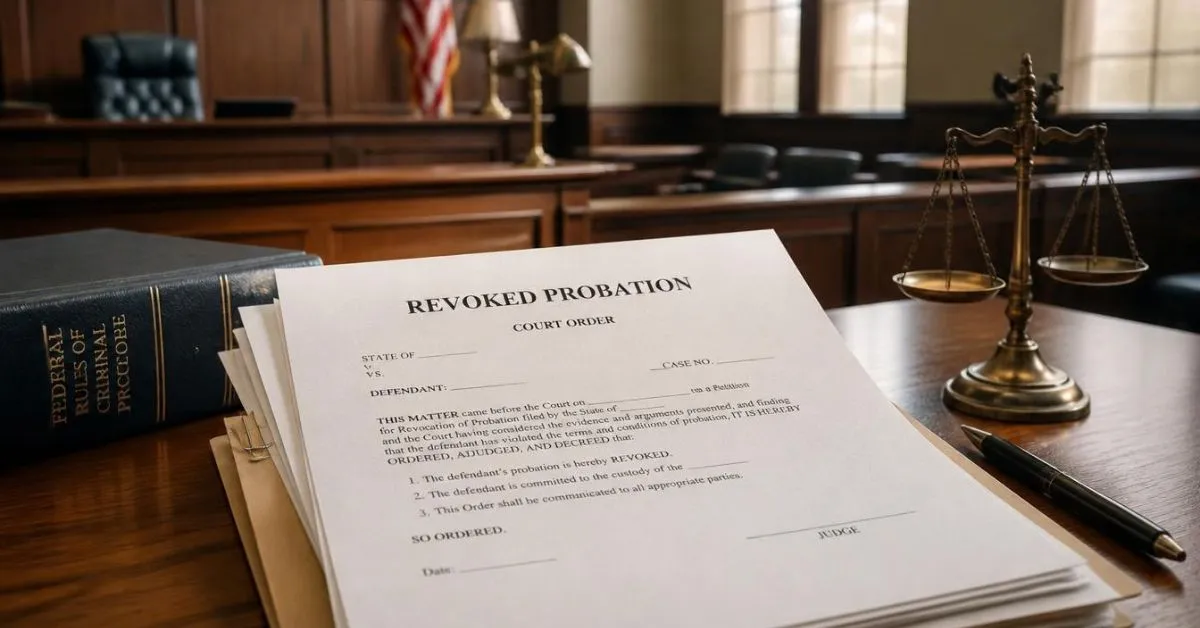
If you see the phrase “revoked probation” in a court record, case update, or legal document, it can raise an immediate question: What does revoked probation mean, and what happens now?
The phrase usually means a court has ended a person’s probation after addressing a violation of one or more probation conditions.
However, the phrase alone does not tell you whether the person will go to jail, receive a different sentence, or remain under some form of supervision.
The outcome can depend on the state or federal court involved, the original sentence, the alleged violation, the person’s history, and the options available to the judge.
Federal law, for example, allows a court in many probation violation situations to either continue probation with changed conditions or revoke probation and resentence the defendant.
This guide explains the term in plain English, shows what it can look like in a real case, and breaks down the legal terms that often appear with it.
Legal information: This article is general information, not legal advice. Probation law varies by jurisdiction. For help with a specific case, speak with a licensed attorney.
⚡ Quick Answer
Revoked probation generally means a court has ended a person’s probation after a probation violation was addressed through the applicable legal process. What happens afterward varies by jurisdiction and case. Possible outcomes can include continued or modified supervision, resentencing, or incarceration where authorized by law.
What Does Revoked Probation Mean Plainly?
Probation is a court-ordered form of supervision that allows a person to remain in the community while following specific conditions.
Those conditions depend on the case. They may include reporting to a probation officer, attending required programs, obeying certain laws, avoiding prohibited conduct, completing treatment or counseling when ordered, paying certain court obligations, or following other conditions set by the court.
When probation is revoked, the court has ended that probation arrangement because of a violation or violations addressed through the applicable legal process.
A useful way to understand the phrase is:
Probation revocation = the court ends the probation after the applicable process.
Importantly, a probation violation does not automatically mean probation must always be revoked. The available response depends on the jurisdiction and circumstances.
For example, federal law provides that, after a probation violation and a Rule 32.1 hearing, a federal court may continue probation with modified or expanded conditions or revoke probation and resentence the defendant.
So if you see “probation revoked” in a court record, the key question is what the court ordered afterward.
A Simple Example of Revoked Probation?
Imagine a person receives a criminal sentence that includes probation.
The court gives that person several conditions. One condition requires regular reporting to a probation officer.
Later, the person repeatedly fails to report. The probation officer reports the alleged violation, and the matter goes before the court.
The court then addresses the alleged violation through the required legal process.
Depending on the applicable law and facts, the judge might:
- Keep the person on probation.
- Change or add probation conditions.
- Extend probation when legally permitted.
- Revoke probation.
- Impose another sentence if the law permits it.
Under federal law, for example, the court can continue probation with modified or enlarged conditions or revoke the probation sentence and resentence the defendant.
This shows why “probation violation” and “revoked probation” should not be treated as identical phrases.
A violation can be the reason for a court proceeding. Revocation is the specific outcome of ending probation.
Where You’ll Encounter This Term?
You may see revoked probation in:
- Court docket entries
- Criminal case records
- Probation violation notices
- Court orders
- Sentencing documents
- Attorney filings
- Hearing records
- Corrections or supervision records
You might also see related wording such as:
- “Probation revoked”
- “Revocation of probation”
- “Probation violation”
- “Revocation hearing”
- “Violation of probation conditions”
- “Revoked and resentenced”
These phrases can look similar but do not always mean exactly the same thing.
For example, a revocation hearing does not necessarily mean probation has already been revoked. A hearing may be scheduled so the court can address an alleged violation.
Likewise, a docket entry saying that a violation was alleged is different from an order stating that the court actually revoked probation.
Reading the complete court document is therefore important.
Why Revoked Probation Matters Legally?
Probation is based on conditions. When a person does not comply with those conditions, the court may have legal authority to respond.
The consequences can be significant because revocation can end the existing probation sentence and, where authorized, lead to another sentence.
In federal court, 18 U.S.C. § 3565 provides that when a defendant violates a probation condition, the court may continue probation with changes or revoke probation and resentence the defendant. The statute also identifies certain circumstances requiring revocation and a sentence that includes imprisonment.
Those mandatory federal provisions include specified violations involving controlled substances, firearms, refusal to comply with required drug testing, and certain repeated positive drug tests.
That does not mean every state probation case follows the same rules.
State courts have their own statutes, procedures, sentencing rules, and terminology. The original sentence also matters because probation conditions are normally tied to the individual case.
This is why it is risky to assume that seeing “revoked probation” automatically means one specific punishment.
How Probation Revocation Is Typically Applied?
The exact process varies by jurisdiction, but a revocation case generally begins with an allegation that a probation condition was violated.
The court then follows the procedure required by the applicable law.
In federal court, Federal Rule of Criminal Procedure 32.1 addresses the process for revoking or modifying probation or supervised release. The rule includes procedures concerning initial appearances, preliminary hearings in applicable circumstances, notice of alleged violations, and revocation proceedings.
If someone is held in custody because of an alleged violation, federal procedure provides for a prompt hearing to address whether there is probable cause to hold the person for a revocation hearing.
At the federal revocation stage, the defendant has procedural protections described in Rule 32.1, including notice of the alleged violation and an opportunity to appear and present evidence, subject to the rule’s requirements.
After the required process, the court determines what action is permitted and appropriate under the governing law.
Possible outcomes can include:
- Continuing probation.
- Modifying probation conditions.
- Enlarging conditions.
- Extending probation where authorized.
- Revoking probation.
- Resentencing where authorized.
The important distinction is that an allegation, a hearing, and a final revocation are different stages.
Common Misunderstandings About Revoked Probation?
Does revoked probation always mean jail?
No. Revocation does not automatically tell you that the person will be incarcerated.
The result depends on the jurisdiction, original sentence, violation, and applicable law. Federal law, for example, allows continuation of probation in some circumstances but requires revocation and imprisonment for certain specified violations.
Does a probation violation automatically revoke probation?
Not necessarily.
A court may have other options after addressing a violation. In federal court, the statute expressly allows the court in many circumstances to continue probation with modified or expanded conditions instead of revoking it.
Does a revocation hearing mean probation is already revoked?
No.
A revocation hearing is part of the process for addressing an alleged violation. The phrase itself does not mean that the court has already entered a final revocation order.
Does revoked probation mean a new crime was committed?
Not necessarily.
A person can face a probation violation proceeding based on failure to follow a probation condition. A separate new criminal case may also exist, but those are legally different matters.
Can probation be revoked for failing to pay money?
Potentially, depending on the type of payment, the reason for nonpayment, and the applicable law.
For example, federal law contains specific provisions addressing default on fines or restitution and allows several possible court responses in certain circumstances.
Because inability to pay and willful nonpayment can raise different legal issues, this is an area where case-specific legal advice can matter.
Are probation and supervised release the same?
No.
They are different forms of federal supervision. Probation can be imposed as a sentence instead of imprisonment in qualifying circumstances, while supervised release generally follows imprisonment.
The terms may appear together in legal documents, but they should not automatically be treated as interchangeable.
Related Legal Terms
| Legal Term | Plain-English Meaning |
| Probation | Court-ordered supervision with conditions that must be followed. |
| Probation violation | An alleged or established failure to follow a probation condition. |
| Revocation | The court’s termination of probation after the applicable process. |
| Revocation hearing | A court proceeding addressing an alleged violation and possible consequences. |
| Probation officer | An officer responsible for supervising a person under probation conditions. |
| Probation condition | A requirement imposed as part of probation. |
| Resentencing | A new sentencing decision that may follow revocation when authorized by law. |
| Supervised release | A separate form of federal supervision that generally follows imprisonment. |
The exact legal meaning and consequences of these terms can vary between federal and state systems.
When to Talk to an Attorney
If “probation revoked” appears in your own court record, do not rely only on a general internet definition.
Look at the complete court order and identify:
- What violation was alleged or found?
- Was a revocation hearing held?
- Did the court actually revoke probation?
- What sentence or order came afterward?
- Is another hearing scheduled?
- Does the document mention a warrant, custody, or resentencing?
A licensed attorney can review the original sentence, probation conditions, court filings, hearing records, and applicable state or federal law.
This is especially important if the document mentions revocation, a warrant, detention, incarceration, resentencing, or a scheduled hearing.
This article is general legal information, not legal advice. A licensed attorney should review a specific case before you make legal decisions based on it.
🎯 Practical Takeaway
Revoked probation means the court has ended probation after addressing a violation under the applicable legal process.
It does not, by itself, tell you exactly what punishment or next step will follow.
If you are looking at a real court record, read the entire order and focus on the court’s actual disposition.
Because probation laws differ between states and federal courts, case-specific questions are best reviewed with a licensed attorney.
FAQs:
What happens after probation is revoked?
After probation is revoked, what happens next depends on the court and applicable law. The person may face resentencing or another consequence authorized by the jurisdiction. In federal cases, revocation can result in resentencing, while some violations may allow probation to continue under different conditions.
Does revoked probation mean you go to jail?
Not in every case. Revocation can have different consequences depending on the law, the original sentence, and the violation involved. Federal law permits different responses in many situations, although certain specified violations require revocation and a sentence that includes imprisonment.
What is a probation revocation hearing?
A probation revocation hearing is a court proceeding used to address an alleged violation of probation conditions. In federal court, Rule 32.1 establishes procedures concerning notice, appearances, hearings, and related procedural rights.
Can probation be reinstated after it is revoked?
It depends on the jurisdiction and circumstances. Once probation has been revoked, the available legal options depend on the court’s authority and the applicable sentencing rules. A person should not assume that reinstatement is automatically available.
What is the difference between probation violation and probation revocation?
A probation violation is a failure to follow a probation condition, whether alleged or established through the applicable process. Probation revocation is the court’s decision to terminate probation. A violation does not always lead to revocation.
Can a judge change probation instead of revoking it?
In some cases, yes. Federal law specifically allows a court, after a qualifying violation and hearing, to continue probation while modifying or enlarging its conditions rather than revoking the probation sentence.
What does “revoked and resentenced” mean?
It generally means the court ended the existing probation sentence and imposed a new sentence under the authority provided by applicable law. In federal court, §3565 specifically provides for revocation followed by resentencing in qualifying cases.
Conclusion:
If you have been wondering what does revoked probation mean, the simplest answer is that the court has ended a person’s probation after addressing a violation of its conditions.
But the phrase does not, by itself, explain the final punishment or what will happen next.
A probation violation can lead to different court responses. In federal cases, the law allows continuation of probation with changed conditions in many situations, while certain listed violations require revocation and a sentence that includes imprisonment.
The difference between an alleged violation, a revocation hearing, and an actual revocation order is also important. These terms describe different parts of the legal process.
If this phrase appears in a real court record, look beyond the words “revoked probation.” Check the court’s complete order, the stated violation, the hearing result, and any new sentence or instructions.
Most importantly, remember that probation law varies by jurisdiction. General information can help you understand the language, but a licensed attorney is the right source for advice about a specific case.
I am Alex Carter, an author at Meaningary.com and an expert in meanings, slang, and everyday expressions. I specialize in explaining name meanings and language in a simple, clear, and reader friendly way.