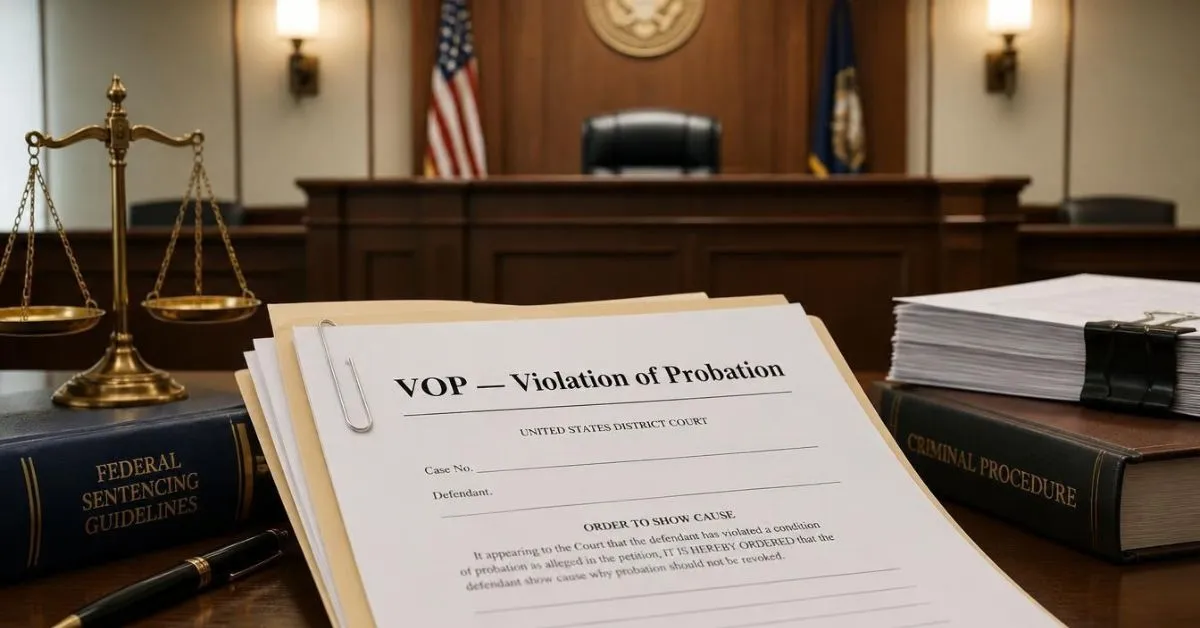
Seeing VOP on court paperwork can be confusing, especially if you are not familiar with probation terms. You may wonder If it means a new criminal charge, a hearing, or something more serious.
In most U.S. court contexts, VOP refers to a violation of probation. Courts and legal records use the abbreviation when someone is accused of breaking a condition of probation.
I have seen how a short abbreviation like this can make an already stressful court situation harder to understand.
The good news is that the basic idea is fairly simple: probation comes with rules, and a VOP matter concerns an alleged failure to follow one or more of those rules.
This guide explains what VOP means, how a VOP matter can arise, what a hearing may involve, why it matters, and what someone should consider doing after receiving a VOP notice.
⚡ Quick Answer:
VOP usually means “Violation of Probation” in court. It means a person on probation is accused of breaking one or more conditions ordered by the court. A VOP may lead to a hearing where the court considers the alleged violation and determines what action, if any, is appropriate.
⚖️ What VOP Means Plainly
VOP means Violation of Probation. Probation is a court-ordered period of supervision during which a person must follow certain conditions. Those conditions can vary from case to case.
For example, a court may require someone on probation to:
- Report to a probation officer.
- Follow certain court-ordered restrictions.
- Attend required programs or treatment.
- Avoid committing new crimes.
- Follow travel or residence requirements.
- Complete other conditions specifically included in the probation order.
A VOP allegation means the person is accused of failing to follow one or more applicable conditions.
The important word is “alleged.” Seeing VOP on a court record does not automatically mean the court has already decided that the person violated probation. In some jurisdictions, a separate proceeding or hearing is used to determine whether a violation occurred. For example, New York courts refer to a “violation of probation (VOP) petition,” while Pennsylvania appellate decisions use the term “VOP court” and discuss findings that a person violated specific probation conditions.
The exact procedure, legal standard, possible consequences, and terminology can differ by state and by the person’s original sentence.
This article provides general legal information, not legal advice. For a specific VOP matter, consult a licensed attorney familiar with the relevant state and court.
🧾 A Simple Example of This in Practice
Imagine someone receives probation after a criminal case. One condition says the person must regularly report to a probation officer.
If the person repeatedly fails to report as required, the probation department may report the alleged violation to the court. Depending on the jurisdiction and circumstances, this can lead to a VOP filing, petition, notice, or hearing.
At that point, the court may consider evidence about what happened and whether a probation condition was actually violated.
A real Pennsylvania case illustrates why the exact probation conditions matter. In Commonwealth v. Foster, the Pennsylvania Supreme Court explained that a VOP finding required evidence that the probationer violated a specific condition of probation or committed a new crime; the court could not rely only on a general belief that probation had not achieved its goals.
This shows why reading the original probation order can be important. The question is not simply, “Did something go wrong?” It can also be, “What specific condition applied, and what evidence concerns that condition?”
🏛️ Where You’ll Encounter VOP
You may see VOP in several parts of the court system, including:
- Court dockets: A docket may list a VOP matter, hearing, or filing.
- Probation paperwork: A probation department may use VOP when referring to an alleged violation.
- Court notices: A notice may tell a person to appear for a violation proceeding.
- Judicial opinions: Courts frequently use VOP as shorthand for violation of probation.
- Criminal records: Some record systems use VOP as an abbreviation for a probation violation. Illinois Legal Aid Online, for example, lists VOP as “Violation of probation” among criminal-record abbreviations.
You might also see related language such as “VOP hearing,” “VOP petition,” “VOP warrant,” or “found in violation.”
One important point is that abbreviations are not always universal. A court system may use the same letters differently, so the surrounding language on the document matters.
In particular, some court records use VOP in contexts involving parole or parole/probation together, while other sources use it specifically for violation of probation. Pennsylvania appellate records show that terminology can depend on the underlying supervision and proceeding.
If your document appears to use VOP differently, do not assume the abbreviation alone tells you everything.
⚠️ Why VOP Matters Legally
A VOP matter can be important because probation is part of a court’s sentence or supervision arrangement. If a court finds that probation was violated, the consequences can vary substantially depending on the jurisdiction, the original sentence, the alleged conduct, and the person’s history.
Possible outcomes can include changes to probation conditions, continued supervision, or other court action. In some circumstances, probation may be revoked and incarceration may become possible.
However, there is no single nationwide VOP penalty that applies to every case.
For example, Pennsylvania appellate decisions show that VOP proceedings can involve revocation and resentencing, but the courts also examine whether the alleged violation was actually supported by evidence and whether the relevant probation condition existed.
That means a person should not assume either:
“VOP automatically means jail.”
or:
“VOP is only a warning.”
The actual legal consequences depend on the jurisdiction and circumstances.
A VOP filing can therefore be something worth taking seriously, even though the abbreviation itself does not tell you the final outcome.
🔎 How VOP Is Typically Applied
The basic process often looks something like this:
1. An alleged violation is identified
A probation officer, prosecutor, or another authorized party may identify conduct that they believe violates probation.
The alleged conduct could relate to a reporting requirement, a new offense, failure to complete a required program, or another condition.
2. A VOP matter may be filed
Depending on the state, this might appear as a VOP petition, violation notice, complaint, or another filing.
For example, New York court decisions refer specifically to a VOP petition alleging violations of probation conditions.
3. The person may have to appear in court
The court may schedule a hearing or another proceeding concerning the alleged violation.
The exact procedure varies by state. Some cases may resolve through an admission or agreement, while others may involve a contested hearing.
4. The court considers the alleged violation
The judge considers the applicable law, probation conditions, and evidence presented.
The legal standard is not identical everywhere. For example, Pennsylvania’s Supreme Court has stated that a VOP finding requires a preponderance of the evidence that a specific probation condition was violated or that the probationer committed a new crime.
5. The court determines the next step
If a violation is established, the court may have several options depending on local law and the original sentence.
Because state laws differ, a result in one state should not automatically be treated as the rule in another.
❌ Common Misunderstandings About VOP
“VOP means I have been convicted of a new crime.”
Not necessarily. VOP usually concerns an alleged violation of probation conditions. A new criminal charge can sometimes be connected to a probation violation, but the two matters are not automatically the same thing.
“A VOP notice means the judge already found me guilty.”
Not necessarily. A VOP filing can be an allegation that leads to a proceeding where the court considers whether a violation occurred.
“Every VOP results in jail.”
No universal rule applies. Consequences depend on the jurisdiction, original sentence, alleged violation, and court’s authority.
“Any bad behavior automatically creates a VOP.”
The relevant question is generally tied to the conditions of probation and applicable law. Pennsylvania’s Supreme Court, for example, emphasized the need for evidence of a specific probation violation or new crime in the case before it.
“VOP means the same thing in every state.”
The basic abbreviation is widely used for violation of probation, but procedures and consequences vary across jurisdictions.
📚 Related Legal Terms
Probation
Court-ordered supervision in the community that comes with specific conditions.
Probation violation
An alleged failure to comply with one or more probation conditions.
VOP hearing
A court proceeding concerning an alleged violation of probation.
Probation officer
An officer responsible for supervising a person on probation and monitoring compliance with applicable conditions.
Revocation
A court action that ends or changes probation, where permitted by applicable law.
Parole
Supervision associated with release from incarceration; it is legally distinct from probation even though court records sometimes discuss parole and probation together.
Violation petition
A formal filing alleging that a person violated applicable supervision conditions. Terminology varies by jurisdiction.
👨⚖️ When to Talk to an Attorney
Consider speaking with a licensed criminal-defense attorney if you or someone close to you has received a VOP notice, petition, summons, or court date.
This is especially important if the paperwork mentions:
- A scheduled VOP hearing
- A possible probation revocation
- A warrant
- A new criminal allegation
- Possible incarceration
- A disputed probation condition
- A request to admit or deny an alleged violation
Bring the attorney the VOP paperwork, original sentencing order, probation conditions, and any other court documents you have. Those documents can help establish exactly what conditions applied and what the court is asking you to address.
Do not rely on a general online explanation to decide how to respond to a specific allegation. State law, local court rules, and the facts of the case can make a major difference.
This article is general information, not legal advice. A licensed attorney can review the specific facts and explain the options that may apply in your jurisdiction.
🎯 Practical Takeaway
If you see VOP in a U.S. court record, it generally means Violation of Probation. It usually relates to an allegation that someone failed to follow a condition of probation, but the abbreviation alone does not tell you whether the violation has been proven or what the final result will be.
If VOP appears on your own court paperwork, read the alleged violation and the listed court date carefully, keep your probation documents together, and consider getting advice from a licensed attorney familiar with your jurisdiction.
❓ FAQs:
What does VOP stand for in court?
VOP usually stands for Violation of Probation. It refers to a legal matter involving an alleged violation of one or more probation conditions. Court records and judicial opinions commonly use VOP as shorthand for this phrase.
Is VOP a criminal charge?
Usually, VOP refers to a probation violation matter, not a standalone criminal charge. However, an alleged new crime can sometimes also form part of a probation violation proceeding. The exact relationship depends on the jurisdiction and circumstances of the case.
Does VOP mean you will go to jail?
Not automatically. A VOP matter can have different outcomes depending on state law, the original sentence, the alleged violation, and what the court determines. In some cases, incarceration may be legally available, while other cases may result in continued or modified supervision.
What happens at a VOP hearing?
A VOP hearing generally concerns whether a person violated probation conditions. The court may consider testimony, documents, admissions, or other evidence, depending on local procedure. The process and legal standard vary by state, so a VOP hearing is not identical across the United States.
Can a VOP be dismissed?
It may be possible for a VOP matter to be resolved without a finding of violation, depending on the facts and applicable law. For example, a court may determine that the alleged violation was not established. Pennsylvania appellate decisions demonstrate that courts examine whether sufficient evidence supports the claimed probation violation.
What is a VOP warrant?
A VOP warrant is generally a warrant associated with an alleged violation of probation. The exact procedure for issuing, challenging, or resolving such a warrant varies by jurisdiction. If you see a warrant reference on your court paperwork, prompt legal guidance can help clarify what it means in that specific court.
Is VOP the same as parole violation?
Not always. Probation and parole are different forms of supervision, although court records sometimes use VOP terminology in proceedings involving parole or both parole and probation. Always check the wording surrounding the abbreviation and the specific supervision involved.
📝 Conclusion:
Understanding what VOP means in court starts with one simple phrase: Violation of Probation.
It generally means that someone under probation supervision is accused of failing to follow one or more conditions attached to that probation.
A VOP filing is important, but it does not by itself tell you that the allegation has been proven or that a particular punishment will follow.
The details matter. Courts may look at the exact probation condition, the evidence supporting the allegation, and the law that applies in that jurisdiction.]
Court decisions show that these issues can be closely examined rather than treated as automatic violations.
If you encounter VOP on your own paperwork, focus first on the alleged violation, the hearing date, and the conditions of your original probation order.
Keep your documents organized and consider speaking with a licensed attorney if the matter could affect your freedom or sentence.
A small abbreviation can carry serious meaning, but understanding the words behind it is the first step toward understanding the process.

I am Lucas Bennett, an author at Meaningary.com and an expert in meanings, slang, and everyday expressions. I specialize in explaining name meanings and language in a simple, clear, and reader friendly way.